answer.
Ask question
Login Signup
Ask question
All categories
  • English
  • Mathematics
  • Social Studies
  • Business
  • History
  • Health
  • Geography
  • Biology
  • Physics
  • Chemistry
  • Computers and Technology
  • Arts
  • World Languages
  • Spanish
  • French
  • German
  • Advanced Placement (AP)
  • SAT
  • Medicine
  • Law
  • Engineering
pantera1 [17]
2 years ago
8

Find the element that makes plumbing pipes. is it a metal nonmetal or metalloid

Chemistry
2 answers:
Sliva [168]2 years ago
8 0
Assuming the plumbing pipe is PVC, the answer would be nonmetal
evablogger [386]2 years ago
6 0
Assuming the plumbing pipe is PVC, the answer would be nonmetal

PVC or polyvinyl chloride has a chemical formula of (C2H3Cl)n. From the element, we can see that the polyvinyl chloride is made from carbon, hydrogen, and chloride. There are no elements that belong to the metal group or metalloid group, so the plumbing pipe would be nonmetal. 
You might be interested in
A solution is prepared by dissolving 91.7 g fructose in 545 g of water. Determine the mole fraction of fructose if the final vol
oee [108]

Answer:

Mole fraction = 0,0166

Explanation:

Mole fraction is defined as mole of a compound per total moles of the mixture. In the solution, the solute is fructose and the solvent is water. That means you need to find moles of fructose and moles of water.

The molecular mass of fructose is 180,16g/mol and mass of water is 18,02 g/mol. Using these values:

91,7g fructose × (1mol / 180,16g) = <em>0,509 moles of fructose</em>

545g water × (1mol / 18,02g) = <em>30,24 moles of water</em>

Thus, mole fraction of fructose is:

\frac{0,509 moles}{0,509mol + 30,24mol} = 0,0166

<em>Mole fraction = 0,0166</em>

I hope it helps!

5 0
2 years ago
The mechanism for the reaction described by 2N2O5(g) ---&gt; 4NO2(g) + O2(g) is suggested to be (1) N2O5(g) (k1)---&gt;(K-1) NO2
aliina [53]
Go add me on Snapchat christian3cruz
5 0
2 years ago
If a reaction occurs, what will be the products of the unbalanced reaction below?Cu(s) + Ni(NO3)2(aq) 
Sveta_85 [38]

Answer:

Cu(NO3)2 --> MM187.5558

NiNO3 *COEF2* --> 120.6983

3 0
2 years ago
You will be using the observations given in the scenarios i - vi below to determine which of the following is true for G (a - c)
WITCHER [35]

Answer:

A spontaneous reaction is taking place in a flask. When you touch the flask, it feels cold and gets colder as the reaction progresses........(c,f,g)

A spontaneous reaction is taking place in a flask as evidenced by the formation of gas bubbles. When you touch the flask, it feels hot and gets hotter as the reaction progresses.... (c,d,h)

A spontaneous reaction is taking place in a flask. When you touch the flask, it feels hot and gets hotter as the reaction progresses....(c,f,h)

A spontaneous reaction is taking place in a flask. You notice the formation of gas bubbles intensifies as the reaction progresses....(c,d,I)

A solid in a closed flask begins to melt. (You can consider this a phase change.)....(b,d,g)

A liquid begins to appear on the inside of a closed flask. At first glance before the liquid began to appear, you might have thought the flask was empty. (You can consider this a phase change.)....(a,e,h)

Explanation:

Now it is necessary here to state the equation for ∆G

∆G= ∆H-T∆S

The values of ∆G depends on the relative values of ∆H, T and ∆S.

When heat is evolved by a system, ∆H is negative, when heat is absorbed by a system, ∆H is positive.

When gases are evolved, ∆S is positive, when gases turn to liquids or solids ∆S is negative.

Let us also recall that, for the melting process ∆S positive ( solid changes to liquid), ∆H is positive(energy is absorbed) and T increases( the substance is heated). Hence ∆G is negative

For the condensation process; ∆H is negative (heat is evolved), ∆S is negative (gas changes to liquid) and T is decreased hence ∆G is positive.


5 0
2 years ago
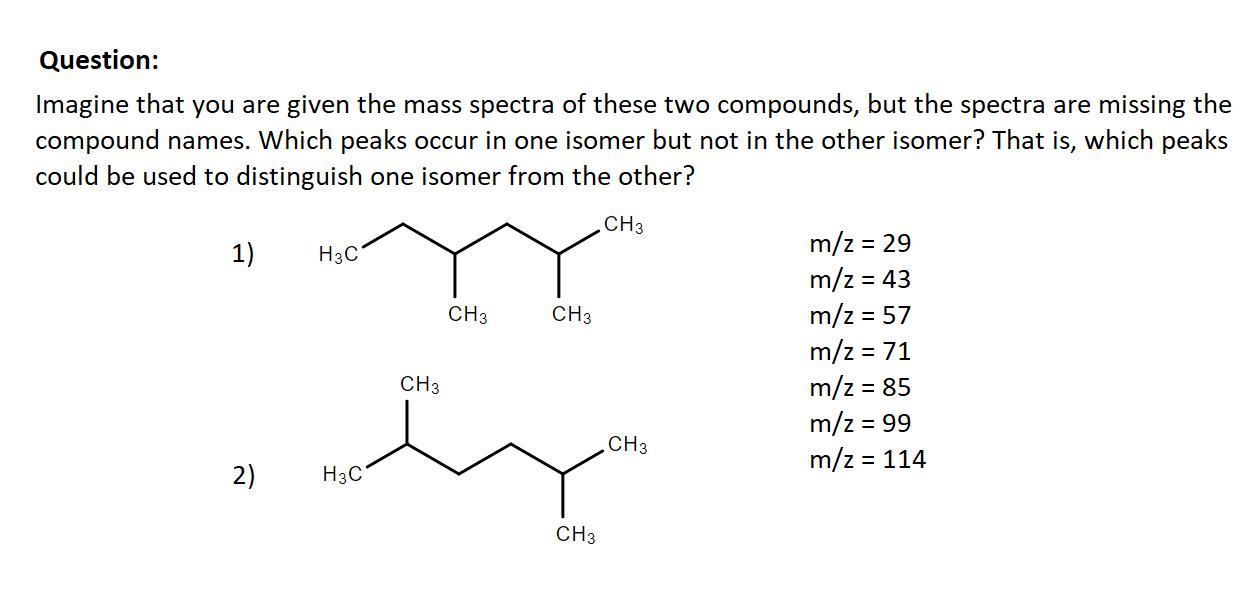
Imagine that you are given the mass spectra of these two compounds, but the spectra are missing the compound names.
12345 [234]

The structures of the isomers and the m/z values of their peaks are not given in the question. The complete question is provided in the attachment

Answer:

Compound 2 (2,5-dimethylhexane) will not have the peaks at 29 and 85 m/z

Explanation:

The fragmentation of molecules by electron ionization of mass spectrometer occurs according to Stevenson's Rule, which states that "The most probable fragmentation is the one that leaves the positive charge on the fragment with the lowest ionization energy". This is much like the Markovnikov's Rule in organic chemistry which has predicted the formation of most stable carbocation and the addition of hydrogen halide to it.

The mass spectra of compound 1 (2,4-dimethylhexane) will contain all the m/z values mentioned in the question. Each peak indicate towards homologous series of fragmentation product of the compound 1. The first peak can be attributed to ethyl carbocation (m/z = 29), with the increase of 14 units the next peak indicates towards propyl carbocation (m/z = 43) and onwards until molecular ion peak of 114 m/z.

Compound 2 (2,5-dimethylhexane) structure shows that the cleavage  of C-C bond will not yield a stable ethyl and hexyl carbocation. Hence, no peaks will be observed at 29 and 85 m/z. The absence of these two peaks can be used to distinguish one isomer from the other.

5 0
2 years ago
Other questions:
  • What is the minimum total energy released when an electron and its antiparticle (positron) annihilate each other?
    8·2 answers
  • Combustion of 8.652 g of a compound containing c, h, o, and n yields 11.088 g of coz, 3.780 g of h2o, and 3.864 g of no2. How ma
    9·1 answer
  • 40pionts
    9·1 answer
  • At elevated temperatures, methylisonitrile (CH3NC) isomerizes to acetonitrile (CH3CN): CH3NC (g) → CH3CN (g) At the start of the
    10·1 answer
  • penicillin. an important antibiotic (antibacterial agent), was discovered accidentally by the scottish bacteriologist alexander
    15·1 answer
  • An equimolar mixture of N2(g) and Ar(g) is kept inside a rigid container at a constant temperature of 300 K. The initial partial
    9·1 answer
  • A 2 L sample of N2(g) and a 1 L sample of Ar(g), each originally at 1 atm and 0°C, are combined in a 1 L tank. If the temperatu
    10·2 answers
  • In two or more complete sentences, explain how to calculate the amount of energy that is transferred when 150 g of cooper cools
    13·1 answer
  • Draw the Lewis structures for CH3OH, CH2O and HCOOH. Indicate the hybrid orbital used in the sigma bonds for each of the carbon
    7·1 answer
  • Calculate the ratio of H+ ions to OH– ions at a pH = 6. Find the concentration of H+ ions to OH– ions listed in Table B of your
    6·1 answer
Add answer
Login
Not registered? Fast signup
Signup
Login Signup
Ask question!