answer.
Ask question
Login Signup
Ask question
All categories
  • English
  • Mathematics
  • Social Studies
  • Business
  • History
  • Health
  • Geography
  • Biology
  • Physics
  • Chemistry
  • Computers and Technology
  • Arts
  • World Languages
  • Spanish
  • French
  • German
  • Advanced Placement (AP)
  • SAT
  • Medicine
  • Law
  • Engineering
IrinaVladis [17]
2 years ago
10

When oils are turned from a liquid to a solid during processing, _________ are formed?

Chemistry
1 answer:
stiv31 [10]2 years ago
3 0
<span>The process of liquid oils turning into solids is called as hydrogenation and through the process Trans fatty acids are formed. This process is done by adding hydrogen to the oils. Hydrogenation helps with the storage of the oils making it easier as they convert into solids.</span>
You might be interested in
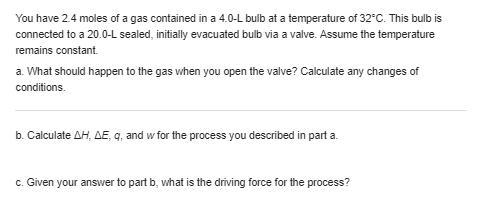
Consider 2.4 moles of a gas contained in a 4.0 L bulb at a constant temperature of 32°C. This bulb is connected to an evacuated
Luden [163]

Complete Question

The complete question is shown on the first uploaded image

Answer

a

As the valve is opened , the gas will flow into the empty container until the both containers have the same pressure

b

\Delta H = 0\ , \Delta E = 0 , q= 0 , w= 0

c

The driving force for this process is the increase in entropy this is because the movement of the internal energy of the gas into a larger volume, what this does is that it increases the amount of disorder(entropy).

Explanation

In order to obtain the parameter in the part B of the question we are first obtain the initial pressure, using the ideal gas equation  

                      P = \frac{nRT}{V}

                     P = \frac{(2.4mol)(0.0821\frac{1 atm}{K \cdot \ mol} )}{4.0L}

                         P =15 \ atm

The next thing is to obtain the new pressure of the gas , using boyle's law

              P_1V_1 = P_2V_2

                  P_2 = \frac{P_1 V_1}{V_2}

                  P_2 = \frac{(15 \ atm)(4.0L)}{24.0 L}

                  P_2 = 2.5 \ atm    

Since the this process is isothermal , the change in heat is equal to zero

                      i.e  q = 0 J

  The workdone to move  the gas to the other container is zero because the  the pressure at this second container is zero due to the fact that it is a vacuum

    i.e  w = -P_{external} \Delta V

              =-(0 \ atm) (24.0 - 4.0L)

              = 0L \cdot atm

  Since the change in heat is zero and the workdone is zero then the change in internal energy is equal to 0

     This is because the change in internal energy is equal to a summation of change in heat and the workdone

                i.e \Delta E = q + w

                            = 0J

Generally the change in enthalpy is mathematically represented as

                \Delta H = n C_p \Delta T

Since the temperature is zero this means that the change in temperature is zero , substituting this value for change in temperature into the equation for  change in enthalpy

           \Delta H = n C_p (0)

                   = 0J


7 0
2 years ago
The first step in the Ostwald process for producing nitric acid is 4NH3(g) + 5O2(g) --&gt; 4NO(g) + 6H2O(g). If the reaction of
wel

Answer:

a. 77%

Explanation:

To solve the exercise, you need to know the limiting reagent. The limiting reagent is one that is consumed first in the chemical reaction. The other reagent is known as an excess reagent, and it is the one left over in a chemical reaction.

To know if ammonia or oxygen is the limiting reagent, we should relate the weights of both compounds in the reaction. We know that 4NH3 (68 g) react with 5O2 (160 g), so we should find out how much NH3 is required to react with 150 g of O2:

160 g O2 _______ 68 g NH3

150 g O2 _______ x = 150 g * 68 g / 160 g = 63.75 g NH3

As we have 150 g of NH3 but only 63.75 g are required, we know that ammonia is the excess reagent, so oxygen is the reagent that limits the reaction and that we should use to calculate the percentage yield of the reaction.

In the reaction we observe that 5O2 (160 g) produces 4NO (120g), so:

160 g O2 ______ 120 g NO

150 g O2 ______ x = 150 g * 120 g / 160 g = 112.5 g NO

If the percent yield of the reaction were 100%, it would produce 112.5 g of NO, however only 87 g of NO were obtained, so we should find out what the percentage of reaction yield was:

112.5 g NO ______ 100%

87 g NO _______ x = 87g * 100% / 112.5 g = 77%

Thus we observe that the reaction had a yield of 77%.

7 0
2 years ago
Read 2 more answers
If 350.0 grams of Cr2O3 are reacted with 235.0 grams of elemental silicon, 213.2 grams of chromium metal are recovered. What is
bulgar [2K]
We calculate for the amount of chromium metal in the reactant by,
                            = 350 x (mass of Cr2/mass of Cr2O3) 
                                 = 350 x (104/152) 
                                   = 239.47 grams
The amount of Cr metal in the product is only 213.2 grams. Thus, the percent yield.
                        percent yield = (213.2 grams/239.47) x 100%
                                             = 89%

4 0
2 years ago
Question 2 The metal molybdenum becomes superconducting at temperatures below 0.90K. Calculate the temperature at which molybden
LenKa [72]

Answer:

Temperature at which molybdenum becomes superconducting is-272.25°C

Explanation:

Conductor are those hard substances which allows path of electric current through them. And super conductors are those hard substances which have resistance against the flow of electric current through them.

As given, molybdenum becomes superconducting at temperatures below 0.90 K.

Temperature in Kelvins can be converted in °C by relation:

T(°C)=273.15-T(K)

Molybdenum becomes superconducting in degrees Celsius.

T(°C)=273.15-0.90= -272.25 °C

Temperature at which molybdenum becomes superconducting is -272.25 °C

5 0
2 years ago
An iron atom has a mass of ×9.2710−23g and a cooking pot has a mass of 0.500kg
morpeh [17]

The number of iron atoms in a cooking pot that has a mass of 0.500 kg can be solve by dividing it by the mass of the iron atom.

Number of iron atoms = ( 0.5 kg) (1000g / 1kg) ( 1 iron atom / 9.27 x 10^-23 g)

<span>Number of iron atoms = 5.39 x 10 ^24 iron atoms</span>

6 0
2 years ago
Read 2 more answers
Other questions:
  • Which statement is true concerning the reaction N(g) + N(g) → N2(g) + energy?
    12·1 answer
  • The molar mass of copper(II) chloride (CuCl2) is 134.45 g/mol. How many formula units of CuCl2 are present in 17.6 g of CuCl2? 7
    9·2 answers
  • Calculate the mass of hydrazine (N2H4) that contains a billion (1.000 x 10^9) hydrogen atoms.
    7·2 answers
  • HCN forms when synthetic fibers containing Orlon® or Acrilan® burn. Acrilan® has an empirical formula of CH2CHCN, so HCN is 50.9
    8·1 answer
  • If 0.640 g of beautiful blue crystals of azulene is dissolve in 99 g of benzen, the resulting solutions boils at 80.23 degrees c
    15·1 answer
  • A student is heating a chemical in a beaker with a Bunsen burner.
    12·2 answers
  • How many molecules of CO2 are contained in a 10.0 L tank at 7.53 atm and 485 K?
    14·2 answers
  • How many moles are 25.0 mL of benzene (density 0.876 g/mL)?
    6·1 answer
  • Consider a 0.238 M aqueous solution of sodium hydroxide, NaOH.
    11·1 answer
  • Cl2 and N2 react according to the following equation 3Cl2(g) + N2(g) rightarrow 2NCl3(g) If 4 L of a stoichiometric mixture of c
    11·1 answer
Add answer
Login
Not registered? Fast signup
Signup
Login Signup
Ask question!