answer.
Ask question
Login Signup
Ask question
All categories
  • English
  • Mathematics
  • Social Studies
  • Business
  • History
  • Health
  • Geography
  • Biology
  • Physics
  • Chemistry
  • Computers and Technology
  • Arts
  • World Languages
  • Spanish
  • French
  • German
  • Advanced Placement (AP)
  • SAT
  • Medicine
  • Law
  • Engineering
raketka [301]
2 years ago
13

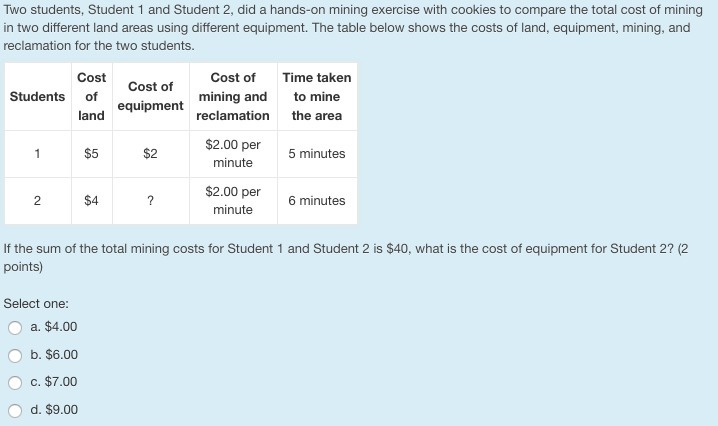
Two students, Student 1 and Student 2, did a hands-on mining exercise with cookies to compare the total cost of mining in two di

fferent land areas using different equipment. The table below shows the costs of land, equipment, mining, and reclamation for the two students.

Physics
1 answer:
grandymaker [24]2 years ago
3 0
Assume cost of equipment for student 2 is m.

We are given that:
Total mining cost for student 1 and student 2 is $40

For student 1:
We are given that:
Cost of land = $5
Cost of equipment = $2
Cost of mining and reclamation = $2 per minute
Time taken to mine = 5 minutes
Therefore,
Total mining cost for student 1= land + equipment
                                                  + cost of mining (time needed)
Total mining cost for student 1 = 2 + 5 + 2(5) = 7 + 10 = $17

This means that:
Total mining cost for student 2 = 40 - 17 = $23

For student 2:
We are given that:
Cost of land = $4
Cost of equipment = m
Cost of mining and reclamation = $2 per minute
Time taken to mine = 6 minutes
Total mining cost for student 2= $23
Therefore,
Total mining cost for student 2= land + equipment
                                                  + cost of mining (time needed)
23 = 4 + m + 2(6)
23 = 4 + m + 12
23 = 16 + m
m = 23 - 16
m = $7

Based on the above calculations, the correct choice would be:
c. $7
You might be interested in
Anne is working on a research project that involves the use of a centrifuge. Her samples must first experience an acceleration o
oee [108]

Answer:

The final rotation is 2.449 times the initial rotation

Explanation:

Centripetal acceleration and rotation speed of particle is related as

a=rω²    

where ω  is angular speed and r radius of circle

Rearranging equation    

ω=\sqrt{\frac{a}{r} }

The initial acceleration is given by

            a₁ =100g

The final acceleration of particle is

            a₂ = 6 (100g)

                  =600g

The final and initial rotation speed are related as

                  \frac{w1}{w2} =\sqrt{\frac{a2}{a1 }

                  ω2=\sqrt{\frac{600g}{100g} } *w1

                   ω2=2.449ω1

6 0
2 years ago
What voltage is required to move 6A through 20?<br><br>​
Marina CMI [18]

Answer:

120V

Explanation:

Given parameters:

Current  = 6A

Resistance  = 20Ω

Unknown:

Voltage = ?

Solution:

According to ohms law;

           V = IR

Where V is the voltage

            I is the current

            R is the resistance

Now, insert the parameters and solve;

    V  = 6 x 20  = 120V

7 0
2 years ago
Enrico says that positive charge is created when you rub a glass rod with silk, and that negative charge is simply the absence o
lisabon 2012 [21]

Answer:5 Neither: both negative and positive charge are present simultaneously in all solid materials on Earth

Explanation:

When we rub a glass rod with silk cloth then some of the electrons from glass rods are stripped away to the silk cloth. These electrons are loosely bound to the silk rod that is why they easily transferred to silk cloth.  

There is no net charge because the charge is induced when we rub the cloth and charge are separated therefore we able to notice these charges.

7 0
2 years ago
The posted speed limit on the road heading from your house to school is45 mi/h, which is about 20 m/s. If you live 8 km (8,000 m
zaharov [31]

Answer:

20.

Explanation:

not. tráfic. is. 20. minuts.

6 0
2 years ago
Read 2 more answers
An object on a number line moved from x = 15 cm to x = 165 cm and then
olasank [31]

Answer:

v_avg = 2.9 cm/s

Explanation:

The average velocity of the object is the sum of the distance of all its trajectories divided the time:

v_{avg}=\frac{x_{all}}{t}

x_all is the total distance traveled by the object. In this case you have that the object traveled in the first trajectory 165cm-15cm = 150cm, and in the second one, 165cm - 25cm = 140cm

Then, x_all = 150cm + 140cm = 290cm

The average velocity is, for t = 100s

v_{avg}=\frac{290cm}{100s}=2.9\frac{cm}{s}

hence, the average velocity of the object in the total trajectory traveled is 2.9 cm/s
3 0
2 years ago
Read 2 more answers
Other questions:
  • A kayaker paddles at 4.0 m/s in a direction 30° south of west. He then turns and paddles at 3.7 m/s in a direction 20° west of s
    14·2 answers
  • When you stand by the side of a pool someone swimming underwater appears to be in a different location than she really is the ef
    10·2 answers
  • Un ladrillo se le imparte una velocidad inicial de 6m/s en su trayectoria hacia abajo. ¿cual sera su velocidad final despues de
    9·1 answer
  • 40-turn circular coil (radius = 4.0 cm, total resistance = 0.20 ) is placed in a uniform magnetic field directed perpendicular
    5·1 answer
  • Air escapes from a balloon at a rate of 2 60 ( ) 1 R t t   3 ft / min , where t is measured in minutes. How much air (in 3 ft
    8·1 answer
  • Learning Goal: How do 2 ordinary waves build up a "standing" wave? A very generic formula for a traveling wave is: y1(x,t)=Asin(
    5·1 answer
  • A 5-kg can of paint is sitting on top of a 2-meter high step ladder. How much work did you do to move the can of paint to the to
    10·1 answer
  • A car starting from rest moves with a constant acceleration of 10 mi/hr2 for 1 hour, then decelerates at a constant 5 mi/hr2 unt
    5·1 answer
  • Guadalupe has a motorized globe on her desk that has a 0.16 m radius. She turns on the 4.25-watt motor and the globe begins to s
    12·1 answer
  • Tire marks left by a decelerating car were 500. m long. If the car’s acceleration was -8.00 m/s2, what was its initial velocity?
    7·1 answer
Add answer
Login
Not registered? Fast signup
Signup
Login Signup
Ask question!
