answer.
Ask question
Login Signup
Ask question
All categories
  • English
  • Mathematics
  • Social Studies
  • Business
  • History
  • Health
  • Geography
  • Biology
  • Physics
  • Chemistry
  • Computers and Technology
  • Arts
  • World Languages
  • Spanish
  • French
  • German
  • Advanced Placement (AP)
  • SAT
  • Medicine
  • Law
  • Engineering
shtirl [24]
2 years ago
11

Given an alloy containing 70 percent of copper and 30 percent nickel, by weight, determine the composition of this alloy in atom

ic percent. note the atomic weights of copper and nickel are 63.546 and 58.71 grams per mole, respectively.
Chemistry
1 answer:
aliina [53]2 years ago
8 0
Answer is: 68% of copper and 32% of nickel.
if use 100 g of alloy, than:
m(Cu) = 0,7 · 100 g = 70 g.
m(Ni) = 0,3 · 100 g = 30 g.
n(Cu) = m(Cu) ÷ M(Cu)
n(Cu) = 70 g ÷ 63,546 g/mol
n(Cu) = 1,10 mol.
n(Ni) = m(Ni) ÷ M(Ni)
n(Ni) = 30 g ÷ 58,71 g/mol
n(Ni) = 0,51 mol
n(Cu) : n(Ni) = 1,10 mol : 0,51 mol
%(Cu) = 1,1 mol ÷ 1,61 mol = 0,68 = 68 %. 
You might be interested in
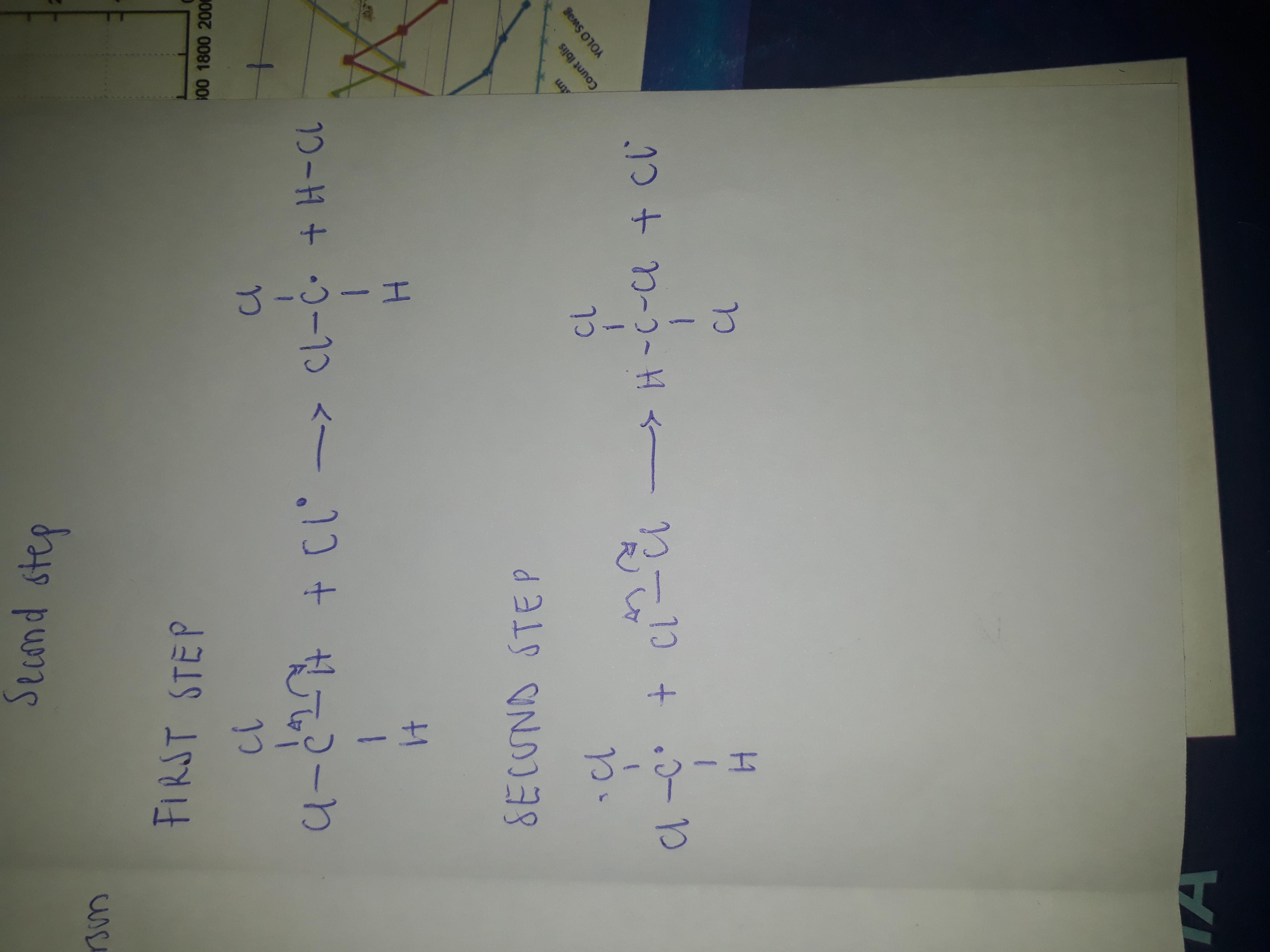
Which of the following represents a propagation step in the monochlorination of methylene chloride (CH2Cl2)?a. CHCl3 + Cl. Right
svetlana [45]

Answer:

B = CHCl2 + Cl2 --> CHCl3 + Cl

Explanation:

Free radical halogenation is a chlorination reaction on Alkane hydrocarbons. This involves the splitting of molecules into radicals/ unstable molecules in the presence of sunlight/ U.V light which ensures bonding of the molecules.

Free radical chlorination is divided into 3 steps which are:

The initiation step

The propagation step

The termination step

So in reference to the question, propagation step involves two steps.

The first step is where the molecule in this case the methylene chloride(CH2Cl2) loses a hydrogen atom and then bond with a chlorine atom radical to give a nethylwnw chloride radical and HCl.

The second step involves the reaction of this methylene chloride got in the first step with chlorine molecule to form trichloride methane and a chlorine radical.

You would find in the attachment the 2 step mechanism.

3 0
2 years ago
A 15.0-L rigid container was charged with 0.500 atm of kryp‑ ton gas and 1.50 atm of chlorine gas at 350.8C. The krypton and chl
Alecsey [184]

Answer: 32.94 g

Explanation: It's stoichiometry problem so balanced equation is required. The balanced equation is given below:

Kr+2Cl_2\rightarrow KrCl_4

From the balanced equation, krypton and chlorine react in 1:2 mol ratio. We will calculate the moles of each reactant gas using ideal gas law equation(PV = nRT) and then using mol ratio the limiting reactant is figured out that helps to calculate the amount of the product formed.

for Krypton, P = 0.500 atm and for chlorine, P = 1.50 atm

V = 15.0 L

T = 350.8 + 273 = 623.8 K

For krypton, n=\frac{0.500*15.0}{0.0821*623.8}

n = 0.146 moles

for chlorine, n=\frac{1.50*15.0}{0.0821*623.8}

n = 0.439

From the mole ratio, 1 mol of krypton reacts with 2 moles of chlorine. So 0.146 moles of krypton will react with 2 x 0.146 = 0.292 moles of chlorine.

Since 0.439 moles of chlorine are available, it is present in excess and hence the limiting reactant is krypton.

So, the amount of product formed is calculated from moles of krypton.

Molar mass of krypton tetrachloride is 225.61 gram per mol.

There is 1:1 mol ratio between krypton and krypton tetrachloride.

0.146molKr(\frac{1molKrCl_4}{molKr})(\frac{225.61gKrCl_4}{1molKrCl_4})

= 32.94 g of KrCl_4

So, 32.94 g of the product will form.

5 0
2 years ago
At 10°c one volume of water dissolves 3.10 volumes of chlorine gas at 1.00 atm pressure. what is the henry's law constant of cl2
s344n2d4d5 [400]
Answer is:  0,133 mol/ l· atm.
T(chlorine) = 10°C = 283K.
p(chlorine) = 1 atm.
V(chlorine) = 3,10 l.
R - gas constant, R = 0.0821 atm·l/mol·K. 
Ideal gas law: p·V = n·R·T
n(chlorine) = p·V ÷ R·T.
n(chlorine) = 1atm · 3,10l ÷ 0,0821 atm·l/mol·K · 283K = 0,133mol.
Henry's law: c = p·k.
k - <span>Henry's law constant.
</span>c - solubility of a gas at a fixed temperature in a particular solvent.
c = 0,133 mol/l.
k = 0,133 mol/l ÷ 1 atm = 0,133 mol/ l· atm.

4 0
2 years ago
Find the enthalpy of neutralization of HCl and NaOH. 87 cm3 of 1.6 mol dm-3 hydrochloric acid was neutralized by 87 cm3 of 1.6 m
Vesna [10]

Answer : The correct option is, (A) -101.37 KJ

Explanation :

First we have to calculate the moles of HCl and NaOH.

\text{Moles of HCl}=\text{Concentration of HCl}\times \text{Volume of solution}=1.6mole/L\times 0.087L=0.1392mole

\text{Moles of NaOH}=\text{Concentration of NaOH}\times \text{Volume of solution}=1.6mole/L\times 0.087L=0.1392mole

The balanced chemical reaction will be,

HCl+NaOH\rightarrow NaCl+H_2O

From the balanced reaction we conclude that,

As, 1 mole of HCl neutralizes by 1 mole of NaOH

So, 0.1392 mole of HCl neutralizes by 0.1392 mole of NaOH

Thus, the number of neutralized moles = 0.1392 mole

Now we have to calculate the mass of water.

As we know that the density of water is 1 g/ml. So, the mass of water will be:

The volume of water = 87ml+87ml=174ml

\text{Mass of water}=\text{Density of water}\times \text{Volume of water}=1g/ml\times 174ml=174g

Now we have to calculate the heat absorbed during the reaction.

q=m\times c\times (T_{final}-T_{initial})

where,

q = heat absorbed = ?

c = specific heat of water = 4.18J/g^oC

m = mass of water = 174 g

T_{final} = final temperature of water = 317.4 K

T_{initial} = initial temperature of metal = 298 K

Now put all the given values in the above formula, we get:

q=174g\times 4.18J/g^oC\times (317.4-298)K

q=14110.008J=14.11KJ

Thus, the heat released during the neutralization = -14.11 KJ

Now we have to calculate the enthalpy of neutralization.

\Delta H=\frac{q}{n}

where,

\Delta H = enthalpy of neutralization = ?

q = heat released = -14.11 KJ

n = number of moles used in neutralization = 0.1392 mole

\Delta H=\frac{-14.11KJ}{0.1392mole}=-101.37KJ/mole

Therefore, the enthalpy of neutralization is, -101.37 KJ

3 0
2 years ago
On a trip to the natural history museum you find two minerals that are similar in color. You can see from their chemical formula
lianna [129]

Answer:Yes they are in the same mineral group

Explanation:zinc is the central elements there. The rest of the elements are present as impurities due to where it was found. Like carbon is can be found in the soil, silicon with oxygen is basically sand, hydrogen is in the atmosphere and also in water and soil too. So apart from zinc, the rest are normal day to day elements.

7 0
2 years ago
Other questions:
  • Enter the symbol of a sodium ion, Na+, followed by the formula of a sulfate ion, SO42−. Separate the ions with a comma only—spac
    15·2 answers
  • What is effective nuclear charge of S2- and S? Does the Zeff differs from ions and atoms of the same element.
    14·2 answers
  • How many moles of O2 should be supplied to burn 1 mol of C3H8 (propane) molecules in a camping stove
    11·1 answer
  • Which reactants would lead to a spontaneous reaction?
    13·1 answer
  • The structure of carbonic acid, an important component of ocean chemistry, is depicted below. What type of model best describes
    10·2 answers
  • For the chemical equation SO2(g)+NO2(g)↽−−⇀SO3(g)+NO(g) the equilibrium constant at a certain temperature is 3.80. At this tempe
    7·1 answer
  • Suppose that 0.323 g of an unknown sulfate salt is dissolved in 50 mL of water. The solution is acidified with 6M HCl, heated, a
    6·1 answer
  • When 15.3 g of sodium nitrate, NaNO₃, was dissolved in water in a constant-pressure calorimeter, the temperature fell from 25.00
    8·2 answers
  • How many moles of O2 would be required to generate 13.0 mol of NO₂ in the reaction below assuming the reaction has only 73.3% yi
    9·1 answer
  • 5. Rubbing alcohol is a commonly used disinfectant and has a cooling effect when applied to the skin. The active ingredient in r
    12·1 answer
Add answer
Login
Not registered? Fast signup
Signup
Login Signup
Ask question!