answer.
Ask question
Login Signup
Ask question
All categories
  • English
  • Mathematics
  • Social Studies
  • Business
  • History
  • Health
  • Geography
  • Biology
  • Physics
  • Chemistry
  • Computers and Technology
  • Arts
  • World Languages
  • Spanish
  • French
  • German
  • Advanced Placement (AP)
  • SAT
  • Medicine
  • Law
  • Engineering
xz_007 [3.2K]
2 years ago
6

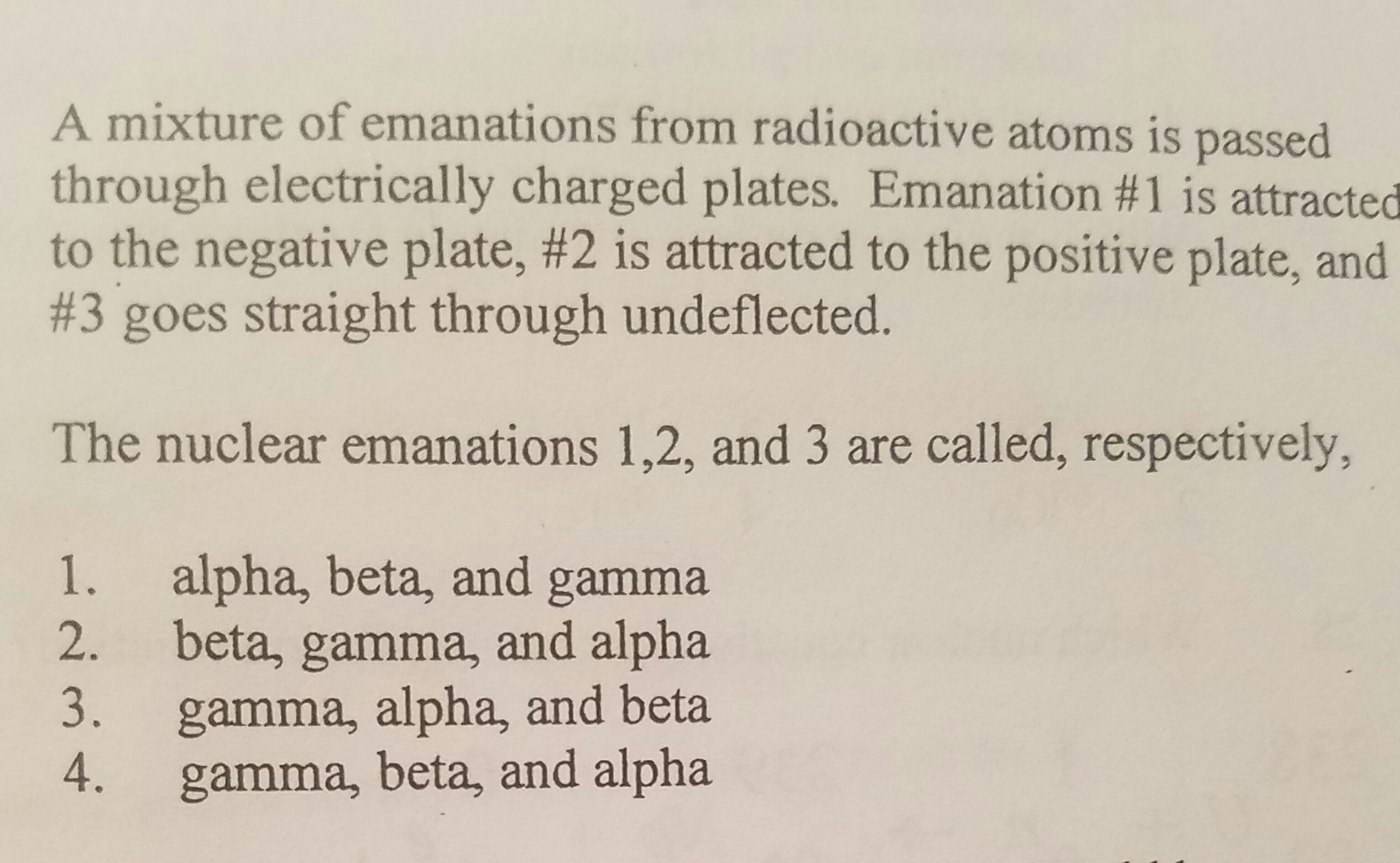
a mixture of emanations from radioactive atoms is passed through electrically charged plates imagination number one is attracted

to the negative plate number to is attracted to the positive plate and number three goes to go straight through on the flag.

Chemistry
1 answer:
slava [35]2 years ago
3 0
Hello there!

The nuclear emanations 1, 2 and 3 are called, respectively:

1) Alpha, beta and gamma

Alpha Radiation consists of two protons and two neutrons, as protons are positive particles, they will be attracted to the negatively charged plate.

Beta Radiation 
is composed of a high-energy electron. As electrons are negative particles, they will be attracted to the positively charged plate.  

Gamma Radiation is composed or photons. Photons don't have charge or mass, and they will not be attracted to the charged plates. This kind of radiation is more penetrating than the other two.

Have a nice day!
You might be interested in
Hydrogen, a potential future fuel, can be produced from carbon (from coal) and steam by the following reaction: C(s)+2H2O(g)→2H2
madam [21]

The question is incomplete , complete question is:

Hydrogen, a potential future fuel, can be produced from carbon (from coal) and steam by the following reaction:

C(s)+ 2 H_2O(g)\rightarrow 2H_2(g)+CO_2(g).\Delta H=?

Note that the average bond energy for the breaking of a bond in CO2 is 799 kJ/mol. Use average bond energies to calculate ΔH of reaction for this reaction.

Answer:

The ΔH of the reaction is -626 kJ/mol.

Explanation:

C(s)+ 2 H_2O(g)\rightarrow 2H_2(g)+CO_2(g).\Delta H=?

We are given with:

\Delta H_{H-O}=459 kJ/mol

\Delta H_{H-H}=432 kJ/mol

\Delta H_{C=O}=799 kJ/mol

ΔH =  (Energies required to break bonds on reactant side) - (Energies released on formation of bonds on product side)

\Delta H=(4\times \Delta H_{O-H})-(2\times \Delta H_{H-H}+2\times\Delta H_{C=O})

=(4\times 459 kJ/mol)-(2\times 432 kJ/mol+2\times 799 kJ/mol

\Delta H=-626 kJ/mol

The ΔH of the reaction is -626 kJ/mol.

5 0
2 years ago
4. a student is shown a Diagram which shows gas bubbles being made by water plant that has been exposed to light. which gas is m
lisov135 [29]
Carbon dioxide is in the bubbles
5 0
2 years ago
Consider the following properties: I) The red color of rubies is due to the presence of chromium ions. II) Objects made of silve
Alenkinab [10]

Answer:

Only II) is correct

Explanation:

I) The red color of the rubies is a physical property of its own structure (wich contains  chromium ions)

II)Objects made of silver become tarnished not by a physical property, but as the result of a chemical reaction on the surface of the object made of silver in combination with the sulfur in the air

2Ag_{(s)}+S\rightarrow Ag_{2}S

This changes the color of the object to black, (similar to the iron oxidation)

iii)Boiling is a physical change where a liquid substance absorbs heat in some way (e.g. a flame) and becomes a gas

6 0
2 years ago
Be sure to answer all parts. From the following reaction and data, find (a) S o of SOCl2 (b) T at which the reaction becomes non
EleoNora [17]

Answer:

Explanation:

Hrxn = -245.6-296.8+396+50.0 = -96.4 (kJ/mol)

Since Grxn = Hrxn - T*Srxn, where T = 298.15K, we have:

Srxn = (Hrxn - Grxn)/T = (-96.4+75.2)× 1000÷298.15 = -71.1 (j/K mol)

Since: Srxn = Sf (SO2) + Sf (SOCl2)- Sf (SO3) - Sf (SCl2),

or: -71.1 = 248.1 + Sf (SOCl2) - 256.7-184,

Sf (SOCl2) = 256.7+184-71.1-248.1 = 121.5 (J/mol*k)

In order to find T such that Grxn = Hrxn - T*Srxn >= 0. since Hrxn is negative and Srxn is positive, Grxn will always be less than zero. Therefore there won't be a temperature point at which the reaction is going to be non-spontaenous

8 0
2 years ago
How many liters of SO2 will be produced from 26.9L O2?
Alexeev081 [22]

Answer:

26.9 L SO₂

Explanation:

Step 1: Write the balanced equation

S(s) + O₂(g) = SO₂(g)

Step 2: Establish the appropriate volume ratio

For gases at the same conditions, the volume ratio is equal to the molar ratio. The volume ratio of O₂(g) to SO₂(g) is 1:1.

Step 3: Calculate the liters of SO₂ produced from 26.9 L of O₂

We will use the previously established volume ratio.

26.9 L O₂ × 1 L SO₂/1 L O₂ = 26.9 L SO₂
5 0
2 years ago
Other questions:
  • imagine you or your family member experienced a medical emergency. explain two reasons when and why confidentiality would be imp
    6·1 answer
  • A voltaic cell that uses the reaction
    9·1 answer
  • If 350.0 grams of Cr2O3 are reacted with 235.0 grams of elemental silicon, 213.2 grams of chromium metal are recovered. What is
    5·1 answer
  • What mass of silver ag which has an atomic mass of 107.87 amu contains the same number of atoms contained in 10.0g of boron b wh
    6·2 answers
  • A radioisotope is placed near a radiation detector, which registers 64 counts per second. Eight hours later, the detector regist
    11·2 answers
  • Please use the E/Z notation when specifying stereochemistry remembering to use parentheses and a dash. Reminder - the double bon
    5·1 answer
  • If 500.0 mL of 0.10 M Ca2+ is mixed with 500.0 mL of 0.10 M SO42−, what mass of calcium sulfate will precipitate? Ksp for CaSO4
    11·1 answer
  • Urea is a common fertilizer with the formula CO(NH2)2 that is sometimes used as a chemical de-icer for icy road surfaces in the
    15·1 answer
  • A sample of pure NO2 is heated to 337?C at which temperature it partially dissociates according to the equation2NO2(g)?2NO(g)+O2
    15·1 answer
  • During a lab experiment performed at STP conditions, you prepare HCl by reacting 100. ml of Cl2 gas with an excess of H2 gas.
    9·1 answer
Add answer
Login
Not registered? Fast signup
Signup
Login Signup
Ask question!
