answer.
Ask question
Login Signup
Ask question
All categories
  • English
  • Mathematics
  • Social Studies
  • Business
  • History
  • Health
  • Geography
  • Biology
  • Physics
  • Chemistry
  • Computers and Technology
  • Arts
  • World Languages
  • Spanish
  • French
  • German
  • Advanced Placement (AP)
  • SAT
  • Medicine
  • Law
  • Engineering
Sidana [21]
2 years ago
4

Each water molecule is joined to _____ other water molecules by ____ bonds. each water molecule is joined to _____ other water m

olecules by ____ bonds. four ... polar covalent two ... hydrogen two ... polar covalent four ... hydrogen three ... ionic

Chemistry
2 answers:
Alina [70]2 years ago
8 0
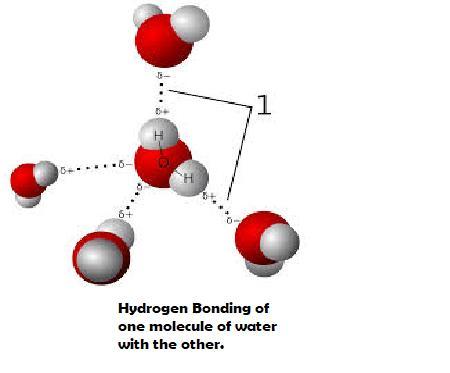
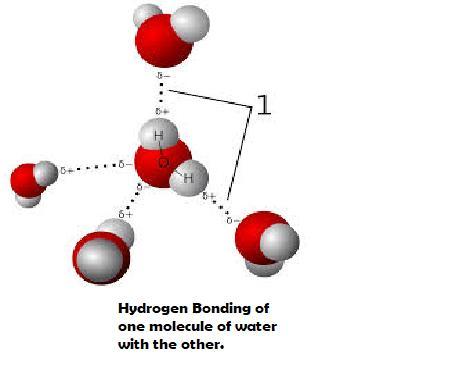
<span>Each water molecule is joined to four other water molecules by hydrogen bonds.

</span>

Hydrogen bond is an electrostatic attraction between two polar groups that occurs when a hydrogen atom (H), covalently bound to a highly electronegative atom such as flourine (F), oxygen (O) and nitrogen (N) atoms.

<span>Because of hydrogen bonds, water has higher melting and boiling temperatures. </span>
alisha [4.7K]2 years ago
5 0

Answer:   Each water molecule is joined to <u>four </u>other water molecules by <u>hydrogen</u> bonds.

Explanation:  As we know that the hydrogen bonding is a type of bonding in which the hydrogen attached to the electronegative atom of one molecule makes electrostatic forces of attraction with the electronegative atom of the other molecule.

Thus hydrogen which is attached to the electronegative oxygen atom will make a bond with the oxygen atom of the other molecule of water . Thus four types of binds can be formed with the one molecule of the water.

You might be interested in
A chemist is working on a reaction represented by this chemical equation:
erastova [34]

Answer is: A. 1.81 mol.

Balanced chemical reaction: FeCl₂ + 2KOH → Fe(OH)₂ + 2KCl.

n(FeCl₂) = 4.15 mol; amount of iron(II) chloride.

n(KOH) = 3.62 mol; amount of potassium hydroxide, limiting reactant.

From chemical reaction: n(KOH) : n(Fe(OH)₂) = 2 : 1.

n(Fe(OH)₂) = n(KOH) ÷ 2.

n(Fe(OH)₂) = 3.62 mol ÷ 2.

n(Fe(OH)₂) = 1.81 mol; amount of iron(II) hydroxide.

6 0
2 years ago
Read 2 more answers
What is the name of Pb(NO3)2? Explain how you determined the bond type and the steps you used to determine the naming convention
Elena L [17]

Answer: Lead(II) nitrate but idk the rest

Explanation:

5 0
2 years ago
When 24 mol of methanol and 15 mol of oxygen combine in the combustion reaction, 2 ch3oh(
umka21 [38]
The balanced equation for combustion is as follows;
2CH₃OH + 3O₂ ---> 2CO₂ + 4H₂O
The stoichiometry of CH₃OH to O₂ is 2:3
the limiting reagent is the reactant that is fully consumed during the reaction. The amount of product formed is directly proportional to the amount of limiting reactant produced. The excess reagent is the reactant that is provided in excess and is not fully used up, there will be an amount of this reagent remaining after the reaction.
If methanol is the limiting reactant,
If 2 mol of methanol reacts with 3 moles of O₂
Then 24 mol of methanol reacts with - 3/2 x 24 = 36 mol of O₂ should be present
But only 15 mol of O₂ is present, therefore O₂ is the limiting reactant and methanol is in excess.
3 mol of O₂ reacts with 2 mol of CH₃OH 
then 15 mol of O₂ reacts with 2/3 x 15 = 10 mol of CH₃OH

Excess reactant is methanol, 10 mol are used up therefore 24 - 10 mol = 14 mol are remaining at the end of the reaction 
8 0
2 years ago
A solution is prepared by mixing 50.0 mL of 0.50 M Cu(NO3)2 with 50.0 mL of 0.50 M Co(NO3)2. Sodium hydroxide is added to the mi
vekshin1

Answer:

Cu(OH)₂ will precipitate first, with [OH⁻] = 2.97x10⁻¹⁰ M

Explanation:

The equilibriums that take place are:

Cu⁺² + 2OH⁻ ↔ Cu(OH)₂(s)   ksp = 2.2x10⁻²⁰ = [Cu⁺²]*[OH⁻]²

Co⁺² + 2OH⁻ ↔ Co(OH)₂(s)   ksp = 1.3x10⁻¹⁵ = [Co⁺²]*[OH⁻]²

Keep in mind that <em>the concentration of each ion is halved </em>because of the dilution when mixing the solutions.

For Cu⁺²:

2.2x10⁻²⁰ = [Cu⁺²]*[OH⁻]²

2.2x10⁻²⁰ = 0.25 M*[OH⁻]²

[OH⁻] = 2.97x10⁻¹⁰ M

For Co⁺²:

1.3x10⁻¹⁵ = [Co⁺²]*[OH⁻]²

1.3x10⁻¹⁵ = 0.25 M*[OH⁻]²

[OH⁻] = 7.21x10⁻⁸ M

<u>Because Copper requires less concentration of OH⁻ than Cobalt</u>, Cu(OH)₂ will precipitate first, with [OH⁻] = 2.97x10⁻¹⁰ M

3 0
2 years ago
How many moles of sodium bicarbonate is needed to neutralize 0.8 ml of sulphuric acid?
svet-max [94.6K]

Answer:

n NaHCO3 = 9.6 E-3 mol

Explanation:

balanced reaction:

  • 2 NaHCO3(s) + H2SO4(ac) ↔ Na2SO4(ac) + 2 CO2(g) + 2 H2O(l)
  • assuming a concentration of H2SO4 6M....normally worked in the lab

⇒ n H2SO4 = 8 E-4 L * 6 mol/L = 4.8 E-3 mol H2SO4

according to balanced reaction, we have that for every mol of H2SO4 there are two mol of NaHCO3 ( sodium bicarbonate)

⇒ mol NaHCO3 = 4.8 E-3 mol H2SO4 * ( 2 mol NaHCO3 / mol H2SO4 )

⇒ ,mol NaHCO3 = 9.6 E-3 mol

So 9.6 E-3 mol NaHCO3,  are the minimun moles necessary to neutralize the acid.

6 0
2 years ago
Other questions:
  • A 36 gram sample of water has an initial temperature of 22 degrees Celsius after the sample absorbs 1200joules of heat energy th
    9·2 answers
  • What did the Romans build as a step toward environmental management? The Romans built to carry water from abundant water areas t
    13·2 answers
  • One ATP molecule's hydrolysis releases 7.3 kcal/mol of energy (∆G = −7.3 kcal/mol of energy). If it takes 2.1 kcal/mol of energy
    8·1 answer
  • 1. Calculate the molar enthalpy of solidification (ΔHsolidification) when 10.00kJ of energy are lost as 30.00g of water are froz
    14·1 answer
  • Consider the dissolution of 1.50 grams of salt XY in 75.0 mL of water within a calorimeter. The temperature of the water decreas
    9·1 answer
  • Platinum, which is widely used as a catalyst, has a work function φ(the minimum energy needed to eject an electron from the meta
    8·1 answer
  • Classify each of these soluble solutes as a strong electrolyte, a weak electrolyte, or a nonelectrolyte. Solutes Formula Hydroch
    5·2 answers
  • Explain how manipulation of light waves can cause reflection, refraction, diffusion, and absorption; and describe how different
    11·1 answer
  • How does heat conduction work in the metal brownie pan?
    8·1 answer
  • A metal crystallizes with a face-centered cubic lattice. The edge of the unit cell is 417 pm. The diameter of the metal atom is:
    15·1 answer
Add answer
Login
Not registered? Fast signup
Signup
Login Signup
Ask question!