answer.
Ask question
Login Signup
Ask question
All categories
  • English
  • Mathematics
  • Social Studies
  • Business
  • History
  • Health
  • Geography
  • Biology
  • Physics
  • Chemistry
  • Computers and Technology
  • Arts
  • World Languages
  • Spanish
  • French
  • German
  • Advanced Placement (AP)
  • SAT
  • Medicine
  • Law
  • Engineering
murzikaleks [220]
2 years ago
4

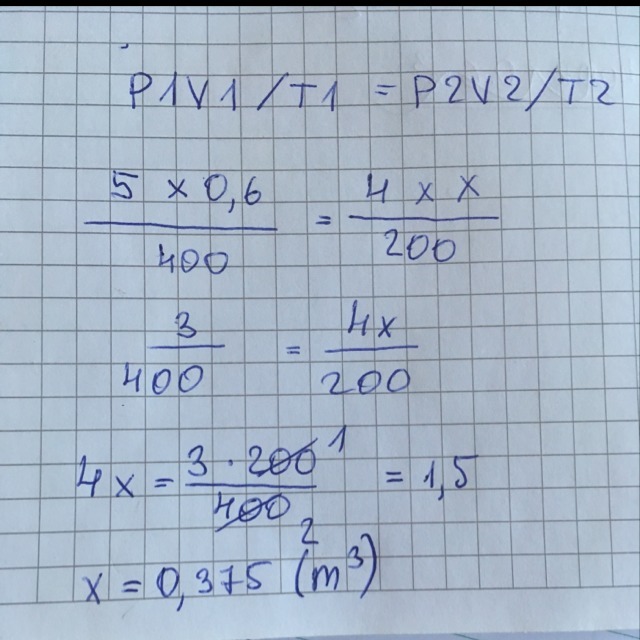
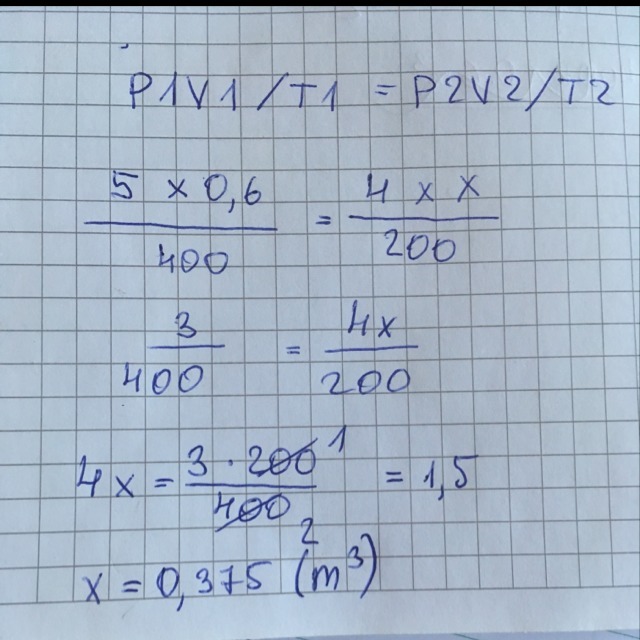
An ideal gas occupies a volume of 0.60 m3 at 5.0 atm and 400. K. What volume does it occupy at 4.0 atm and a temperature of 200.

K?
What is the known and unknown when using P1V1/T1=P2V2/T2

Physics
1 answer:
Wewaii [24]2 years ago
3 0
It is given that P1=5atm
V1=0,6m3
T1=400K
And
P2=4atm
T2=200K
Therefore the unknown is V2
From now on you put all the known in the formula P1xV1/T1=P2xV2/T2 and with the help of algebra find what the unknown is ☺️

You might be interested in
Biologists think that some spiders "tune" strands of their web to give enhanced response at frequencies corresponding to those a
garik1379 [7]

Answer:

T=2.94*10^-10  N/m.

Explanation:

Biologists think that some spiders "tune" strands of their web to give enhanced response at frequencies corresponding to those at which desirable prey might struggle. Orb spider web silk has a typical diameter of 20μm, and spider silk has a density of 1300 kg/m³.

To have a fundamental frequency at 150Hz , to what tension must a spider adjust a 14cm -long strand of silk?

l=length of the spider silk, 14cm

velocity of wave = √(T/μ)          

where T = tension and

μ = mass per unit length)

λ/2=l

for fundamental frequency λ/2 =14cm    

 (λ= wavelength of standing wave;  as there will be no node

   except the endpoints of silk strand)

               λ = 28 cm = 0.28 m

and since frequency * wavelength = speed of wave. we have,

                  150 * 0.28 = √(T/μ)                                        ..................(#)

now μ = mass/length = [volume * density]/length = [(length*area) * density] / length = area * density

         = [π * (10 * 10^(-6))²] * 1300  = 13π * 10^(-8).

now putting this in equation (#) we get

    150 * 0.28 = √(T/[13π * 10^(-8)]).

thus T = [13π * 10^(-8)] * (42)²     =  

2.94*10^-10  N/m.

6 0
2 years ago
Listed in the Item Bank are key terms and expressions, each of which is associated with one of the columns. Some terms may displ
olga2289 [7]

Answer:

What is u should know it bc u should answered it already

Explanation:

7 0
2 years ago
Read 2 more answers
The gravitational force between two asteroids is 6.2 × 10⁸ n. asteroid y has three times the mass of asteroid z. if the distance
SOVA2 [1]
Let m =  mass of asteroid y.
Because asteroid y has three times the mass of asteroid z, the mass of asteroid z is m/3.

Given:
F = 6.2x10⁸ N
d = 2100 km = 2.1x10⁶ m
Note that
G = 6.67408x10⁻¹¹ m³/(kg-s²)

The gravitational force between the asteroids is
F = (G*m*(m/3))/d² = (Gm²)/(3d²)
or
m² = (3Fd²)/G
     = [(3*(6.2x10⁸ N)*(2.1x10⁶ m)²]/(6.67408x10⁻¹¹ m³/(kg-s²))
    = 1.229x10³² kg²
m = 1.1086x10¹⁶ kg = 1.1x10¹⁶ kg (approx)

Answer: 1.1x10¹⁶ kg
4 0
2 years ago
Read 2 more answers
The first-order rearrangement of CH3NC is measured to have a rate constant of 3.61 × 10⁻¹⁵ s–1 at 298 K and a rate constant of 8
netineya [11]

Answer:

The activation energy for this reaction, Ea = 159.98 kJ/mol

Explanation:

Using the Arrhenius equation as:

ln\frac {K_2}{K_1}=-\frac {E_a}{R}\times (\frac {1}{T_2}-\frac {1}{T_1})

Where, Ea is the activation energy.

R is the gas constant having value 8.314 J/K.mol

K₂ and K₁ are the rate constants

T₂ and T₁ are the temperature values in kelvin.

Given:

K₂ = 8.66×10⁻⁷ s⁻¹ , T₂ = 425 K

K₁ = 3.61×10⁻¹⁵ s⁻¹ , T₁ = 298 K

Applying in the equation as:

ln\frac {8.66\times 10^{-7}}{3.61\times 10^{-15}}=-\frac {E_a}{8.314}\times (\frac {1}{425}-\frac {1}{298})

Solving for Ea as:

Ea = 159982.23 J /mol

1 J/mol = 10⁻³ kJ/mol

Ea = 159.98 kJ/mol

7 0
2 years ago
A small rivet connecting two pieces of sheet metal is being clinched by hammering. Determine the impulse exerted on the rivet an
kykrilka [37]

Answer:

a) the impulse exerted by the rivet when the anvil has an infinite mass support is 0.932 lb.s

the energy absorbed by the rivet under each blow  when the anvil has an infinite mass support = 9.32 ft.lb

b) the impulse exerted by the rivet when the anvil has a support weight of 9 lb = 0.799 lb.s

the energy absorbed by the rivet under each blow when the anvil has a support weight of 9 lb is = 7.99 ft.lb

Explanation:

The first picture shows a schematic view of a free body momentum diagram of the hammer head and the anvil.

Using the principle of conservation of momentum to determine the final velocity of anvil and hammer after the impact; we have:

m_Hv_H + m_Av_A = m_Hv_2+m_Av_2

From the question given, we can deduce that the anvil is at rest;

∴ v_A = 0; then, we have:

m_Hv_H + 0 = (m_H+m_A) v_2

Making v_2 the subject of the formula; we have:

v_2 = \frac{m_Hv_H}{m_H + m_A}       ------- Equation  (1)

Also, from the second diagram; there is a representation of a free  body momentum  of the hammer head;

From the diagram;

F = impulsive force exerted on the  rivet

Δt = the change in time of application of the impulsive force

Using the principle of impulse of momentum to the hammer in the quest to determine the impulse exerted (i.e FΔt ) on the rivet; we have:

m_Hv_H - F \delta t = m_Hv_2

- F \delta t = - m_Hv_H + m_Hv_2

F \delta t = m_Hv_H - m_Hv_2

F \delta t = m_H(v_H - v_2)        ------- Equation   (2)

Using the function of the kinetic energy  of the hammer before impact T_1; we have:

T_1 = \frac{1}{2} m_Hv_H^2  -------- Equation (3)

We determine the mass of the hammer m_H  by using the formula from:

W_H = m_Hg

where;

W_H = weight of the hammer

m_H = mass of the hammer

g = acceleration due to gravity

Making m_H the subject of the formula; we have:

m_H = \frac{W_H}{g}

m_H = \frac{1.5 \ lb}{32.2 \ ft/s^2}

m_H = 0.04658 \ lb.s^2/ft

Now;

T_1 = \frac{1}{2} m_Hv_H^2

T_1 = \frac{1}{2}*(0.04658 \ lb.s^2 /ft) *(20 \ ft/s)^2

T_1 = \frac{18.632 }{2}

T_1 = 9.316 \ ft.lb

After the impact T_2 ; the final kinetic energy of the hammer and anvil can be written as:

T_2 = \frac{1}{2}(m_H +m_A)v^2_2

Recall from equation (1) ; where v_2 = (\frac{m_Hv_H}{m_H+m_A})  ; if we slot that into the above equation; we have:

T_2 = \frac{1}{2}(m_H +m_A)( \frac{m_Hv_H}{m_H+m_A})^2

T_2 = \frac{1}{2} \frac{m^2_H +v^2}{m_H+m_A}

T_2 = \frac{1}{2} ({m^2_H +v^2})(\frac{m_H}{m_H+m_A})

Also; from equation (3)

T_1 = \frac{1}{2} m_Hv_H^2; Therefore;

T_2 = T_1 (\frac{m_H}{m_H+m_A})    ----- Equation (4)

a)

Now; To calculate the impulse exerted by the rivet FΔt and the energy absorbed by the rivet under each blow  ΔT when the anvil has an infinite mass support; we have the following process

First , we need to find the mass of the anvil when we have an infinite mass support;

mass of the anvil m_A = \frac{W_A}{g}

where we replace;  W_A \ with \ \infty and g = 32.2 ft/s²

m_A =  \frac{\infty}{32.2 \ ft/s}

However ; from equation (1)

v_2 = \frac{m_H v_H}{m_H + m_A}

v_2 = \frac{0.04658*20}{0.04658+ \ \infty}

v_2 = 0

From equation (2)

F \delta t = m_H(v_H + v_2)      

F \delta t = (0.04658 lb .s^2 /ft )(20ft/s  - 0)

F \delta t = \ 0.932 \  lb.s

Therefore the impulse exerted by the rivet when the anvil has an infinite mass support is  0.932 lb.s

For the energy absorbed by the rivet ; we have:

T_2 = T_1 (\frac{m_H}{m_H+m_A} )

where;

T_1= 9.316 \ ft.lb

m_H = 0.04658 \ lb.s^2/ft

m_A = \infty

Then;

T_2 = (9.316 \ ft.lb) (\frac{0.04658\  lb.s^2/ft)}{0.04658  \ lb.s^2/ft+ \infty} )

T_2 = (9.316 \ ft.lb)* 0

T_2 = 0

Then the energy absorbed by the rivet under each blow ΔT when the anvil has an infinite mass support

ΔT = T_1 - T_2

ΔT = 9.316 ft.lb - 0

ΔT ≅  9.32 ft.lb

Therefore; we conclude that the energy absorbed by the rivet under each blow  when the anvil has an infinite mass support = 9.32 ft.lb

b)

Due to the broadness of this question, the text is more than 5000 characters, so i was unable to submit it after typing it . In the bid to curb that ; i create a document for the answer  for the part b of this question.

The attached file can be found below.
5 0
2 years ago
Other questions:
  • ____ 27. An amusement park ride has a frequency of 0.05 Hz. What is the ride’s period?
    15·1 answer
  • Jack (mass 52.0 kg ) is sliding due east with speed 8.00 m/s on the surface of a frozen pond. he collides with jill (mass 49.0 k
    9·1 answer
  • At a football game, an air gun fires T-shirts into the crowd. The gun is fired at an angle of 46 degree from the horizontal with
    14·1 answer
  • (1 point) Suppose a spring with spring constant 7 N/m is horizontal and has one end attached to a wall and the other end attache
    10·1 answer
  • Water at 298 K discharges from a nozzle and travels horizontally hitting a flat, vertical wall. The nozzle diameter is 12 mm and
    7·1 answer
  • ou purchase a rectangular piece of metal that has dimen- sions 5.0 * 15.0 * 30.0 mm and mass 0.0158 kg. The seller tells you tha
    11·1 answer
  • You are standing in a boat. Which of the following strategies will make the boat start moving? Check all that apply.
    13·2 answers
  • The dielectric strength of rutile is 6.0 × 10⁶ V/m, which corresponds to the maximum electric field that the dielectric can sust
    13·2 answers
  • A swimmer standing near the edge of a lake notices a cork bobbing in the water. While watching for one minute, she notices the c
    10·1 answer
  • The Problems: 1. Xavier starts at a position of 0 m and moves with an average speed of 0.50 m/s for 3.0 seconds. He normally mov
    7·1 answer
Add answer
Login
Not registered? Fast signup
Signup
Login Signup
Ask question!