answer.
Ask question
Login Signup
Ask question
All categories
  • English
  • Mathematics
  • Social Studies
  • Business
  • History
  • Health
  • Geography
  • Biology
  • Physics
  • Chemistry
  • Computers and Technology
  • Arts
  • World Languages
  • Spanish
  • French
  • German
  • Advanced Placement (AP)
  • SAT
  • Medicine
  • Law
  • Engineering
irga5000 [103]
2 years ago
5

The acid dissociation constant ka for an unknown acid ha is 4.57 x 10^-3 what is the base dissociation constant kb for th econju

gate base of the acid anion a-

Chemistry
1 answer:
SashulF [63]2 years ago
4 0

Answer:

2.19 x 10^-12.

Explanation:-

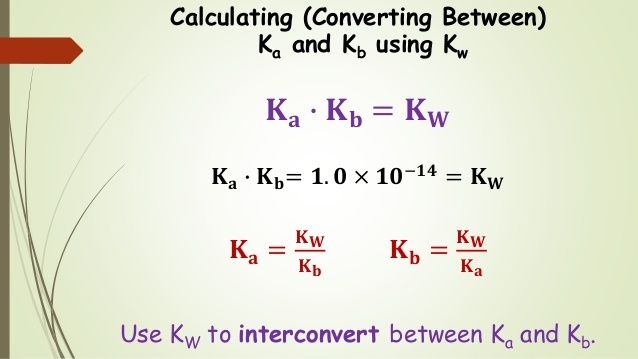
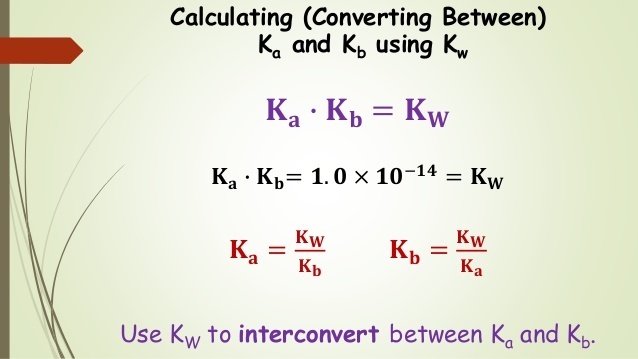
The relation between Ka and Kb for an acid and it's conjugate base is

Ka x Kb = Kw where Kw = ionic product of water.

So Kb = 10^-14 / (4.57 x 10 ^ -3)

= 2.19 x 10^-12

You might be interested in
At 10°c one volume of water dissolves 3.10 volumes of chlorine gas at 1.00 atm pressure. what is the henry's law constant of cl2
s344n2d4d5 [400]
Answer is:  0,133 mol/ l· atm.
T(chlorine) = 10°C = 283K.
p(chlorine) = 1 atm.
V(chlorine) = 3,10 l.
R - gas constant, R = 0.0821 atm·l/mol·K. 
Ideal gas law: p·V = n·R·T
n(chlorine) = p·V ÷ R·T.
n(chlorine) = 1atm · 3,10l ÷ 0,0821 atm·l/mol·K · 283K = 0,133mol.
Henry's law: c = p·k.
k - <span>Henry's law constant.
</span>c - solubility of a gas at a fixed temperature in a particular solvent.
c = 0,133 mol/l.
k = 0,133 mol/l ÷ 1 atm = 0,133 mol/ l· atm.

4 0
2 years ago
If a 0.4856 gram sample of khp is dissolved in sufficient water to prepare 250 ml of solution, and 25 ml of the solution require
dangina [55]

Mass of potassium hydrogen pthalate KHP is 0.4856 g, its molar mass is 204.22 g/mol, number of moles of KHP can be calculated as follows:

n=\frac{m}{M}

Here, m is mass and M is molar mass, putting the values,

n=\frac{0.4856 g}{204.22 g/mol}=0.00237 mol

This will be number of moles of NaOH at equivalent point.

Detailed calculations:

Molarity is defined as number of moles in 1 L of solution, for 250 mL of solution, molarity will be:

M=\frac{0.00237 mol}{250 \times 10^{-3}L}=0.009511 M

For 25 mL, apply dilution law as follows:

M_{1}V_{1}=M_{2}V_{2}

Putting the values,

0.009511\times 250=M_{2}\times 25 mL

On rearranging,

M_{2}=\frac{0.009511\times 250}{25}=0.09511 M

Convert molarity into number of moles,

n=M\times V=0.09511 mol/L\times 25\times 10^{-3}L=0.00237 mol

At equivalent point, number of moles of KHP will be equal to NaOH, thus, number of moles of NaOH will be 0.00237 mol.

Calculation for molarity:

Volume of NaOH is 18.75 mL, thus, molarity can be calculated as follows:

M=\frac{n}{V}

Putting the values,

M=\frac{0.00237 mol}{18.75\times 10^{-3}L}=0.1264 M

Therefore, molarity of NaOH is 0.1264 M
7 0
2 years ago
A 55.0 L steel tank at 20.0 ∘C contains acetylene gas, C2H2, at a pressure of 1.39 atm. Assuming ideal behavior, how many grams
JulijaS [17]

Answer:

PV=nRT

n = PV/RT

n = m/Mm

m/Mm = PV/RT

m = MmPV/RT

T in kelvin = T Celsius + 273.15 = 293.15 K

m = (26.04 x 1.39 x 55)/(0.08206 x 293.15)

mass in grams = 82.8 grams  

Explanation:

Ideal gases formula is PV=nRT, where:

P is the pressure (1.39 atm in this case)

V is the volume (55.0 L in this case)

R is the gas constant (0.08206 L.atm/K.mole)

T is the temperature (20.0C) should be converted to Kelvin

all the unit should correspond to the one in the R.

we also know that to find the mass, we can use number mole with the formula number of mole(n) = mass (m) divided by the molar mass (Mm). therefore we substituted that in the formula and make (m) the subject of the formula.

we found the mass to be 82.8 grams

7 0
2 years ago
Jill is doing an experiment on the movement of pill bugs. She will place the pill bugs on flat surfaces covered with diffirent m
Ostrovityanka [42]

Answer:D

Explanation:

6 0
2 years ago
What do you think happens to Difluoroethane at –24°C? Provide evidence to support your claim.
balandron [24]

Answer:

The following subsections explain the explanation according to the particular circumstance.

Explanation:

  • The boiling point seems to be the temperature beyond which the working fluid as well as the boiling phase would be at a predetermined pressure or voltage at equilibrium among one another and.  
  • The vapor or boiling temperature of 1,1 difluoroethane seems to be -25oC at 1 atm, although as a gas it can remain at a higher temperature around -24oC.
6 0
2 years ago
Other questions:
  • jan is holding an ice cube. what causes the ice to melt? thermal energy from the ice is transferred to the air. thermal energy f
    12·2 answers
  • Hydrogen has three isotopes with mass numbers of 1, 2, and 3 and has an average atomic mass of 1.00794 amu. This information ind
    10·2 answers
  • The highest energy occupied molecular orbital in the f-f bond of the f2 molecule is _____
    10·1 answer
  • Which term names the metamorphic change to a rock that results mainly from the heat energy of nearby magma? A. local metamorphis
    5·2 answers
  • Write the lewis structure for ch2clcoo−. assign a formal charge for any atom with a non-zero formal charge.
    15·1 answer
  • A 2.20 g sample of a compound gave 5.63 g CO2 and 2.30 g H2O on combustion in air. The compound is known to contain only C, H, O
    8·1 answer
  • Describe the pattern of the lewis dot structure of the first 18 elements
    14·1 answer
  • What name is used to describe the H-N-H group?
    14·1 answer
  • A vial contains radioactive iodine-131 with an activity of 2.0 mCi/mL. If a thyroid test requires 2.9 mCi in an "atomic cocktail
    13·1 answer
  • 18) Why are the large oak trees so important for storks? Where are<br> they found?<br> 1
    8·1 answer
Add answer
Login
Not registered? Fast signup
Signup
Login Signup
Ask question!