answer.
Ask question
Login Signup
Ask question
All categories
  • English
  • Mathematics
  • Social Studies
  • Business
  • History
  • Health
  • Geography
  • Biology
  • Physics
  • Chemistry
  • Computers and Technology
  • Arts
  • World Languages
  • Spanish
  • French
  • German
  • Advanced Placement (AP)
  • SAT
  • Medicine
  • Law
  • Engineering
wlad13 [49]
2 years ago
7

How many protons neutrons and electrons are there in a neutral atom of 43k (potassium-43)?

Chemistry
1 answer:
Veronika [31]2 years ago
3 0

Answer:

             Number of Protons  =  19

             Number of Neutrons  =  25

             Number of Electrons  =  19

Explanation:

Number of Protons:

                               The number of protons present in any atom are equal to the atomic number of that particular atom. Hence, as the atomic number of Potassium is 19 therefore, it contains 19 protons.

Number Neutrons:

                             The number of neutrons present in atom are calculated as,

                               # of Neutrons  =  Atomic Mass - # of protons

As given,

                                Atomic Mass  =  43

                                # of Protons  =  19

So,

                                # of Neutrons  =  43 - 19

                                # of Neutrons  =  24

Number of Electrons:

                                   As we know for a neutral atom the number of electrons are exactly equal to the number of protons present in its nucleus. So, for 19 protons in neutral Potassium atom there must be 19 electrons.

You might be interested in
Which of these is a difference between a single skin cell and the skin tissue that covers an entire hand?
fgiga [73]

Answer:

c

Explanation:

the cells grow more than the tissue

7 0
2 years ago
Read 2 more answers
The three‑dimensional structure of a generic molecule is given. Identify the axial and equatorial atoms in the three‑dimensional
Dima020 [189]

Answer:

Explanation:

CHECK THE ATTACHMENT FOR THE COMPLETE QUESTION AND THE DETAILED EXPLANATION

NOTE:

Equatorial atoms are referred to atoms that are attached to carbons in the cyclohexane ring which is found at the equator of the ring.

Axial atoms are atoms that exist in a bond which is parallel to the axis of the ring in cyclohexane

4 0
2 years ago
50 kg of N2 gas and 10kg of H2 gas are mixed to produce NH3 gas calculate the NH3gas formed. Identify the limiting reagent in th
statuscvo [17]

Answer:

1. H2 is the limiting reactant.

2. 56666.67g ( i.e 56.67kg) of NH3 is produced.

Explanation:

Step 1:

The equation for the reaction. This is given below:

N2 + H2 —> NH3

Step 2:

Balancing the equation.

N2 + H2 —> NH3

The above equation can be balanced as follow :

There are 2 atoms of N on the left side and 1 atom on the right side. It can be balance by putting 2 in front of NH3 as shown below:

N2 + H2 —> 2NH3

There are 6 atoms of H on the right side and 2 atoms on the left side. It can be balance by putting 3 in front of H2 as shown below

N2 + 3H2 —> 2NH3

Now the equation is balanced.

Step 3:

Determination of the masses of N2 and H2 that reacted and the mass of NH3 produced from the balanced equation. This is illustrated below:

N2 + 3H2 —> 2NH3

Molar Mass of N2 = 2x14 = 28g/mol

Molar Mass of H2 = 2x1 = 2g/mol

Mass of H2 from the balanced equation = 3 x 2 = 6g

Molar Mass of NH3 = 14 + (3x1) = 14 + 3 = 17g/mol

Mass of NH3 from the balanced equation = 2 x 17 = 34g

From the balanced equation above,

28g of N2 reacted with 6g of H2 to produce 34g of NH3

Step 4:

Determination of the limiting reactant. This is illustrated below:

N2 + 3H2 —> 2NH3

Let us consider using all the 10kg (i.e 10000g) of H2 to see if there will be any left of for N2.

From the balanced equation above,

28g of N2 reacted with 6g of H2.

Therefore, Xg of N2 will react with 10000g of H2 i.e

Xg of N2 = (28 x 10000)/6

Xg of N2 = 46666.67g

We can see from the calculations above that there are leftover for N2 as only 46666.67g reacted out of 50kg ( i.e 50000g) that was given. Therefore, H2 is the limiting reactant.

Step 5:

Determination of the mass of NH3 produced during the reaction. This is illustrated below:

N2 + 3H2 —> 2NH3

From the balanced equation above,

6g of H2 reacted to produce 34g of NH3.

Therefore, 10000g of H2 will react to produce = ( 10000 x 34)/6 = 6g of 56666.67g of NH3.

Therefore, 56666.67g ( i.e 56.67kg) of NH3 is produced.

3 0
2 years ago
Read 2 more answers
The combustion of propane (c3h8) produces co2 and h2o: c3h8 (g) + 5o2 (g) → 3co2 (g) + 4h2o (g) the reaction of 2.5 mol of o2 wi
Andrews [41]
The answer is 2 mol of H₂O will be produced.
The balanced equation for the chemical reaction is:

<span>c3h8 (g) + 5o2 (g) → 3co2 (g) + 4h2o (g) 
5 moles of O</span>₂ produces 4 moles of H₂O, and when there is 2.5 mol of O₂, moles of H₂O will be:
2.5 x 4/5 = 2 mol of H₂O
8 0
2 years ago
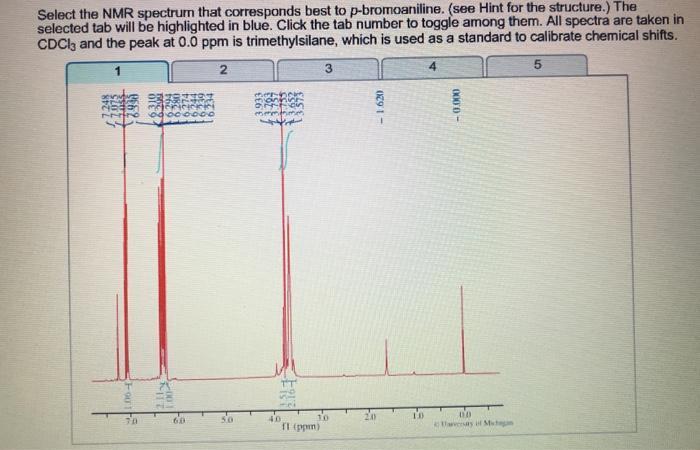
Select the NMR spectrum that corresponds best to p-bromoaniline. (see Hint for the structure.) The selected tab will be highligh
lana [24]

Answer:

The NMR spectrum that corresponds best to p-bromoaniline  is the one that is attached in the image below.

Explanation:

For the p-bromoaniline 3 types of hydrogen are observed. The first signal that appears at 3.7 ppm would be from the hydrogens of the NH2 group, the hydrogens in ortho position with respect to the NH2 group give a double at approximately 6.54 ppm, and finally the characteristic 7.21 ppm signal is observed for the hydrogens in meta position with with respect to the NH2 group.

7 0
2 years ago
Other questions:
  • Which compound most likely contains polar covalent bonds?. The choices are the following: NaCl. AlF3. Br2. NF3
    13·2 answers
  • In an experiment, 16.8 g of k2so4 was dissolved in 1.00 kg of water to make a solution. the freezing point of the solution was m
    11·1 answer
  • Twenty-seven milliliters of an acid with an unknown concentration are titrated with a base that has a concentration of 0.55 M. T
    10·2 answers
  • 200 grams of an organic sample which contains only carbon, hydrogen, and oxygen is analyzed and found to contain 97.30 grams of
    11·2 answers
  • Assume the following substances are soluble in water.
    11·1 answer
  • Chlorine gas can be made from the reaction of manganese dioxide with hydrochloric acid. MnO2(s) + 4HCl(aq) → MnCl2(aq) + 2H2O(l)
    12·1 answer
  • Consider the reaction: 2 Al + 3Br2 → 2 AlBr3 Suppose a reaction vessel initially contains 5.0 mole Al and 6.0 mole Br2. What is
    7·1 answer
  • You have a balloon filled with hydrogen gas which keeps it at a constant pressure, regardless of its volume. The initial volume
    7·1 answer
  • Dalton’s theory states that atoms are the smallest possible parts of elements. In a chemical reaction, atoms will rearrange and
    15·2 answers
  • 11. Imagine that the unknown solution contains potassium bicarbonate, which is frequently used as a pH buffering agent in foods
    8·1 answer
Add answer
Login
Not registered? Fast signup
Signup
Login Signup
Ask question!