answer.
Ask question
Login Signup
Ask question
All categories
  • English
  • Mathematics
  • Social Studies
  • Business
  • History
  • Health
  • Geography
  • Biology
  • Physics
  • Chemistry
  • Computers and Technology
  • Arts
  • World Languages
  • Spanish
  • French
  • German
  • Advanced Placement (AP)
  • SAT
  • Medicine
  • Law
  • Engineering
Dmitrij [34]
2 years ago
11

200 grams of an organic sample which contains only carbon, hydrogen, and oxygen is analyzed and found to contain 97.30 grams of

carbon, 16.22 grams of hydrogen and the remainder oxygen. What is the empirical formula for the compound?

Chemistry
2 answers:
faltersainse [42]2 years ago
4 0

Answer:

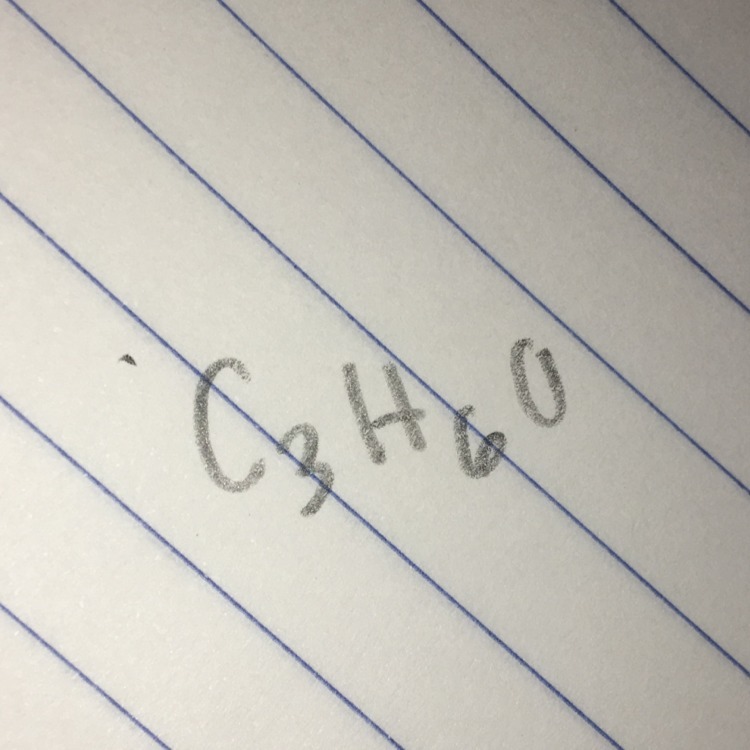
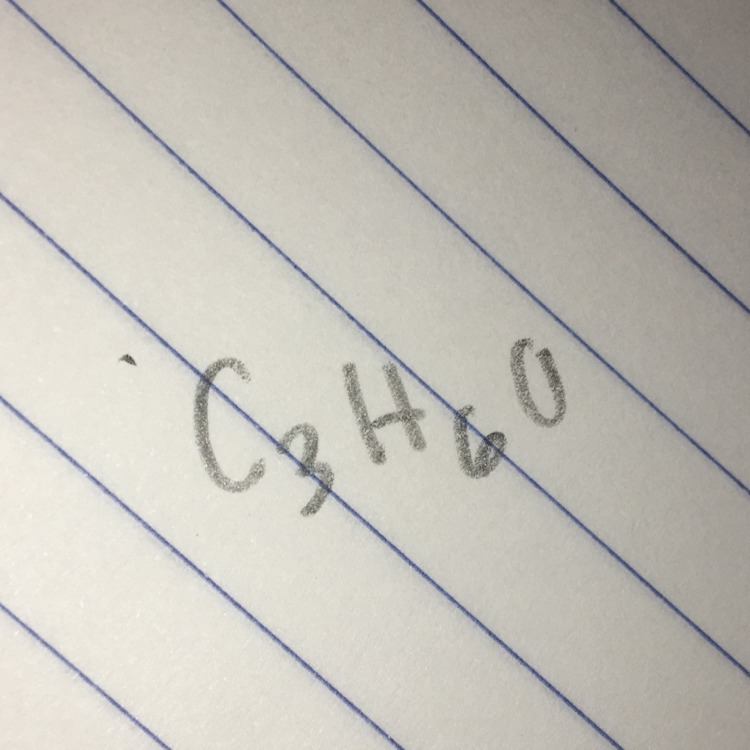
The Empirical formula of an organic compound is=C_3H_6O_2

Explanation:

Mass of an organic compound = 200 g

Mass of carbon = 97.30 g

moles of carbon = \frac{97.30 g}{12 g/mol}=8.108 mol

Mass of hydrogen = 16.22 g

Moles of hydrogen = \frac{16.22 g}{1 g/mol}=16.220 mol

Mass of oxygen = 200 g - 97.30 g - 16.22 g = 86.48 g

Moles of oxygen =\frac{86.48 g}{16 g/mol}=5.405 mol

Divide the all the moles of element with smallest value of moles.

Carbon = \frac{8.108 mol}{5.405 mol}=1.5

Hydrogen = \frac{16.220 mol}{5.405 mol}=3

Oxygen =\frac{5.405 mol}{5.405 mol}=1

Empirical formula =C_{1.5}H_3O_1

Converting them into whole number ratios.

Empirical formula =C_3H_6O_2

ipn [44]2 years ago
3 0
The empirical formula for 200 grams of an organic sample which contains carbon,hydrogen, and oxygen is C3H6O

You might be interested in
Write a balanced equation for the reaction of NaCH3COO (also written as NaC2H3O2) and HCl.
hammer [34]
The balance chemical equation is:

NaCH₃COO + HCl → NaCl + HCH₃COO

Make 
4 0
2 years ago
Read 2 more answers
How many moles of chromium(iii) nitrate are produced when chromium reacts with 0.85 moles of lead(iv) nitrate to produce chromiu
Alexxandr [17]
The  moles  of  chromium (iii)  nitrate  produced  is  calculated  as   follows

write  the  equation  for  reaction

 3  Pb(NO3)2  +  2 Cr  =  2 Cr(NO3)3  +  3  Pb

by  use  of  mole  ratio  between  Pb(NO3)2  to  Cr(NO3)3  which  is  3  :  2  the  moles  of  Cr(NO3)3  is therefore  
=  0.85  x2  /3  =  0.57   moles
5 0
2 years ago
Consider a saturated solution formed when 17.5 g of a solute dissolve in 28.3 g of a solvent, giving a total solution volume of
STALIN [3.7K]

Answer:

a) 38.2 % mass

b) 61.8 g solute/100 g solvent

c) 1.65 g/mL

Explanation:

Given the data:

mass of solute = 17.5 g

mass of solvent= 28.3 g

total solution volume= 27.8 mL

a)- mass percent= mass of solute/mass of solution x 100

mass of solution = mass solute + mass solvent = 17.5 g + 28.3 g = 45.8 g

mass % = 17.5 g/45.8 g x 100 = 38.2 % mass

b)- solubility = grams of solute/ 100 g solvent

                    = 17.5 g x (100 g /28.3 g solvent) = 61.8 g solute/100 g solvent  

c)- density = massof solution/total volumesolution  = 45.8 g/27.8 mL = 1.65 g/mL

7 0
2 years ago
A gold wire has a diameter of 1.00 mm. What length of this wire contains exactly 1.00 mol of gold? (density of Au = 17.0 g/cm3)
allochka39001 [22]

Answer:

The answer to your question is 7160 cm

Explanation:

Data

diameter = 1 mm

length = ?

amount of gold = 1 mol

density = 17 g/cm³

Process

1.- Get the atomic mass of gold

Atomic mass = 197 g

then, 197g ------------ 1 mol

2.- Calculate the volume of this wire

density = mass/volume

volume = mass/density

volume = 197/17

volume = 5.7 cm³

3.- Calculate the length of the wire

Volume = πr²h

solve for h

h = volume /πr²

radius = 0.05 cm

substitution

h = 5.7/(3.14 x 0.05²)

h = 5.7 / 0.0025

h = 7159.2 cm ≈ 7160 cm

8 0
2 years ago
Read 2 more answers
How many grams of NH3 can be prepared from the synthesis of 77.3 grams of nitrogen and 14.2 grams of hydrogen gas?
lbvjy [14]

Answer:

80.41 g

Explanation:

Data Given:

Mass of Nitrogen (N₂) = 77.3 g

Mass of Hydrogen (H₂) = 14.2 g

many grams of NH₃ = ?

Solution:

First we look at the balanced synthesis reaction

              N₂   +    3 H₂  ------—> 2 NH₃

             1 mol      3 mol

As 1 mole of Nitrogen react with 3 mole of hydrogen

Convert moles to mass

molar mass of N₂ = 2(14) = 28 g/mol

molar mass of H₂ = 2(1) + 2 g/mol

Now

                     N₂             +           3 H₂        ------—>      2 NH₃

             1 mol (28 g/mol)     3 mol(2g/mol)

                    28 g                        6 g

28 grams of N₂ react with 6 g of H₂  

So

if 28 grams of N₂ produces 6 g of H₂  so how many grams of N₂ will react with 14.2 g of H₂.

Apply Unity Formula

                 28 g of N₂ ≅ 6 g of H₂

                 X g of N₂ ≅ 14.2 g of H₂

Do cross multiply

                X g of N₂ = 28 g x 14.2 g / 6 g

                X g of N₂ = 66.3 g

As we have given with 77. 3 g of N₂ but from this calculation we come to know that 66.3 g will react with 14.2 g of hydrogen and the remaining 10 g N₂ will be in excess

So, Hydrogen is limiting reactant in this reaction and the amount of NH₃ depends on the amount of hydrogen.

Now

To find mass of NH₃ we will do following calculation

Look at the reaction

As we Know

                     N₂             +           3 H₂        ------—>      2 NH₃

                                                   6 g                            2 mol

So, 6 g of hydrogen gives 2 moles of NH₃, then how many moles of NH₃ will be produce by 14.2 g

Apply Unity Formula

                 6 g of H₂ ≅ 2 mol of NH₃

                14.2 g of H₂ ≅ X mol of NH₃

Do cross multiply

               X mol of NH₃= 14.2 g x 2 mol / 6 g

                X mol of NH₃ = 4.73 mol

So, 14.2 g of hydrogen gives 4.73 moles of NH₃

Now

Convert moles of NH₃ to mass

Formula will be used

        mass in grams = no. of moles x molar mass . . . . . . (2)

Molar mass of  NH₃

Molar mass of  NH₃ = 14 + 3(1)

Molar mass of  NH₃ = 14 + 3 = 17 g/mol

Put values in equation 2

        mass in grams = 4.73 mole x 17 g/mol

        mass in grams =  80.41 g

mass of NH₃=  80.41 g
3 0
2 years ago
Other questions:
  • You are writing a safety contract for your class. List 10 things you would include in the contract.
    8·2 answers
  • The density of a gaseous compound is 1.623 g/l at stp determine the molar mass of the compound
    6·1 answer
  • According to reference table adv-10, which reaction will take place spontaneously?
    8·1 answer
  • a student adds 15 g of baking soda to 10 g of acetic acid in a beaker. a chemical reaction occurs and a gas is given off. after
    10·1 answer
  • Which family on the periodic table is least likely to enter into chemical reactions? 1 2 17 18
    10·2 answers
  • An increase in temperature will effect vapor pressure by:
    6·1 answer
  • Click the "draw structure" button to launch the drawing utility. under certain reaction conditions, 2,3−dibromobutane reacts wit
    6·1 answer
  • The following reaction is exothermic. C6H12O6(s)+6O2(g)⇌6CO2(g)+6H2O(g)C6H12O6(s)+6O2(g)⇌6CO2(g)+6H2O(g) Predict the effect (shi
    13·1 answer
  • A 1.80 g sample of barium chloride hydrate, BaCl2 ⋅ xH2O is treated with excess sulfuric acid, forming a BaSO4 precipitate which
    6·2 answers
  • What is the value of the σ∗1s mo wave function at the nodal plane?
    15·2 answers
Add answer
Login
Not registered? Fast signup
Signup
Login Signup
Ask question!