answer.
Ask question
Login Signup
Ask question
All categories
  • English
  • Mathematics
  • Social Studies
  • Business
  • History
  • Health
  • Geography
  • Biology
  • Physics
  • Chemistry
  • Computers and Technology
  • Arts
  • World Languages
  • Spanish
  • French
  • German
  • Advanced Placement (AP)
  • SAT
  • Medicine
  • Law
  • Engineering
Aleksandr [31]
2 years ago
6

Click the "draw structure" button to launch the drawing utility. under certain reaction conditions, 2,3−dibromobutane reacts wit

h two equivalents of base to give three products, each of which contains two new π bonds. product a has two sp hybridized carbon atoms, product b has one sp hybridized carbon atom, and product c has none. what is the structure of b?

Chemistry
1 answer:
REY [17]2 years ago
4 0

Answer:

Explanation:

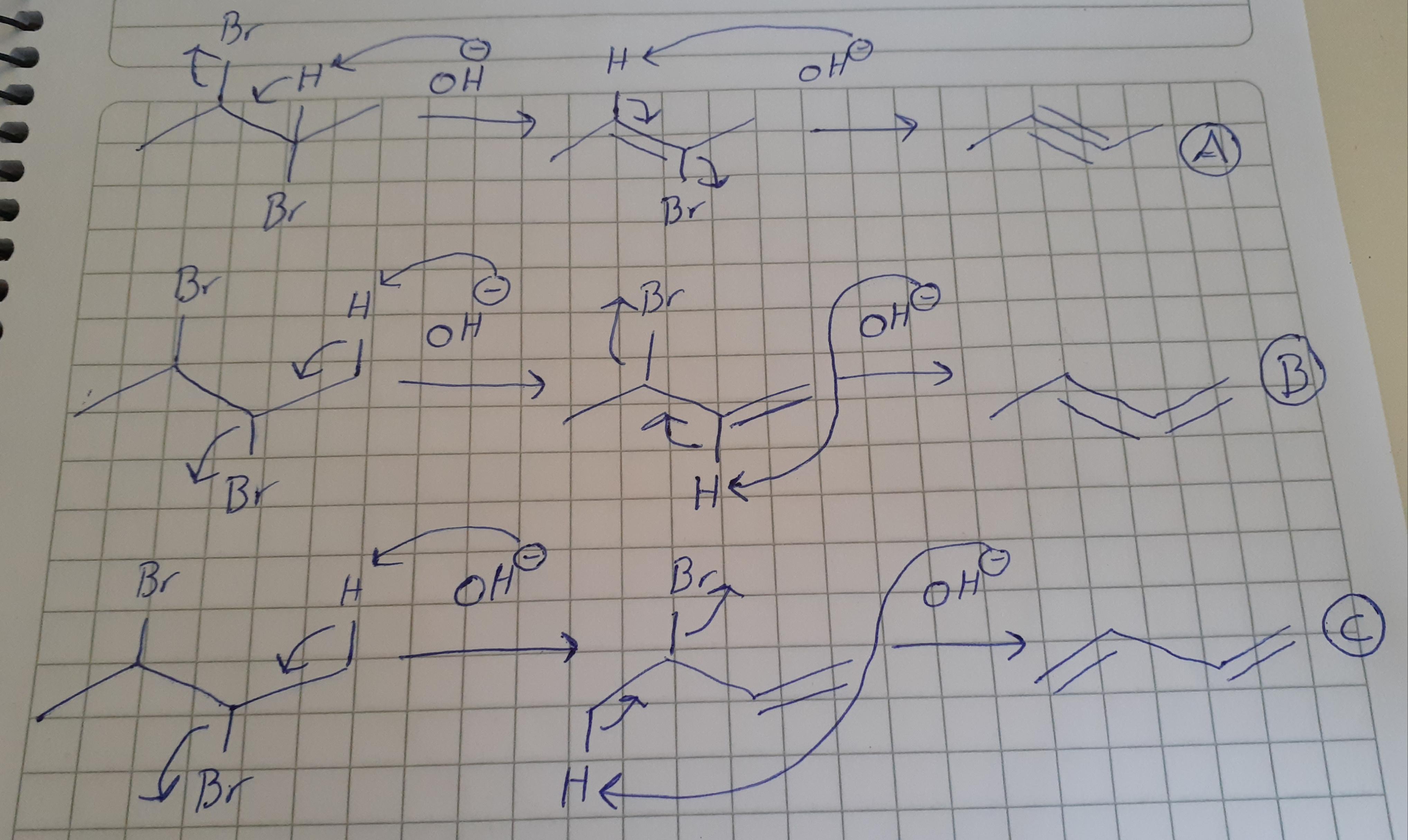
According to this. Let's analize the possible products a, b and c.

First, the problem states that we have 2 eq. of base, For this case, let's assume it's KOH. Now, As we are doing a reaction with base, means that this reaction can only take places under conditions of SN2 and E2, a fast reaction that is taking place in only 1 step.

With this in mind, let's analyze product a. This states that it has two sp hybridized carbon, in other words, a triple bond between two carbons. So the product is with no doubt, an alkyne.

Product b has only one sp hybridized carbon, which means that this carbon should cannot be an alkyne because we need two carbon atoms. The only way to have one atom of C sp hybridized, is with two double bonds, so product b would have to a alkene with two double bonds.

Product c do not have sp hybridized carbon, therefore, it only has two double bonds in two different Carbon atoms, so it's another alkene with two double bonds, but in two different atoms of carbon.

Picture attached show the product a, b and c. Hope this can help
You might be interested in
5. A Dumas bulb is filled with chlorine gas at the ambient pressure and is found to contain 7.1 g of chlorine when the temperatu
kati45 [8]

Answer:

a. The original temperature of the gas is 2743K.

b. 20atm.

Explanation:

a. As a result of the gas laws, you can know that the temperature is inversely proportional to moles of a gas when pressure and volume remains constant. The equation could be:

T₁n₁ = T₂n₂

<em>Where T is absolute temperature and n amount of gas at 1, initial state and 2, final states.</em>

<em />

<em>Replacing with values of the problem:</em>

T₁n₁ = T₂n₂

X*7.1g = (X+300)*6.4g

7.1X = 6.4X + 1920

0.7X = 1920

X = 2743K

<h3>The original temperature of the gas is 2743K</h3><h3 />

b. Using general gas law:

PV = nRT

<em>Where P is pressure (Our unknown)</em>

<em>V is volume = 2.24L</em>

<em>n are moles of gas (7.1g / 35.45g/mol = 0.20 moles)</em>

R is gas constant = 0.082atmL/molK

And T is absolute temperature (2743K)

P*2.24L = 0.20mol*0.082atmL/molK*2743K

<h3>P = 20atm</h3>

<em />

7 0
2 years ago
3 Ni2+(aq) + 2 Cr(OH)3(s) + 10 OH− (aq) → 3 Ni(s) + 2 CrO42−(aq) + 8 H2O(l) ΔG∘ = +87 kJ/molGiven the standard reduction potenti
Mrrafil [7]

Answer:

The standard reduction potential E°cell (Cr6+/Cr3+) is -0.13V

Explanation:

<u>Step 1</u>: Data given

3 Ni^2+(aq) + 2 Cr(OH)3(s) + 10 OH− (aq) → 3 Ni(s) + 2 CrO4^2−(aq) + 8 H2O(l) ΔG∘ = +87000 J/mol

Ni2+(aq) + 2 e− → Ni(s)    E∘red = -0.28 V

<u>Step 2:</u> The half reactions:

Cathode:  Ni2+(aq) + 2 e− → Ni(s)    E° = -0.28 V

Anode: CrO4^2-(aq) + 4H2O(l) +3e- → Cr(OH)3(s) + 5OH- (aq)   E°= unknown

<u>Step 3:</u> Calculate E°cell

ΔG° = -n*F*E°cell

⇒ with ΔG° = the gibbs free energy

⇒ n = the number of electrons in the net reaction = 6

⇒ F = the Faraday constant = 96485 C

⇒ E°cell= the standard cell potential

<u>Step 4:</u> Calculate E°(Cr6+/Cr3+

E°cell= ΔG°/(-n*F)

E°cell = 87000 /(-6*96485)

E°cell = -0.150 V

E°cell = E°(Ni2+/Ni) - E°(Cr6+/Cr3+)

E°(Cr6+/Cr3+) = -0.13V

The standard reduction potential E°cell (Cr6+/Cr3+) is -0.13V

7 0
2 years ago
Which statement describes the transfer of heat energy that occurs when an ice cube is added to an insulated container with 100 m
nadya68 [22]
Number 3 is the most likely answer
4 0
2 years ago
If a reaction occurs, what will be the products of the unbalanced reaction below?Cu(s) + Ni(NO3)2(aq) 
Sveta_85 [38]

Answer:

Cu(NO3)2 --> MM187.5558

NiNO3 *COEF2* --> 120.6983

3 0
2 years ago
Your task is to measure the amount of energy evolved during the combustion of some hydrocarbon. Which of the following would be
Dahasolnce [82]

Answer:

c. Bomb calorimetry

Explanation:

The hydrocarbons are combustibles, it means that they can react in a combustion reaction to release energy. To measure this amount of energy, it's necessary equipment that the reaction can be placed in a controlled way. The bomb calorimeter is this equipment, which is an adiabatic vessel, with water. The heat is calculated based on the increase in the water temperature.

The coffee-cup calorimetry is used to measure the heat of a dissolution reaction and the bomb manometry is used to measure the pressure.

7 0
2 years ago
Other questions:
  • A beam of light passes though a liquid in a test tube without scattering. Which type of mixture is most likely in the test tube?
    13·2 answers
  • A solution is a special mixture where you cannot see the individual substances that are mixed. You look at two bowls of ice crea
    5·1 answer
  • A person is pushing a box across a table. The measured forces on the box are 10N, 14N, 7N, 10N. Which force is represented by 7N
    11·2 answers
  • What is the molarity of potassium ions in a 0.122 M K2CrO4 solution
    12·2 answers
  • In two or more complete sentences, explain how to calculate the amount of energy that is transferred when 150 g of cooper cools
    13·1 answer
  • A student placed 11.5 g of glucose (C6H12O6) in a volumetric flask, added enough water to dissolve the glucose by swirling, then
    12·2 answers
  • A. Consider four different samples: aqueous LiI, molten LiI, aqueous AgI, and molten AgI. Current run through each sample produc
    9·1 answer
  • Which compound would be expected to show intense IR absorption at 2710 and 1705 cm-1? (Ph = phenyl group)
    5·1 answer
  • At STP, a 50-gram sample of H20(I) and a 100-gram sample of H20(I) have
    15·2 answers
  • Rank the following chemical species from lowest absolute entropy (So) (1) to highest absolute entropy (5) at 298 K?
    7·1 answer
Add answer
Login
Not registered? Fast signup
Signup
Login Signup
Ask question!