answer.
Ask question
Login Signup
Ask question
All categories
  • English
  • Mathematics
  • Social Studies
  • Business
  • History
  • Health
  • Geography
  • Biology
  • Physics
  • Chemistry
  • Computers and Technology
  • Arts
  • World Languages
  • Spanish
  • French
  • German
  • Advanced Placement (AP)
  • SAT
  • Medicine
  • Law
  • Engineering
Nesterboy [21]
2 years ago
13

Classify the compound below as an alkane, alkene, alkyne, alcohol, aldehyde, amine, and so forth

Chemistry
1 answer:
Gnoma [55]2 years ago
6 0

<em>Answer:</em>

  • Organic compounds are those which are derivatives of hydrocarbons. They are classified into following functional groups.

<em>Alkane:  </em>

  • Alkane are simplest hydrocarbons.
  • They have general formula CnH2n+2. These hydrocarbons contain single bond.
  • For example ethane , H3C----CH3.

<em>Alkene:</em>

  • Alkene are most reactive.
  • They have general formula CnH2n.
  • These contain double bond in their structure.
  • For example , ethene, H2C=CH2

<em>Alkyne:</em>

  • These are less less reactive as compare to alkenes.
  • They have general formula CnH2n-2.
  • They contain triple bonds in their structure.
  • For example Acetylene HC≡CH

<em>Alcohol:</em>

Alcohol have functional group OH. They have general formual R---OH, R may be alkyl group.For example Ethanol H3CH2C---OH

<em>Amine:</em>

  • Amine contain NH2 F.G.
  • They have general formula R---NH2.
  • There are three types of amine like primary, secondary and tertiary amine.
  • For example H3CH2C---NH2

<em>Aldehyde:</em>

  • Aldehydes have CHO F.G .
  • They have general formula R--CHO.
  • For example H3CH2C---CHO

<em>Ketone:</em>

  • Ketones have R--CO--R functional group.
  • For example acetone H3C---CO---CH3

<em>Carboxylic acid:</em>

  • They functional group COOH.
  • Their general formula is R---COOH.
  • For example Acetic acid H3C---COOH
You might be interested in
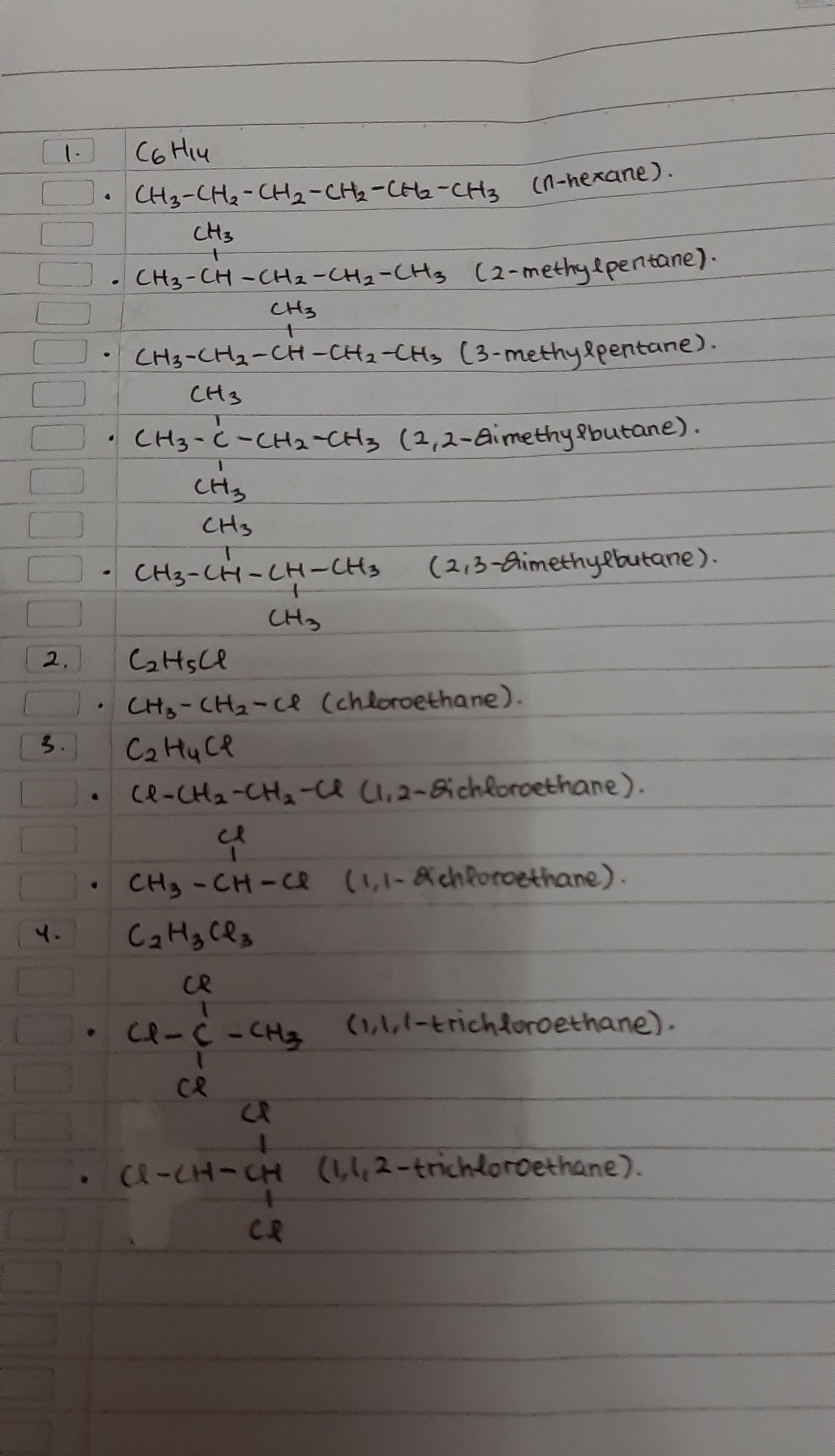
1.35 Draw structures for all constitutional isomers with the following molecular formulas: (a) C6H14 (b) C2H5Cl (c) C2H4Cl2 (d )
Anna11 [10]

I hope this will help ;)

6 0
2 years ago
Which statement is true about writing chemical formulas of covalent compounds?
Korvikt [17]
Your answer is d hope I helped
4 0
2 years ago
Read 2 more answers
Estimate the increase in the molar entropy of O2(g) when the temperature is increased at constant pressure from 298 K to 348 K,
Tamiku [17]

Explanation:

It is known that relation between entropy, heat energy and temperature is as follows.

        dS = \frac{Q}{T}

        \int dS = \int \frac{Q}{T}

Also we know that at constant pressure, Q = \Delta H = C_{p} - dT

     \int_{S_{1}}^{S_{2}} dS = \int_{T_{1}}^{T_{2}} C_{p} \frac{dT}{T}

     \Delta S = C_{p} \int_{T_{1}}^{T_{2}} \frac{dT}{T}

As the given data is as follows.

        T_{1} = 298 K,          T_{2} = 348 K

         C_{p} = 29.355 J/K mol

Now, putting the given values into the above formula as follows.

          \Delta S = C_{p} ln {T_{1}}^{T_{2}} \frac{dT}{T}

                  = 29.355 [ln (348) - ln (298)]

                  = 29.355 [5.85 - 5.69]

                  = 4.48 J/k mol

Thus, we can conclude that the increase in the molar entropy of given oxygen gas is 4.48 J/k mol.

6 0
2 years ago
(a) The mass density of a gaseous compound was found to be 1.23 kg m^−3 at 330 K and 20 kPa. What is the molar mass of the compo
Luden [163]

Answer:

The molar mass of the compound is:- 168.82 g/mol

The molar mass of the gas is:- 16.38 g/mol

Explanation:

(a)

Using ideal gas equation as:

PV=nRT

where,  

P is the pressure

V is the volume

n is the number of moles

T is the temperature  

R is Gas constant having value = 0.0821 L.atm/K.mol

Also,  

Moles = mass (m) / Molar mass (M)

Density (d)  = Mass (m) / Volume (V)

So, the ideal gas equation can be written as:

PM=dRt

Given that:-

Pressure = 20 kPa = 20000 Pa

The expression for the conversion of pressure in Pascal to pressure in atm is shown below:

P (Pa) = \frac {1}{101325} P (atm)

20000 Pa = \frac {20000}{101325} atm

Pressure = 0.1974 atm

Temperature = 330 K

d = 1.23 kg/m³ = 1.23 g/L

Molar mass = ?

Applying the equation as:

0.1974 atm × M = 1.23 g/L × 0.0821 L.atm/K.mol × 330 K

⇒M = 168.82 g/mol

<u>The molar mass of the compound is:- 168.82 g/mol</u>

(b)

Given that:

Pressure = 152 Torr

Temperature = 298 K

Volume = 250 cm³ = 0.25 L

Using ideal gas equation as:

PV=nRT

R = 62.3637\text{torr}mol^{-1}K^{-1}

Applying the equation as:

152 Torr × 0.25 L = n × 62.3637 L.torr/K.mol × 298 K

⇒n = 0.002045 moles

Given that :  

Mass of the gas = 33.5 mg = 0.0335 g

Molar mass = ?

The formula for the calculation of moles is shown below:

moles = \frac{Mass\ taken}{Molar\ mass}

Thus,

0.002045\ moles&#10;= \frac{0.0335\ g}{Molar\ mass}

<u>The molar mass of the gas is:- 16.38 g/mol</u>

5 0
2 years ago
Question 4: Which members of an ecosystem are part of the energy flow?
Vanyuwa [196]

Answer:

The answer is A (number 1)

5 0
2 years ago
Other questions:
  • Identify all actions that you should take if you have chipped or broken glassware. Notify your teacher. Have the custodian clean
    8·2 answers
  • A compound that contains only carbon, hydrogen, and oxygen is 48.64% C and 8.16% H by mass. What is the empirical formula of thi
    5·1 answer
  • Justin is growing a garden and has many different types of liquids with which he could water his plants. He has water, coffee, m
    11·2 answers
  • The identity of an element depends on the number of
    10·2 answers
  • Suppose that 0.323 g of an unknown sulfate salt is dissolved in 50 mL of water. The solution is acidified with 6M HCl, heated, a
    6·1 answer
  • A 60.0 mL sample of 0.250 M NaOH is added to a beaker containing 125 mL of 0.120 M HOCl. Ka for HOCl is 3.5 x 10⁻⁸ at 25o C. Fin
    6·1 answer
  • A 1000.0 ml sample of lake water in titrated using 0.100 ml of a 0.100 M base solution. What is the molarity (M) of the acid in
    13·1 answer
  • Hydroxyl radicals react with and eliminate many atmospheric pollutants. However, the hydroxyl radical does not clean up everythi
    15·1 answer
  • If two gases react, pumping more gas into the reaction container will _____ the rate of the reaction.
    12·2 answers
  • What is the hybridization and shape for an XeF6 2+ molecule?
    8·1 answer
Add answer
Login
Not registered? Fast signup
Signup
Login Signup
Ask question!