answer.
Ask question
Login Signup
Ask question
All categories
  • English
  • Mathematics
  • Social Studies
  • Business
  • History
  • Health
  • Geography
  • Biology
  • Physics
  • Chemistry
  • Computers and Technology
  • Arts
  • World Languages
  • Spanish
  • French
  • German
  • Advanced Placement (AP)
  • SAT
  • Medicine
  • Law
  • Engineering
Tju [1.3M]
2 years ago
9

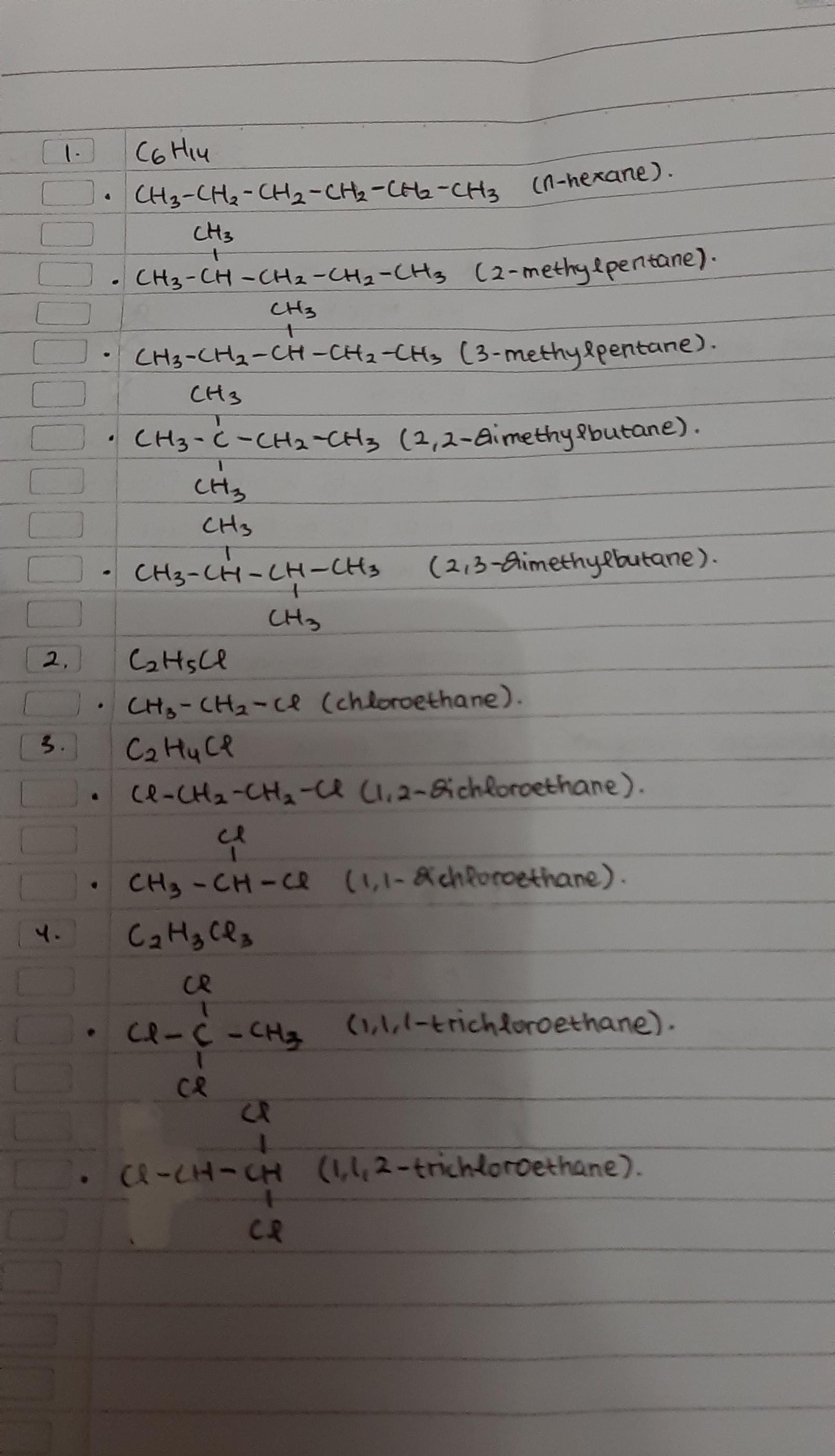
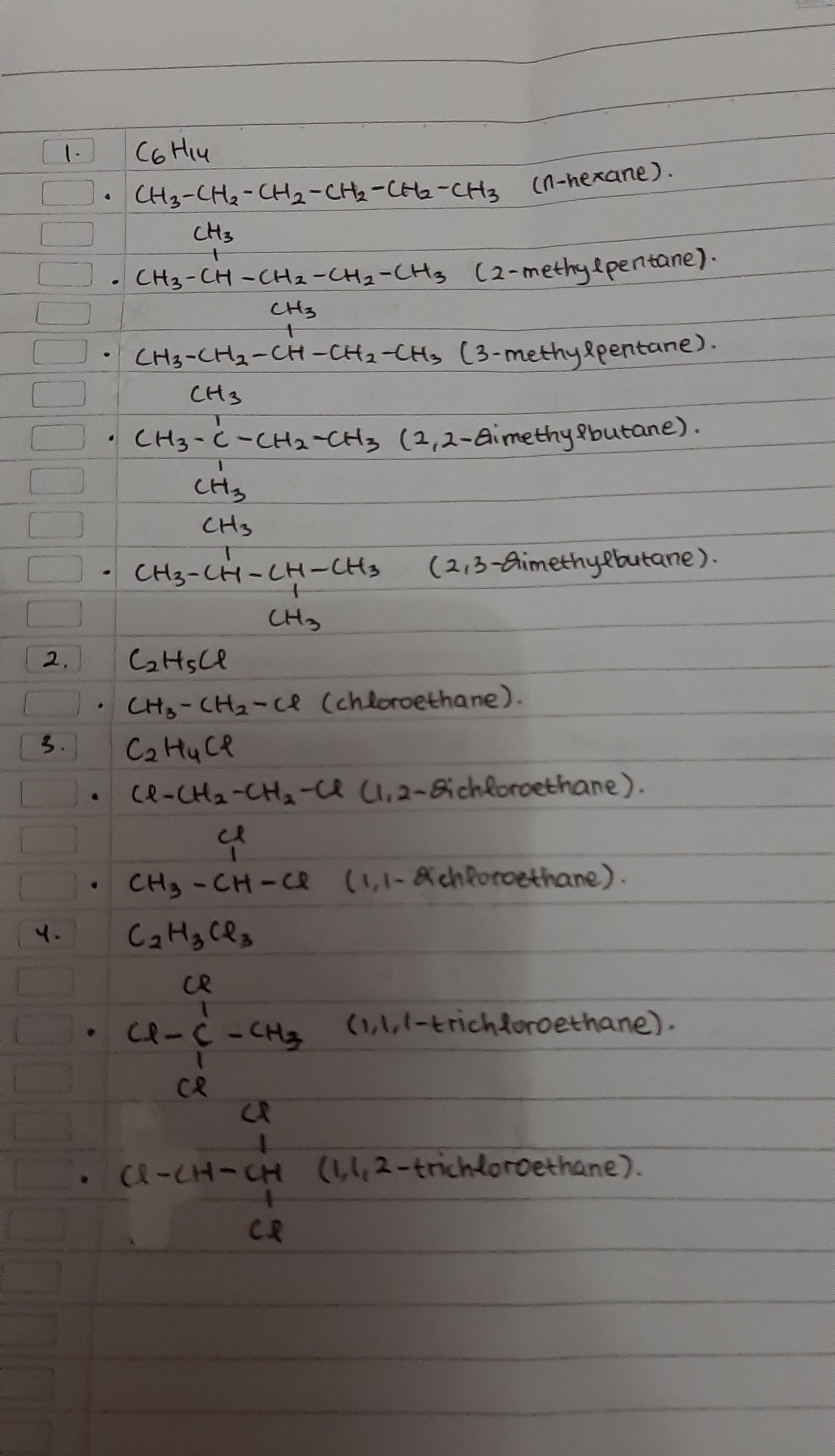
1.35 Draw structures for all constitutional isomers with the following molecular formulas: (a) C6H14 (b) C2H5Cl (c) C2H4Cl2 (d )

C2H3Cl3

Chemistry
1 answer:
Anna11 [10]2 years ago
6 0

I hope this will help ;)

You might be interested in
As Danny was pouring cereal for his breakfast, he noticed that the cereal box says that the cereal contains 5 milligrams of iron
Vinil7 [7]

Answer:

Correct, because B it is reported to the nearest miligram

Explanation:

4.6 rounded up is 5

6 0
2 years ago
What types of compounds are CaCl2, Cu, C2H6, respectively.
mina [271]

Answer:

Ionic, metal, organic

Explanation:

In this case, we have to analyze each compound:

-) CaCl_2

In this compound, we have a non-metal atom (Cl) and a metal atom (Ca) . So, we will have a high electronegativity difference between these atoms, With this in mind, we will have an ionic bond. Ions can be produced:

CaCl_2~->~Ca^+^2~+~2Cl^-

The cation would be Ca^+^2 and the anion is Cl^-. So, we will have an <u>ionic compound.</u>

-) Cu

In this case, we have a single atom. If we check the periodic table we will find this atom in the transition metals section (in the middle of the periodic table). So, this indicates that Cu (Copper) is a <u>metal.</u>

-) C_2H_6

In this molecule, we have single bonds between carbon and hydrogen. The electronegativity difference between C and H are not high enough to produce ions. So, with this in mind, we will have covalent bonds. This is the main characteristic of <u>organic compounds. </u> (See figure 1)

5 0
2 years ago
A liquid has a volume of 34.6 ml and a mass of 46.0 g. what is the density of the liquid?
Minchanka [31]

The density of a substance can simply be calculated by dividing the mass by the volume:

density = mass / volume


Therefore calculating for the density since mass and volume are given:

density = 46.0 g / 34.6 mL

density = 1.33 g / mL

5 0
2 years ago
If an aqueous solution of urea n2h4co is 26% by mass and has density of 1.07 g/ml, calculate the molality of urea in the soln
Ksju [112]
Answer is: molality of urea is 5.84 m.

If we use 100 mL of solution:
d(solution) = 1.07 g/mL.
m(solution) = 1.07 g/mL · 100 mL.
m(solution) = 107 g.
ω(N₂H₄CO) = 26% ÷ 100% = 0.26.
m(N₂H₄CO) = m(solution) · ω(N₂H₄CO).
m(N₂H₄CO) = 107 g · 0.26.
m(N₂H₄CO) = 27.82 g.
1) calculate amount of urea:
n(N₂H₄CO) = m(N₂H₄CO) ÷ M(N₂H₄CO).
n(N₂H₄CO) = 27.82 g ÷ 60.06 g/mol.
n(N₂H₄CO) = 0.463 mol; amount of substance.
2) calculate mass of water:
m(H₂O) = 107 g - 27.82 g.
m(H₂O) = 79.18 g ÷ 1000 g/kg.
m(H₂O) = 0.07918 kg.
3) calculate molality:
b = n(N₂H₄CO) ÷ m(H₂O).
b = 0.463 mol ÷ 0.07918 kg.
b = 5.84 mol/kg.
5 0
2 years ago
Read 2 more answers
Why is the wavelength of 633 nm used to analyze the standard solutions and drink samples?
RUDIKE [14]

Answer:

Corresponding with orange light, is the wavelength that blue solutions absorb the most.

Explanation:

If light is diffused through a solution of a given color, emerges of light from another wavelength is consumed and fades away. However, the wavelength of light relating to the color of such a solution is transferred. The color of the light is consumed is usually the contrasting one being transferred. As seen in a color wheel where, blue complement orange, red complement green, and yellow complement violet.

Thus, for a blue substance in solution, its complementary color is said to be orange, Given that the wavelength of orange color varies from 600 - 640 nm where it's maximum absorbance is approximately 633 nm. This wavelength is what is employed when analyzing the standard solutions and drink samples.
6 0
1 year ago
Other questions:
  • Which mass of urea CO(NH2)2 contains same mass of nitrogen as 101.1 g of potassium nitrate?
    5·1 answer
  • A student titrates 10.00 milliliters of hydrochloric acid of unknown molarity with 1.000 m naoh. it takes 21.17 milliliters of b
    11·1 answer
  • A standard solution of 0.243 m naoh was used to determine the concentration of a hydrochloric acid solution. if 46.33 ml of naoh
    8·1 answer
  • Complete combustion of a 0.600-g sample of a compound in a bomb calorimeter releases 24.0 kJ of heat. The bomb calorimeter has a
    10·2 answers
  • The nucleus of an atom is dense and positively charged. What was observed when positively charged particles were radiated onto a
    5·2 answers
  • How many structures are possible for a trigonal bipyramidal molecule with a formula of ax3y2?
    15·1 answer
  • NiO is to be reduced to nickel metal in an industrial process by use of the reaction:NiO(s) + CO(g) &lt;-----&gt; Ni(s) + CO2(g)
    8·1 answer
  • If 0.255 moles of AgNO₃ react with 0.155 moles of H₂SO₄ according to this UNBALANCED equation below, how many grams of Ag₂SO₄ co
    13·1 answer
  • Suppose a 0.025M aqueous solution of sulfuric acid (H2SO4) is prepared. Calculate the equilibrium molarity of SO4−2. You'll find
    15·1 answer
  • The pyruvate dehydrogenase complex catalyzes the oxidative decarboxylation of pyruvate to form acetyl‑CoA. E1 , E2 , and E3 are
    13·1 answer
Add answer
Login
Not registered? Fast signup
Signup
Login Signup
Ask question!
