answer.
Ask question
Login Signup
Ask question
All categories
  • English
  • Mathematics
  • Social Studies
  • Business
  • History
  • Health
  • Geography
  • Biology
  • Physics
  • Chemistry
  • Computers and Technology
  • Arts
  • World Languages
  • Spanish
  • French
  • German
  • Advanced Placement (AP)
  • SAT
  • Medicine
  • Law
  • Engineering
nalin [4]
2 years ago
13

A locomotive is accelerating at 1.6 m/s2. it passes through a 20.0-m-wide crossing in a time of 2.4 s. after the locomotive leav

es the crossing, how much time is required until its speed reaches 32 m/s?

Physics
2 answers:
ladessa [460]2 years ago
6 0

<u>Answer:</u>

After reaching crossing locomotive takes 17.6 seconds to reach velocity 32 m/s.

<u>Explanation:</u>

  Acceleration of locomotive = 1.6 m/s^2

  Time at which it crosses crossing = 2.4 seconds.

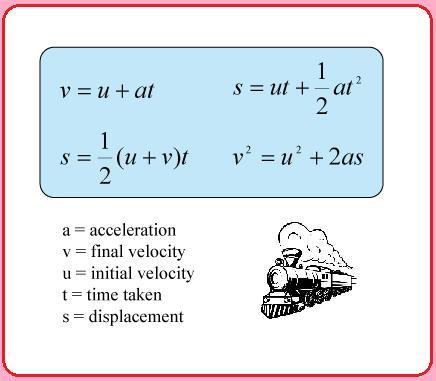
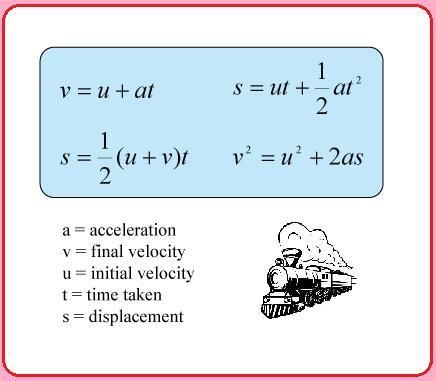
  We have equation of motion, v = u + at, where v is the final velocity, u is the initial velocity, a is the acceleration and t is the time taken.

  When it reaches 32 m/s, v = 32 m/s, u = 0 m/s, a= 1.6 m/s^2 seconds.

   32 = 0 + 1.6 * t

    t = 20 seconds.

  So locomotive's velocity is 32 m/s after 20 seconds and it reaches crossing at 2.4 seconds.

  So after reaching crossing it takes 17.6 seconds to reach velocity 32 m/s.

Alla [95]2 years ago
4 0

It required about 14 seconds after the locomotive leaves the crossing until its speed reaches 32 m/s.

<h3>Further explanation</h3>

Acceleration is rate of change of velocity.

\large {\boxed {a = \frac{v - u}{t} } }

\large {\boxed {d = \frac{v + u}{2}~t } }

<em>a = acceleration (m / s²)v = final velocity (m / s)</em>

<em>u = initial velocity (m / s)</em>

<em>t = time taken (s)</em>

<em>d = distance (m)</em>

Let us now tackle the problem!

<u>Given:</u>

a = 1.6 m/s²

d = 20.0 m

t₁ = 2.4 s

v₂ = 32 m/s

<u>Unknown:</u>

Δt = ?

<u>Solution:</u>

Initially, we calculate the initial speed of the locomotive when entering the crossing.

d = ut + \frac{1}{2}at_1^2

20 = u(2.4) + \frac{1}{2}(1.6)(2.4)^2

20 = u(2.4) + 4.608

u(2.4) = 20 - 4.608

u = 15.392 \div 2.4

u = (481 \div 75) ~ m/s

Next we calculate the total time needed for the locomotive to reach 32 m/s

v_2 = u + at_2

32 = (481 \div 75) + 1.6t_2

t_2 = (32 - \frac{481}{75}) \div 1.6

t_2 \approx 16 ~ seconds

Finally, the time needed for the locomotive to reach a speed of 32 m/s after leaving the crossing is:

\Delta t = t_2 - t_1

\Delta t = 16 - 2.4

\Delta t \approx 14 ~ seconds

<h3>Learn more</h3>
  • Velocity of Runner : brainly.com/question/3813437
  • Kinetic Energy : brainly.com/question/692781
  • Acceleration : brainly.com/question/2283922
  • The Speed of Car : brainly.com/question/568302

<h3>Answer details</h3>

Grade: High School

Subject: Physics

Chapter: Kinematics

Keywords: Velocity , Driver , Car , Deceleration , Acceleration , Obstacle , Speed , Time , Rate , Sperm , Whale , Travel

You might be interested in
"For a first order instrument with a sensitivity of .4 mV/K and a time" constant of 25 ms, find the instrument’s response as a f
ELEN [110]

Answer:

Explanation:

Given that:

For a first order instrument with a sensitivity of .4 mV/K

constant c  = 25 ms = 25 × 10⁻³ s

The initial temperature T_1 = 273 K

The final temperature T_2 = 473 K

The initial volume = 0.4 mV/K × 273 K = 109.2 V

The final volume =  0.4 mV/K × 473 K =  189.2 V

the instrument’s response as a function of time for a sudden temperature increase can be computed as follows:

Let consider y to be the function of time i.e y(t).

So;

y(t) = 109.2  + (189.2 - 109.2)( 1 - \mathbf{e^{-t/c}})mV

y(t) = (109.2 +  80 ( 1 - \mathbf{e^{t/25\times 10^{-3}}})) mV

Plot the response y(t) as a function of time.

The plot of y(t) as a function of time can be seen in the diagram  attached below.

What are the units for y(t)?

The unit for y(t) is mV.

Find the 90% rise time for y(t90) and the error fraction,

The 90% rise time for y(t90) is as follows:

Initially 90% of 189.2 mV = 0.9 ×  189.2 mV

=  170.28 mV

170.28 mV = (109.2 +  80 ( 1 - \mathbf{e^{t/25\times 10^{-3}}})) mV

170.28 mV - 109.2 mV = 80 ( 1 - \mathbf{e^{t/25\times 10^{-3}}})) mV

61.08 mV =  80 ( 1 - \mathbf{e^{t/25\times 10^{-3}}})) mV

0.7635  mV = ( 1 - \mathbf{e^{t/25\times 10^{-3}}})) mV

t = 1.44 × 25  × 10⁻³ s

t = 0.036 s

t = 36 ms

The error fraction = \dfrac{189.2-170.28  }{189.2}

The error fraction = 0.1

The error fraction = 10%
8 0
2 years ago
A straight wire carries a current of 3 A which is in the plane of this page, pointed toward the top of the page. A particle of c
Ilia_Sergeevich [38]

Answer:

The magnitude of the magnetic force exerted on the moving charge by the current in the wire is 2.18 x 10^{-8} N

The direction of the magnetic force exerted on the moving charge by the current in the wire is radially inward

Explanation:

given information:

current, I = 3 A

q_{0} = +6.5 x 10^{-6} C

r = 0.05 m

v = 280 m/s

and direction of the magnetic force exerted on the moving charge by the current in the wire, we can use the following formula:

F = qvB sin θ

where

F = magnetic force (N)

q = electric charge (C)

v = velocity (m/s)

θ = the angle between the velocity and magnetic field

to find B we use

B = μ_{0}I/2πr

μ_{0} = 4π x 10^{-7} or 1.26 x 10^{-6} N/A^{2} , thus

B = 4π x 10^{-7} x 3 / 2π(0.05)

  = 1.2  x  10^{-5} T

Now, we can calculate the magnitude force

F = qvB sin θ

θ = 90°, because the speed and magnetic are perpendicular

F = 6.5 x 10^{-6} x 280  x 1.2 x  10^{-5} sin 90°

  = 2.18 x 10^{-8} N

Using the hand law, the magnetic direction is radially inward

8 0
2 years ago
Given that average speed is distance traveled divided by time, determine the values of m and n when the time it takes a beam of
schepotkina [342]
If speed = distance/time , then time = speed/distance.

So...

Speed of light = 3*10^8(m/s)
Average distance from Earth to Sun = 149.6*10^9(m)

Therefore, t=(3*10^8(m/s))/(149.6*10^9(m))

I hope this was a helpful explanation, please reply if you have further questions about the problem.

Good luck!
5 0
2 years ago
The Earth has mass ME and average radius RE. The Moon has mass MM and the average distance from the center of mass of the moon t
marusya05 [52]

Answer:

Moment of inertia of Earth about its own axis is given as

I = 9.7 \times 10^{37} kg m^2

Explanation:

Since Earth is considered as solid sphere

So we will have

I = \frac{2}{5}M_eR_e^2

so we will have

I = \frac{2}{5}(5.97 \times 10^{24})(6.371 \times 10^6)^2

so we have

I = 9.7 \times 10^{37} kg m^2

3 0
2 years ago
Large capacitors can hold a potentially dangerous charge long after a circuit has been turned off, so it is important to make su
KengaRu [80]

Answer:

93.3x10^-3s

Explanation:

If

Resistance = 1.8 kΩ

Current = 50 mA

Capacitor = 120 μF

Voltage = 140 V

to calculate the discharge current

Applying the formula of discharge current

io=vo/R

io= 140/ 1.8x 10³

= 0.078A

to calculate the time

Applying the formula of current

io= vo/R e-t/RC

50= 140/1800e-t/RC

0.649= e-t/RC

-t/RC= ln( 0.649)

t = 0.432x 120x10^-6x 1800

t=93.3 x 10^-3seconds

8 0
2 years ago
Other questions:
  • A 0.10 kg piece of copper at an initial temperature of 95°c is dropped into 0.20 kg of water contained in a 0.28 kg aluminum cal
    6·1 answer
  • In the Daytona 500 auto race, a Ford Thunderbird and a Mercedes Benz are moving side by side down a straightaway at 71.0 m/s. Th
    12·1 answer
  • A beam of unpolarized light shines on a stack of five ideal polarizers, set up so that the angles between the polarization axes
    12·1 answer
  • What affects the way a projectile performs when it is shot from a firearm?
    10·2 answers
  • forces F1 (east) and F2 are simultaneously applied to a 3.0kg mass. when F2 is east, a=5.0m/s² east and when F2 is west a=1.0m/s
    5·1 answer
  • A black, totally absorbing piece of cardboard of area A = 1.7 cm2 intercepts light with an intensity of 8.1 W/m2 from a camera s
    11·2 answers
  • Global Precipitation Measurement (GPM) is a tool scientists use to forecast weather. Which statements describe GPM? Select three
    7·1 answer
  • BEST ANSWER GETS BRAINLIEST!
    13·1 answer
  • The Type K thermocouple has a sensitivity of about 41 micro-Volts/℃, i.e. for each degree difference in the junction temperature
    6·1 answer
  • I pull the throttle in my racing plane at a = 12.0 m/s2. I was originally flying at v = 100. m/s. Where am I when t = 2.0s, t =
    11·1 answer
Add answer
Login
Not registered? Fast signup
Signup
Login Signup
Ask question!