answer.
Ask question
Login Signup
Ask question
All categories
  • English
  • Mathematics
  • Social Studies
  • Business
  • History
  • Health
  • Geography
  • Biology
  • Physics
  • Chemistry
  • Computers and Technology
  • Arts
  • World Languages
  • Spanish
  • French
  • German
  • Advanced Placement (AP)
  • SAT
  • Medicine
  • Law
  • Engineering
REY [17]
2 years ago
3

Jessica has 12.7 moles of a compound for an experiment. How many particles of the compound does she have?

Chemistry
1 answer:
Sholpan [36]2 years ago
4 0

Number of moles is defined as the ratio of given mass in g to the molar mass.

The mathematical expression is given as:

Number of moles  =\frac{given mass in g}{molar mass}

Number of moles of compound  = 12.7 moles (given)

As, 1 mole of any compound is equal to 6.022\times 10^{23} particles.

where,  6.022\times 10^{23}  is Avogadro number.

Formula for calculating particles is given by:

N= n\times N_{A}

where, N =  number of particles, n = number of moles and N_{A} is Avogadro number.

Put the values,

N= 12.7 moles\times 6.022\times 10^{23}

= 76.4794\times10^{23} or  7.64794\times10^{24}

\simeq 7.65\times10^{24}

Hence, number of particles of the compound is equal to 7.65\times10^{24}


You might be interested in
A balloon filled with 1.22 L of gas at 286 K is heated until the
TiliK225 [7]

Answer: 670K

Explanation:

Given that,

Original volume of gas V1 = 1.22 L

Original temperature T1 = 286 K

New volume V2 = 2.86 L

New temperature T2 = ?

Since volume and temperature are involved while pressure is constant, apply the formula for Charles law

V1/T1 = V2/T2

1.22 L/286 K = 2.86 L/ T2

Cross multiply

1.22 L x T2 = 286 K x 2.86 L

1.22T2 = 817.96

Divide both sides by 1.22

1.22T2/1.22 = 817.96/1.22

T2 = 670.459 K (Round to the nearest whole number as 670 K)

Thus, the temperature of the gas is 670 Kelvin

4 0
2 years ago
Cl2 and N2 react according to the following equation 3Cl2(g) + N2(g) rightarrow 2NCl3(g) If 4 L of a stoichiometric mixture of c
melamori03 [73]

Answer:

Volume of NCl3 is 3L

Explanation:

Avogadro states: All gases at the same volume under temperature and pressure constant have the same number of moles.

The chemical equation is:

3Cl2(g) + N2(g) → 2NCl3(g)

Where 3 moles of chlorine reacts with 1 mole of nitrogen to produce 2 moles of NCl3.

But using Avogadros law we can say:

3L of chlorine and 1L of nitrogen produce 2L of Nitrogen trichloride.

3L of chlorine and 1L of nitrogen: 4L (The stoichiometric mixture)

That means, volume of NCl3 produced is 3L

8 0
2 years ago
Ammonia NH3 may react with oxygen to form nitrogen gas and water.4NH3 (aq) + 3O2 (g) \rightarrow 2 N2 (g) + 6H2O (l)If 2.15g of
bagirrra123 [75]

Answer:

NH3 is the limiting reactant

The % yield is 36.1 %

Explanation:

<u>Step 1: </u>Data given

Mass of NH3 = 2.15 grams

Mass of O2 = 3.23 grams

Molar mass of NH3 = 17.03 g/mol

Molar mass of O2 = 32 g/mol

volume of N2 produced = 0.550 L

Temperature = 295 K

Pressure = 1.00 atm

<u>Step 2:</u> The balanced equation:

4NH3 (aq) + 3O2 (g) → 2 N2 (g) + 6H2O (l)

<u>Step 3:</u> Calculate moles of NH3

Moles NH3 = Mass NH3 / Molar Mass NH3

Moles NH3 = 2.15 grams / 17.03 g/mol

Moles NH3 = 0.126 moles

<u>Step 4:</u> Calculate moles of O2

Moles O2 = 3.23 grams / 32 g/mol

Moles O2 = 0.101 moles

<u>Step 5: </u>Calculate the limiting reactant

For 4 moles NH3 consumed, we need 3 moles of O2 to produce, 2 moles of N2 and 6 moles of H2O

NH3 is the limiting reactant. It will completely be consumed ( 0.126 moles).

O2 is in excess, there will be 3/4 * 0.126 = 0.0945 moles consumed

There will remain 0.101 - 0.945 = 0.0065 moles of O2

<u>Step 6:</u> Calculate moles of N2

For 4 moles NH3 consumed, we need 3 moles of O2 to produce, 2 moles of N2 and 6 moles of H2O

For 4 moles NH3 , we'll have 2 moles of N2 produced

For 0.126 moles NH3 consumed, we'll have 0.063 moles of N2 produced.

<u>Step 7</u>: Calculate volume of N2 produced

p*V = n*R*T

⇒ with p = the pressure of the gas = 1.00 atm

⇒ with V = the volume = TO BE DETERMINED

⇒ with n = the number of moles N2 = 0.063 moles

⇒ with R = the gasconstant = 0.08206 L*atm/K*mol

⇒ with T = the temperature = 295

V = (nRT)/p

V = (0.063*0.08206*295)/1

V = 1.525 L = theoretical yield

<u>Step 8:</u> Calculate the % yield

% yield = actual yield / theoretical yield

% yield = (0.550 L / 1.525 L)*100%

% yield = 36.1 %

4 0
2 years ago
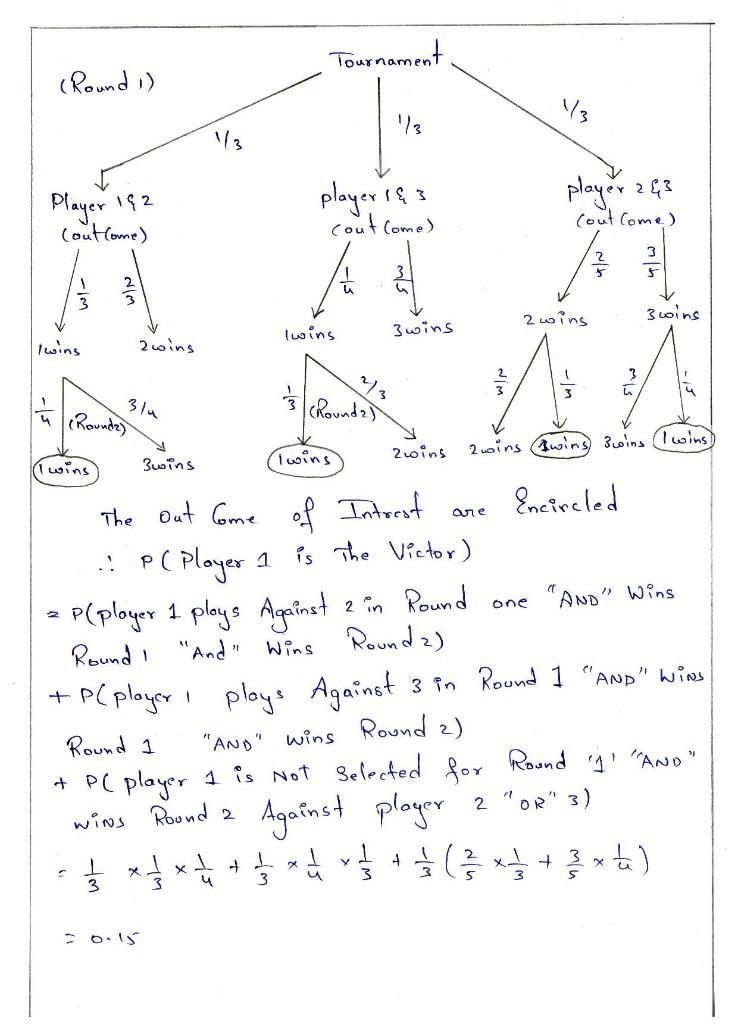
Players 1, 2, 3 are playing a tournament. Two of these three players are randomly chosen to play a game in round one, with the w
Anastasy [175]

The answer & explanation for this question is given in the attachment below.

6 0
2 years ago
Determine how many grams of silver would be produced, if 12.83 x 10^23 atoms of copper react with an excess of silver nitrate. G
AnnyKZ [126]
1) Chemical equation

Cu + 2AgNO3 ---> Cu (NO3)2 + 2Ag

2) molar ratios

1 mol Cu: 2 moles AgNO3 : 1 mol Cu (NO3)2 : 2 mol Ag

3) Convert 12. 83 * 10^23 atoms of Cu in moles

12.83 * 10 ^ 23 atoms / (6.02 * 10^23 atoms / mol) = 2.131 mol Cu

4) Use the proportions

2.131 mol Cu * 2 mol Ag / 1 mol Cu = 4.262 mol Ag

5) Use the atomic mass of silver to convert 4.262 mol in grams

mass = number of moles * atomic mass = 4.262 mol * 107.9 g / mol = 459.9 grams

Answer: 459.9 g
5 0
2 years ago
Other questions:
  • Which of the pairs of molecular structures shown below depict enantiomers (enantiomeric forms) of the same molecule?
    11·1 answer
  • Identify the reaction type for each generic chemical equation
    15·2 answers
  • if 20.g of a radioactive isotope are present at 1:00 pm and 5.0g remain at 2:00 pm, what is the half life of the isotope?
    9·1 answer
  • A sample of the compound MSO4 weighing 0.1131 g reacts with BaCl2 and yields 0.2193 g BaSO4. What is the elemental mass of M and
    5·1 answer
  • If 0.640 g of beautiful blue crystals of azulene is dissolve in 99 g of benzen, the resulting solutions boils at 80.23 degrees c
    15·1 answer
  • Draw the Lewis structure (including resonance structures) for diazomethane (CH2N2)(CH2N2). For each resonance structure, assign
    15·1 answer
  • Chose the statements that are TRUE from the list below Group of answer choices Ions exist alone in nature We add calcium carbona
    5·1 answer
  • Catherine has some seawater. She wants to separate pure water from the seawater.
    8·2 answers
  • What affects the rate at which acid rain reacts with a statue
    6·1 answer
  • elabora un cuadro comparativo como el del modelo , en el que describas los planteamientos filosoficos de tales , anaximenes y an
    15·1 answer
Add answer
Login
Not registered? Fast signup
Signup
Login Signup
Ask question!