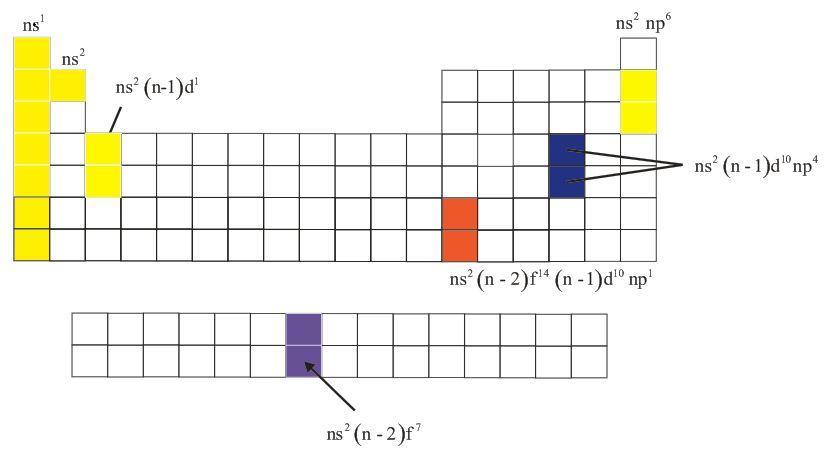
1) The configuration belongs to group 1 (alkali metals).
2) The configuration belongs to group 2 (alkaline earth metals).
3) This electronic configuration belongs to d block elements.
4) The electronic configuration belongs to f block elements.
5) This electronic configuration belongs to p block element after lanthanides.
6) This electronic configuration belongs to p block element.
7) This electronic configuration belongs to group 18 (noble gas).
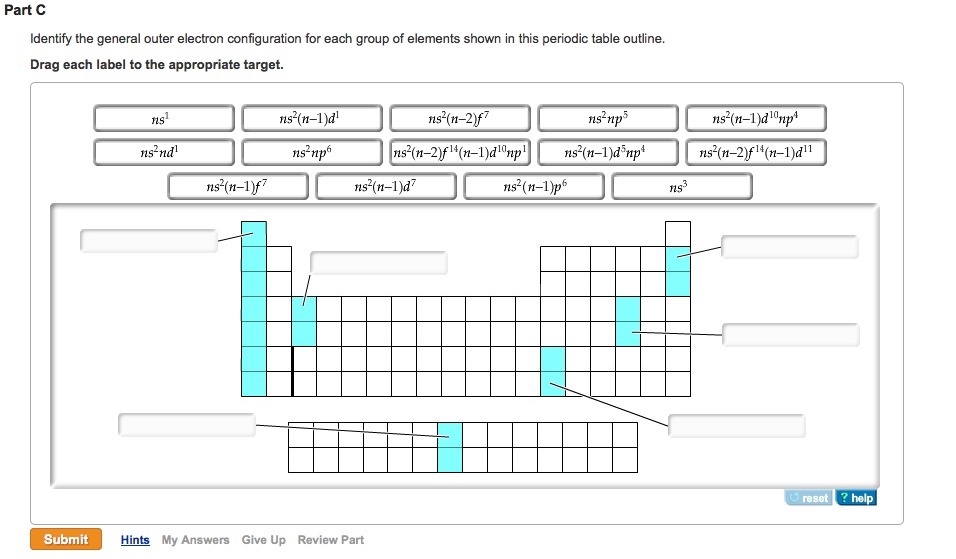
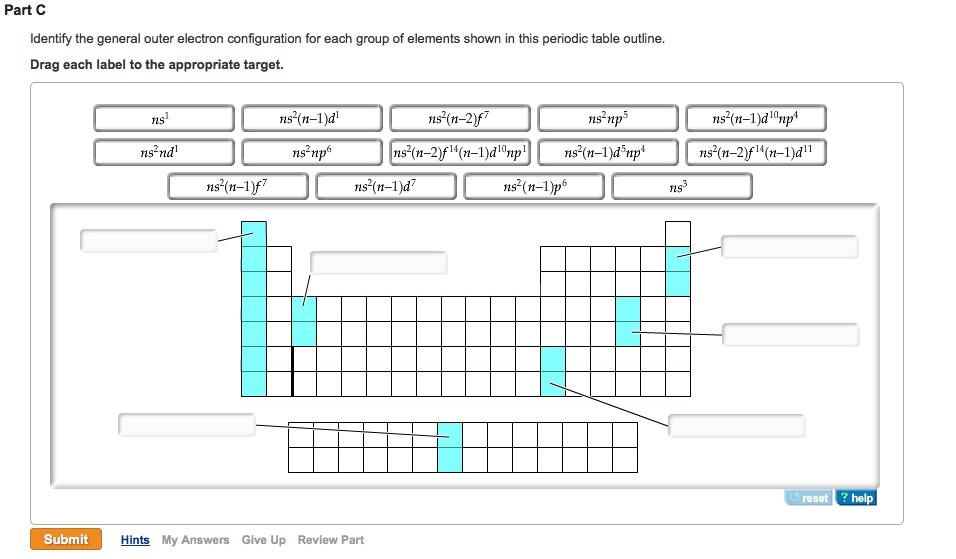
Refer to the attached image for their position in the periodic table.
Further Explanation:
Electronic configuration is the arrangement and representation of electrons in orbitals shells and subshells. It is mainly determined by the atomic number of the atom and is unique to the position of atom in periodic table.
Rules to determine electronic configuration are as follows
1. Aufbau principle
2. Hund’s rule
3. Pauli exclusion principle
Aufbau principle
It states that electrons occupy orbitals in order of their increasing energy level and atomic number. It is also called as building up principle. According to this rule, added electrons first filled the orbital of the lowest energy level and then move to higher energy level orbital in increasing order.
The order of orbital energy level is

Hund’s rule
According to Hund’s rule, electrons first filled up the empty orbitals also called as degenerating orbitals having parallel spins and same energy and then the pairing of electrons takes place.
Pauli Exclusion Principle
It states that each electron has unique set of four quantum numbers. This means the first three quantum numbers are same but the fourth one is different having opposite spins and thus each orbital can have maximum of two electrons having opposite spins.
1) 
This configuration belongs to group 1 (alkali metals).
For example, sodium (Na) is an element with atomic number 11 and it has one valence electron  like all alkali metals.
The electron configuration of sodium atom (Na): 
2) 
This configuration belongs to group 2 (alkaline earth metals).
For example, helium (He) is an element with atomic number 2.
The electron configuration of helium (He) is  .
.
3)

This electronic configuration belongs to d block elements
For example, scandium (Sc) is an element with atomic number 21.
The electron configuration of scandium atom:  .
.
4) 
This electronic configuration belongs to f block elements.
For example, europium (Eu) is an element with atomic number 63.
Electron configuration of europium atom: ![\left[ {{\text{Xe}}} \right]6{s^2}4{f^7}](https://tex.z-dn.net/?f=%5Cleft%5B%20%7B%7B%5Ctext%7BXe%7D%7D%7D%20%5Cright%5D6%7Bs%5E2%7D4%7Bf%5E7%7D) .
.
5)

This electronic configuration belongs to p block element after lanthanides.
For example, thallium (Tl) is an element with atomic number 81.
The electron configuration of thallium atom:  .
.
7) 
This electronic configuration belongs to p block element and group 18 (noble gas).
For example, neon (Ne) is an element (noble gas) with atomic number 10.
The electron configuration of neon atom:  .
.
Learn more:
1. What happens to the reducing agent during redox reaction?:brainly.com/question/2890416
2. Determination of element from given electron configuration: brainly.com/question/9616334
Answer details:
Grade: High School
Subject: Chemistry
Chapter: Electronic configuration of the elements.
Keywords: Neon, selenium, thallium, europium, electronic configuration, noble gas, Aufbau principle, Hund’s rule and pauli’s exclusion principle.