answer.
Ask question
Login Signup
Ask question
All categories
  • English
  • Mathematics
  • Social Studies
  • Business
  • History
  • Health
  • Geography
  • Biology
  • Physics
  • Chemistry
  • Computers and Technology
  • Arts
  • World Languages
  • Spanish
  • French
  • German
  • Advanced Placement (AP)
  • SAT
  • Medicine
  • Law
  • Engineering
forsale [732]
2 years ago
8

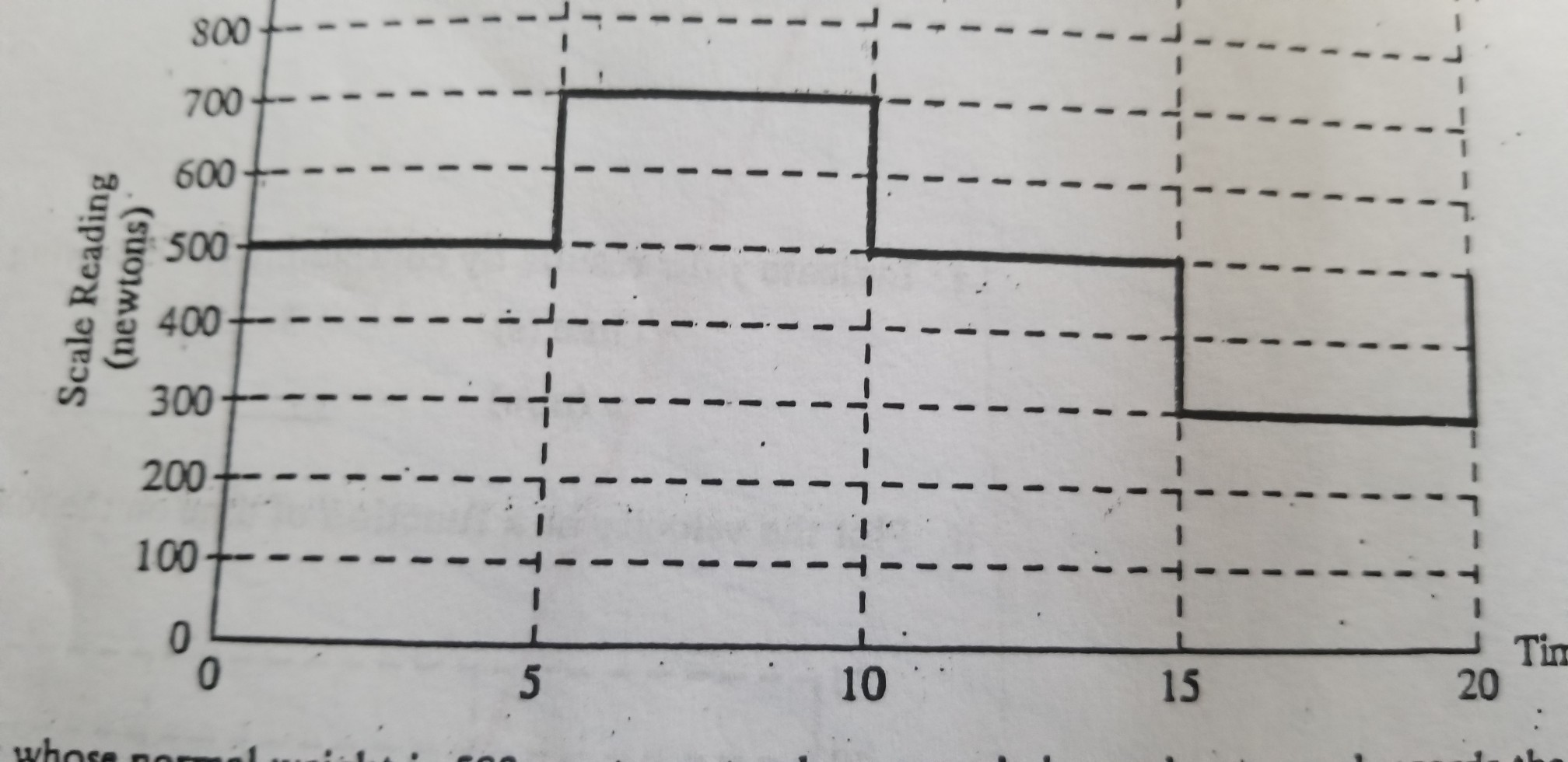
a student whose normal weight is 500 newtons stands on a scale in a elevator. displacement, velocity, and acceleration are upwar

d. What is the acceleration for each 5 second interval.

Physics
2 answers:
ICE Princess25 [194]2 years ago
7 0

Answer:

0-5s   a =  0 m/s^2

5-10 s  a = 3.92m/s^2

10-15s   a = o m/s^2

15-20s  a = -3.92 m/s^2

Explanation:

From the given graph we can have following information:

0-5 seconds - 500 Newtons

5-10 seconds - 700 Newtons

10-15 seconds - 500 Newtons

15-20 seconds - 300 Newtons"

Acceleration for each 5 second is given as

0-5s =  0 m/s^2 because force remain constant  

5-10 s

= f_{net} = ma

= 700-500 =51×a

a = 3.92m/s^2

10-15s = o m/s^2 as force remain constant

15-20s

= f_{net} =ma

= 300-500 = 51a

a = -3.92 m/s^2

Serggg [28]2 years ago
3 0

0-5 seconds and 10-15 seconds: zero acceleration, constant velocity (may be zero)

5-10 seconds: upward acceleration, velocity increasing upwards or decreasing downwards

15-20 seconds: downward acceleration, velocity decreasing upward or increasing downward


You might be interested in
A 13,000-N vehicle is to be lifted by a 25-cm diameter hydraulic piston. What force needs to be applied to a 5.0 cm diameter pis
MaRussiya [10]

Answer:

Explanation:

We shall apply Pascal's Law in fluid mechanics

According to it , pressure is transmitted in liquid from one point to another without any change .

25 cm diameter = 12.5 x 10⁻² m radius

Area = 3.14 x (12.5 x 10⁻²)²

= 490.625 x 10⁻⁴ m²

Pressure by vehicle

Force / area

13000 / 490.625 x 10⁻⁴

= 26.497 x 10⁴ Pa

5 cm diameter = 2.5 x 10⁻² radius

area = 3.14 x (2.5 x 10⁻²)²

= 19.625 x 10⁻⁴ m²

If we assume required force F on this area

Pressure = F / 19.625 x 10⁻⁴ Pa

According to Pascal Law

F / 19.625 x 10⁻⁴  = 26.497 x 10⁴

F = 19.625 x 26.497

= 520 N

4 0
2 years ago
A 40-kg box is being pushed along a horizontal smooth surface. The pushing force is 15 n directed at an angle of 15° below the
Kobotan [32]

Answer:

Acceleration of the crate is 0.362 m/s^2.

Explanation:

Given:

Mass of the box, m = 40 kg

Applied force, F = 15 N

Angle at which the force is applied, (\theta) = 15°

We have to find the magnitude of the acceleration.

Let the acceleration be "a".

FBD is attached with where we can see the horizontal and vertical component of force.

⇒ F_x=Fcos(\theta)          and             ⇒ F_y=Fsin (\theta)

⇒ F_x=15cos(15)                           ⇒ F_y=15sin (15)

⇒ Applying concept of  forces.

⇒ \sum F_x=F_n_e_t =F-f

⇒ F_n_e_t =F-f

⇒ ma =F-f       <em>  ...Newtons second law Fnet = ma</em>

⇒ a =\frac{F-f}{m}              

⇒ Plugging the values.

⇒ a =\frac{15cos(15)-0}{40}     <em>...f is the friction which is zero here.</em>

⇒ a =\frac{14.48}{40}

⇒ a=0.362\ ms^-^2

Magnitude of the acceleration of the crate is 0.362 m/s^2.

4 0
2 years ago
Two billiard balls move toward each other on a table. The mass of the number three ball, m1, is 5 g with a velocity of 3 m/s. Th
Stels [109]

This question deals with the law of conservation of momentum, which basically says that the total momentum in a system must stay the same, provided there are no outside forces. Since you were given the mass and velocity of the two objects you can find the momentum (p=mv) of each and then add them together to find the total momentum of the system before they collide. This total momentum must be the same after they collide.  Since you have the mass and velocity of one of the objects after the collision you can find the its momentum after.  Subtract this from the the system total and you will have the momentum of the other object after the collision.  Now that you know the momentum of the other object you can find its velocity using p=mv and its mass from before.

Be careful with the velocities.  They are vectors, so direction matters.  Typically moving to the right is positive (+) and moving to the left is negative (-).  It is not clear from your question which direction the objects are moving before and after the collision.

6 0
2 years ago
Read 2 more answers
A 44-cm-diameter water tank is filled with 35 cm of water. A 3.0-mm-diameter spigot at the very bottom of the tank is opened and
cricket20 [7]

Answer:

The frequency f = 521.59 Hz

The rate at which the frequency is changing = 186.9 Hz/s

Explanation:

Given that :

Diameter of the tank = 44 cm

Radius of the tank = \frac{d}{2} =\frac{44}{2} = 22 cm

Diameter of the spigot = 3.0 mm

Radius of the spigot = \frac{d}{2} =\frac{3.0}{2} = 1.5 mm

Diameter of the cylinder = 2.0 cm

Radius of the cylinder = \frac{d}{2} = \frac{2.0}{2} = 1.0 cm

Height of the cylinder = 40 cm = 0.40 m

The height of the water in the tank from the spigot = 35 cm = 0.35 m

Velocity at the top of the tank = 0 m/s

From the question given, we need to consider that  the question talks about movement of fluid through an open-closed pipe; as such it obeys Bernoulli's Equation and the constant discharge condition.

The expression for Bernoulli's Equation is as follows:

P_1+\frac{1}{2}pv_1^2+pgy_1=P_2+\frac{1}{2}pv^2_2+pgy_2

pgy_1=\frac{1}{2}pv^2_2 +pgy_2

v_2=\sqrt{2g(y_1-y_2)}

where;

P₁ and P₂ = initial and final pressure.

v₁ and v₂ = initial and final fluid velocity

y₁ and y₂ = initial and final height

p = density

g = acceleration due to gravity

So, from our given parameters; let's replace

v₁ = 0 m/s ; y₁ = 0.35 m ; y₂ = 0 m ; g = 9.8 m/s²

∴ we have:

v₂ = \sqrt{2*9.8*(0.35-0)}

v₂ = \sqrt {6.86}

v₂ = 2.61916

v₂ ≅ 2.62 m/s

Similarly, using the expression of the continuity for water flowing through the spigot into the cylinder; we have:

v₂A₂ = v₃A₃

v₂r₂² = v₃r₃²

where;

v₂r₂ = velocity of the fluid and radius at the spigot

v₃r₃ = velocity of the fluid and radius at the cylinder

v_3 = \frac{v_2r_2^2}{v_3^2}

where;

v₂ = 2.62 m/s

r₂ = 1.5 mm

r₃ = 1.0 cm

we have;

v₃ = (2.62  m/s)* (\frac{1.5mm^2}{1.0mm^2} )

v₃ = 0.0589 m/s

∴ velocity  of the fluid in the cylinder =  0.0589 m/s

So, in an open-closed system we are dealing with; the frequency can be calculated by using the expression;

f=\frac{v_s}{4(h-v_3t)}

where;

v_s = velocity of sound

h = height of the fluid

v₃ = velocity  of the fluid in the cylinder

f=\frac{343}{4(0.40-(0.0589)(0.4)}

f= \frac{343}{0.6576}

f = 521.59 Hz

∴ The frequency f = 521.59 Hz

b)

What are the rate at which the frequency is changing (Hz/s) when the cylinder has been filling for 4.0 s?

The rate at which the frequency is changing is related to the function of time (t) and as such:

\frac{df}{dt}= \frac{d}{dt}(\frac{v_s}{4}(h-v_3t)^{-1})

\frac{df}{dt}= -\frac{v_s}{4}(h-v_3t)^2(-v_3)

\frac{df}{dt}= \frac{v_sv_3}{4(h-v_3t)^2}

where;

v_s (velocity of sound) = 343 m/s

v₃ (velocity  of the fluid in the cylinder) = 0.0589 m/s

h (height of the cylinder) = 0.40 m

t (time) = 4.0 s

Substituting our values; we have ;

\frac{df}{dt}= \frac{343*0.0589}{4(0.4-(0.0589*4.0))^2}

= 186.873

≅ 186.9 Hz/s

∴ The rate at which the frequency is changing = 186.9 Hz/s  when the cylinder has been filling for 4.0 s.
8 0
2 years ago
The electric force between two charged objects of charge +Q0 that are separated by a distance R0 is F0. The charge of one of the
vovikov84 [41]

Answer:

F=3F_o(\frac{R_o}{R_{o2}})^2

Explanation:

This problem is approached using Coulomb's law of electrostatic attraction which states that the force F of attraction or repulsion between two point charges, Q_1 and Q_2 is directly proportional to the product of the charges and inversely proportional to the square of their distance of separation R.

F=\frac{kQ_1Q_2}{R^2}..................(1)

where k is the electrostatic constant.

We can make k the subject of formula  as follows;

k=\frac{FR^2}{Q_1Q_2}...........(2)

Since k is a constant, equation (2) implies that the ratio of the product of the of the force and the distance between two charges to the product of charges is a constant. Hence if we alter the charges or their distance of separation and take the same ratio as stated in equation(2) we will get the same result, which is k.

According to the problem, one of the two identical charges was altered from Q_o to 3Q_o and their distance of separation from R_o to R_{o2}, this also made the force between them to change from F_o to F_{o2}. Therefore as stated by equation (2), we can write the following;

\frac{F_oR_o^2}{Q_o*Q_o}=\frac{F_{o2}R_{o2}^2}{3Q_o*Q_o}.............(3)

Therefore;

\frac{F_oR_o^2}{Q_o^2}=\frac{F_{o2}R_{o2}^2}{3Q_o^2}.............(4)

From equation (4) we now make the new force F_{o2} the subject of formula as follows;

{F_oR_o^2}*{3Q_o^2}=F_{o2}R_{o2}^2*{Q_o^2}

Q_o then cancels out from both side of the equation, hence we obtain the following;

3{F_oR_o^2}=F_{o2}R_{o2}^2.............(4)

From equation (4) we can now write the following;

F_{o2}=\frac{3F_oR_o^2}{R_{o2}^2}

This could also be expressed as follows;

F_{o2}=3F_o(\frac{R_o}{R_{o2}})^2

3 0
2 years ago
Other questions:
  • a very thin layer of gold plating was placed on a metal tray that measures 25.22 cm by 13.22cm. The gold plating increased the m
    8·1 answer
  • The best way to cool soft and thick foods (such as beans, sauce or chili) when using the refrigerator is?
    11·2 answers
  • What common laboratory measuring device will we likely always use in experiments that measure enthalpy changes?
    13·1 answer
  • The connections of many simple pieces in the brain is evidence of the:
    11·2 answers
  • A boy throws a 15 kg ball at 4.7 m/s to a 65 kg girl who is stationary and standing on a skateboard. After catching the ball, th
    13·1 answer
  • In a physics laboratory experiment, a coil with 200 turns enclosing an area of 12cm2 is rotated in 0.040 s from a position where
    7·1 answer
  • 7. A mother pushes her 9.5 kg baby in her 5kg baby carriage over the grass with a force of 110N @ an angle
    5·1 answer
  • Maria throws an apple vertically upward from a height of 1.3 m with an initial velocity of +2.8 m/s. Will the apple reach a frie
    13·1 answer
  • Calculate the current through a 10.0-m long 22-gauge nichrome wire with a radius of 0.321 mm if it is connected across a 12.0-V
    11·1 answer
  • 9ma electric current is flowing through a conducting wire , then the number of electron passing through it in 3 min is
    12·1 answer
Add answer
Login
Not registered? Fast signup
Signup
Login Signup
Ask question!
