answer.
Ask question
Login Signup
Ask question
All categories
  • English
  • Mathematics
  • Social Studies
  • Business
  • History
  • Health
  • Geography
  • Biology
  • Physics
  • Chemistry
  • Computers and Technology
  • Arts
  • World Languages
  • Spanish
  • French
  • German
  • Advanced Placement (AP)
  • SAT
  • Medicine
  • Law
  • Engineering
Kobotan [32]
2 years ago
9

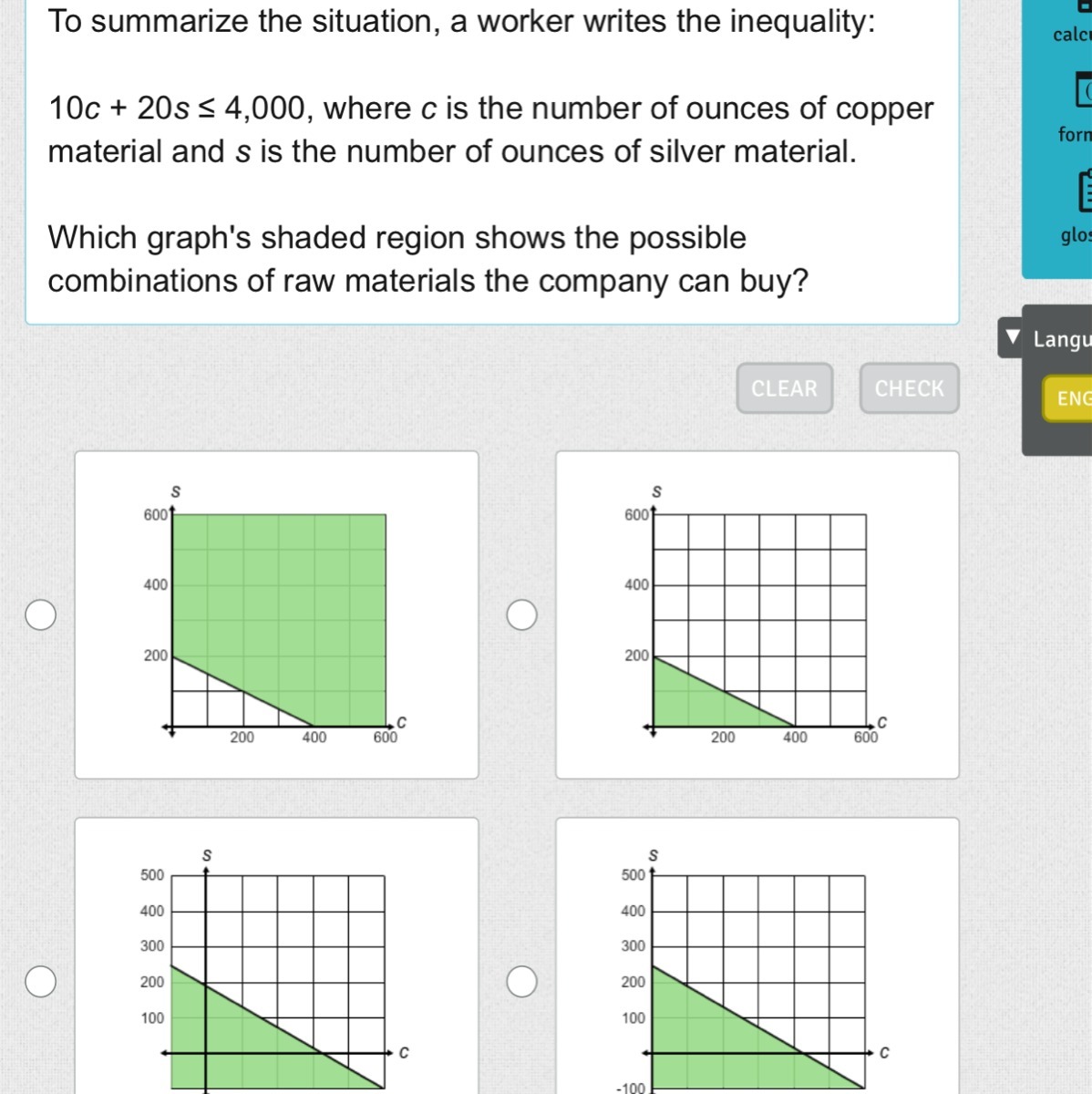
An electronics company can spend no more than $4,000 on raw materials for circuit boards. The raw materials cost $10 per ounce f

or copper and $20 per ounce for silver. To summarize the situation, a worker writes the inequality: 10c + 20s ≤ 4,000, where c is the number of ounces of copper material and s is the number of ounces of silver material. Which graph's shaded region shows the possible combinations of raw materials the company can buy?

Mathematics
1 answer:
inysia [295]2 years ago
7 0

Answer:

Option B (top of the 2nd column) is the correct answer.

Step-by-step explanation:

An electronics company can spend no more than $4,000 on raw materials for circuit boards.

The raw materials cost $10 per ounce for copper and $20 per ounce for silver.

Let us assume that,

c = the number of ounces of copper,

s = the number of ounces of silver.

The inequalities will be,

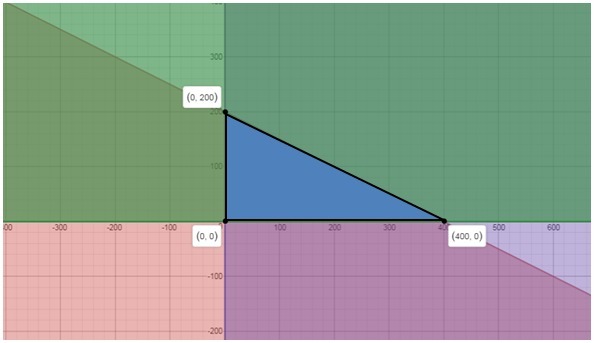
10c + 20s \le4000

and

c\ge 0,\\\\s\ge 0

As the number of ounces used can not be in negative.

Plotting the graph and drawing the shaded region by origin test, we get the shaded region as attached below.

Therefore, option B (top of the 2nd column) is the correct answer.

You might be interested in
Thirteen is at least the difference of a number v and 1
Digiron [165]

Answer: 13 ≥  v - 1

Step-by-step explanation: The equation above represents the situation; Thirteen is at least the difference of a number v and 1

4 0
2 years ago
The table represents a linear function. A two column table with six rows. The first column, x, has the entries, negative 2, nega
Radda [10]

Answer: The slope is 3

Step-by-step explanation:

For each unit of run in the x-values, there is an increase of 3 in the y-values. Slope is Rise over Run so 3/1 = 3

8 0
2 years ago
Read 2 more answers
The coordinates of the vertices of △PQR are P(1, 4) , Q(2, 2) , and R(−2, 1) . The coordinates of the vertices of △P′Q′R′ are P′
sveticcg [70]

ANSWER


The correct  answer is B


<u>EXPLANATION</u>

If we analyse the coordinates carefully, you realize there is a mapping of

(x,y)\rightarrow(-x,y)

This is a reflection in the y-axis.


Since the transformation is a reflection, the shape is preserved. Therefore, the image triangle P'Q'R' of triangle

PQR are congruent.


5 0
2 years ago
Read 2 more answers
6.5% of people in the U.S. Have A- blood type. You randomly select 6 Americans and ask them if their blood type is A-. a) Find t
Keith_Richards [23]

Answer:

a) 7.54189*10^-8

b) 0.99999999

c) E ( X ) = 0.39 , s ( X ) = 0.604

Step-by-step explanation:

Solution:-

- We will assume the proportion of people with A- blood group is independent and remains constant for a fairly small sample of n = 6 Americans selected at random.

- We will denote a random variable X = The number of americans out of 6 that have blood group type A-.

- The random variable is assumed to follow binomial distribution.

- The probability of success is the proportion of people in U.S that have blood group type A-, p = 0.065:

                        X ~ Bin ( 6 , 0.065 )

Where, r represents the number of americans out of selected 6 have blood group A-. The pmf of a binomial variate is given as:

                       P ( X = r ) = nCr * ( p ) ^r * ( 1 - p ) ^ ( n - r )

a) Find the probability that all 6 are type A-

- We will pmf given above and set r = 6. And evaluate the resulting probability:

                     P ( X = 6 ) = 6C6 * ( p )^6 * ( 1  - p ) ^ ( 0 )

                                      = p^6

                                      = ( 0.065 )^6  

                                      = 7.54189*10^-8

b) Find the probability that at most 4 of them are type A-

- We will pmf given above and evaluate the following expression:

                     P ( X ≤ 4 ) = 1 - P ( X = 5 ) - P ( X = 6 )

                     P ( X ≤ 4 ) = 1 - 6C5 * ( p )^5 * ( 1  - p ) ^ ( 1 ) - p^6

                                      = 1 - 6*(0.065)^5 ( 0.935 ) - 0.065^6

                                      = 1 - 6.50923*10^-8 - 7.54189*10^-8        

                                      = 0.99999999          

c) Find the mean and standard deviation.

- The mean E ( X ) of the defined random variable distributed binomially is given by:

                     E ( X ) = n*p = 6*0.065 = 0.39 people

- The mean s( X ) of the defined random variable distributed binomially is given by:


                    s ( X ) = √n*p*q = √(6*0.065*0.935) = 0.604

5 0
2 years ago
A polynomial function has a root of -4 with multiplicity of 4, a root of -1 with multiplicity of 3, and a root of 5 with multipl
Dmitrij [34]

Answer:

To draw this graph, we start from the left in quadrant 3 drawing the curve to -4 on the x-axis to touch it but not cross. We continue back down and curve back around to cross the x-axis at -1. We continue up past -1 and curve back down to 5 on the x-axis. We touch here without crossing and draw the rest of our function heading back up. It should form a sideways s shape.


Step-by-step explanation:


A polynomials is an equation with many terms whose leading term is the highest exponent known as degree. The degree or exponent tells how many roots exist. These roots are the x-intercepts.


This polynomial has roots -4, -1, and 5. This means the graph must touch or cross through the x-axis at these x-values. What determines if it crosses the x-axis or the simple touch it and bounce back? The even or odd multiplicity - how many times the root occurs.


In this polynomial:


Root -4 has even multiplicity of 4 so it only touches and does not cross through.


Root -1 has odd multiplicity of 3 so crosses through.


Root 5 has even multiplicity of 6 so it only touches and does not cross through.


Lastly, what determines the facing of the graph (up or down) is the leading coefficient. If positive, the graph ends point up. If negative, the graph ends point down. All even degree graphs will have this shape.


To draw this graph, we start from the left in quadrant 3 drawing the curve to -4 on the x-axis to touch it but not cross. We continue back down and curve back around to cross the x-axis at -1. We continue up past -1 and curve back down to 5 on the x-axis. We touch here without crossing and draw the rest of our function heading back up. It should form a sideways s shape.

7 0
2 years ago
Read 2 more answers
Other questions:
  • The clean up hitter on a baseball tean batted 1/3 of the runs the team scored. The hitter batted in 3 runs. Select the equation
    7·1 answer
  • The number of guests per month at a large resort is given in the table below, where f(x) is the number of guests, in hundreds, x
    5·2 answers
  • At a gas station the price of gas is $2.40 a gallon. Draw a graph to represent the relationship between the cost of gas and the
    12·1 answer
  • Which represents the solution(s) of the graphed system of equations, y = x2 + x – 2 and y = 2x – 2? (–2, 0) and (0, 1) (0, –2) a
    12·2 answers
  • A frequent flyer was interested in the relationship between dollars spent on flying and the distance flown. She sampled 20 frequ
    12·1 answer
  • Find the geometric mean of 16 and 25. Round your answer to the nearest tenth
    9·1 answer
  • Shenika factored the polynomial completely. What is the value of A?
    15·2 answers
  • Terry has a number cube that is numbered from 1 to 6. She rolls the cube 50 times. Which equation can be used to predict the num
    10·1 answer
  • A contractor has submitted bids on three state jobs: an office building, a theater, and a parking garage. State rules do not all
    9·1 answer
  • Use the hundredth grids below to answer the questions. The first two hundredth grids show Sophia's work. The second two hundredt
    5·2 answers
Add answer
Login
Not registered? Fast signup
Signup
Login Signup
Ask question!