answer.
Ask question
Login Signup
Ask question
All categories
  • English
  • Mathematics
  • Social Studies
  • Business
  • History
  • Health
  • Geography
  • Biology
  • Physics
  • Chemistry
  • Computers and Technology
  • Arts
  • World Languages
  • Spanish
  • French
  • German
  • Advanced Placement (AP)
  • SAT
  • Medicine
  • Law
  • Engineering
OLEGan [10]
2 years ago
3

How is the modern atomic model similar to bohr's model?

Chemistry
1 answer:
Alinara [238K]2 years ago
8 0

Bohr thought that electrons orbited the nucleus in circular paths; whereas in the modern view atomic electron structure is more like 3D standing waves. Bohr built upon Rutherford's model of the atom. ... He believed that electrons moved around the nucleus in circular orbits with quantised potential and kinetic energies.


You might be interested in
The partial pressures of CH 4, N 2, and O 2 in a sample of gas were found to be 183 mmHg, 443 mmHg, and 693 mmHg, respectively.
Natasha2012 [34]

Answer:

Mole fraction N₂ = 0.336

Explanation:

Mole fraction of a gas can be determined in order to know the partial pressure of the gas, and the total pressure, in the mixture.

Total pressure in the mixture: Sum of partial pressure from all the gases

Total pressure = 183 mmHg + 443 mmHg + 693 mmHg =1319 mmHg

Mole fraction N₂ = Partial pressure N₂ / Total pressure

443 mmHg / 1319 mmHg = 0.336

Remember that mole fraction does not carry units

8 0
2 years ago
Read 2 more answers
If 6.00 g of CaCl2 • 2 H2O and 5.50 g of Na2CO3 are allowed to react in aqueous solution, what mass of CaCO3 will be produced? P
Andre45 [30]

Answer:

6.00 g CaCl₂ .2H₂O /1 × 1 mol CaCl₂ .2H₂O / 147 g CaCl₂ .2H₂O × 0.04 mol CaCO₃/ 0.04 mol of  CaCl₂ .2H₂O  × 100 g CaCO₃ /  1 mole CaCO₃ = 4 g

5.50 g Na₂CO₃   /1 × 1 Na₂CO₃  / 106 g Na₂CO₃ × 0.05 mol CaCO₃/ 0.05 mol of Na₂CO₃  × 100 g CaCO₃ /  1 mole CaCO₃ = 5 g

Explanation:

Given data:

Mass of CaCl₂.2H₂O = 6.00 g

Mass of Na₂CO₃ = 5.50 g

Mass of CaCO₃ produced = ?

Solution:

Number of moles of CaCl₂.2H₂O.

Number of moles = mass/ molar mass

Number of moles = 6.00 g/ 147 g/ mol

Number of moles = 0.04 mol

Number of moles of Na₂CO₃:

Number of moles = mass/ molar mass

Number of moles = 5.50 g/ 106 g/ mol

Number of moles = 0.05 mol

Chemical equation:

CaCl₂  +  Na₂CO₃   →   CaCO₃ + 2NaCl

Now we will compare the moles of CaCO₃  with Na₂CO₃  and CaCl₂ through balanced chemical equation .

                      CaCl₂              :               CaCO₃

                             1                :                1

                       0.04               :            0.04

Mass of CaCO₃:

Mass = number of moles × molar mass

Mass = 0.04 mol× 100 g/mol

Mass = 4 g

6.00 g CaCl₂ .2H₂O /1 × 1 mol CaCl₂ .2H₂O / 147 g CaCl₂ .2H₂O × 0.04 mol CaCO₃/ 0.04 mol of  CaCl₂ .2H₂O  × 100 g CaCO₃ /  1 mole CaCO₃ = 4 g

                     Na₂CO₃            :            CaCO₃

                          1                   :                1

                       0.05               :            0.05

Mass of CaCO₃:

Mass = number of moles × molar mass

Mass = 0.05 mol× 100 g/mol

Mass = 5 g

5.50 g Na₂CO₃   /1 × 1 Na₂CO₃  / 106 g Na₂CO₃ × 0.05 mol CaCO₃/ 0.05 mol of Na₂CO₃  × 100 g CaCO₃ /  1 mole CaCO₃ = 5 g

                     

5 0
2 years ago
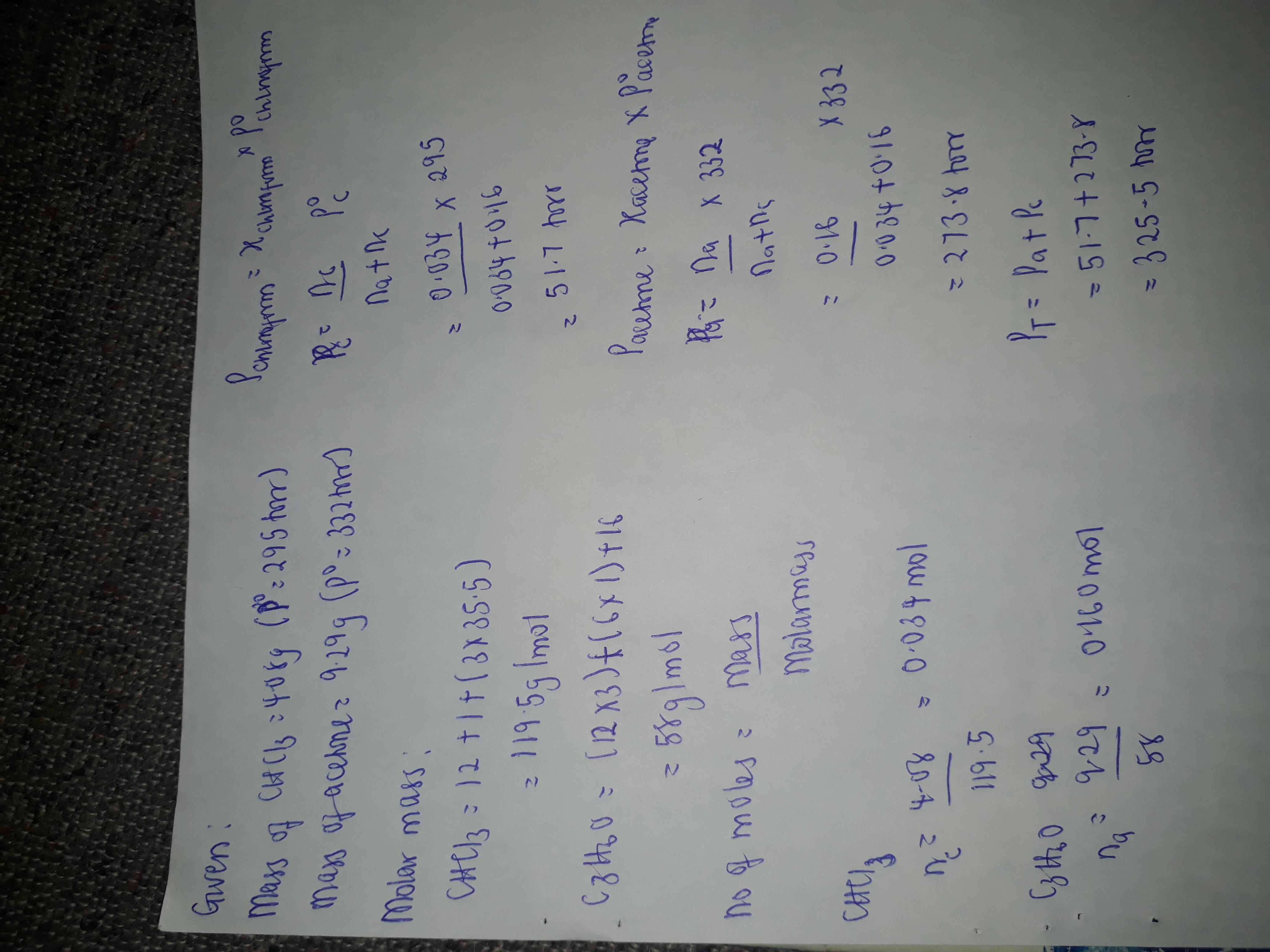
A solution contains 4.08 g of chloroform (CHCl3) and 9.29 g of acetone (CH3COCH3). The vapor pressures at 35 ∘C of pure chlorofo
Sergeeva-Olga [200]

Explanation:

Below is an attachment containing the solution.

8 0
2 years ago
Read 2 more answers
How many grams of water would there be in 100.0g of hydrate? How many moles?
IceJOKER [234]
The calculation for the amount of water present in the given amount of hydrate is shown below,
            amount water = (100 g hydrate) x (0.347 g H2O / 0.946 g hydrate)
                                  = 36.68 g
Thus, the amount of water present in the hydrate is approximately 36.68 g. 
6 0
2 years ago
Read 2 more answers
What is the number of moles of solute in 650ml of a 0.40M solution?
Doss [256]
V=650 ml = 0.65 l

c=0.4 mol/l

n=vc

n=0.65 l * 0.4 mol/l = 0.26 mol
8 0
2 years ago
Read 2 more answers
Other questions:
  • Which of these elements has the least attraction for electrons ina chemical bond?(1) oxygen (3) nitrogen(2) fluorine (4) chlorin
    7·2 answers
  • What is the percent by mass of sulfur in sulfur dioxide?a.32b.33c.50d.67?
    10·1 answer
  • In the reaction C + O2 → CO2, 18 g of carbon react with oxygen to produce 72 g of carbon dioxide. What mass of oxygen would be n
    15·1 answer
  • 7. How many moles of argon are there in 20.0 L, at 25 degrees Celsius and 96.8 kPa?
    11·2 answers
  • Which of the following reactions will not occur as written? Which of the following reactions will not occur as written? Sn (s) +
    8·2 answers
  • What explains the observation that FADH2 oxidation yields one less ATP than NADH oxidation by the Electron Transport System
    6·1 answer
  • Zinc metal is added to hydrochloric acid to generate hydrogen gas and is collected over a liquid whose vapor pressure is the sam
    7·1 answer
  • A potential energy diagram is shown. A graph is plotted with Potential Energy in KJ on the y axis and Reaction Pathway on the x
    6·1 answer
  • A student has two samples of NaCl, each one from a different source. Assume that the only potential contaminant in each sample i
    9·1 answer
  • gypsum is insoluble in water. you are asked to purify a sample of gypsum that is contaminated with a soluble salt.
    6·1 answer
Add answer
Login
Not registered? Fast signup
Signup
Login Signup
Ask question!