answer.
Ask question
Login Signup
Ask question
All categories
  • English
  • Mathematics
  • Social Studies
  • Business
  • History
  • Health
  • Geography
  • Biology
  • Physics
  • Chemistry
  • Computers and Technology
  • Arts
  • World Languages
  • Spanish
  • French
  • German
  • Advanced Placement (AP)
  • SAT
  • Medicine
  • Law
  • Engineering
Inessa [10]
2 years ago
3

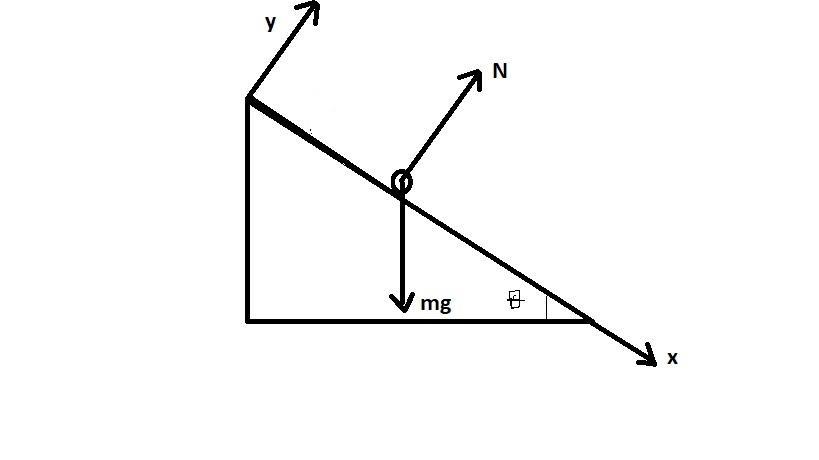
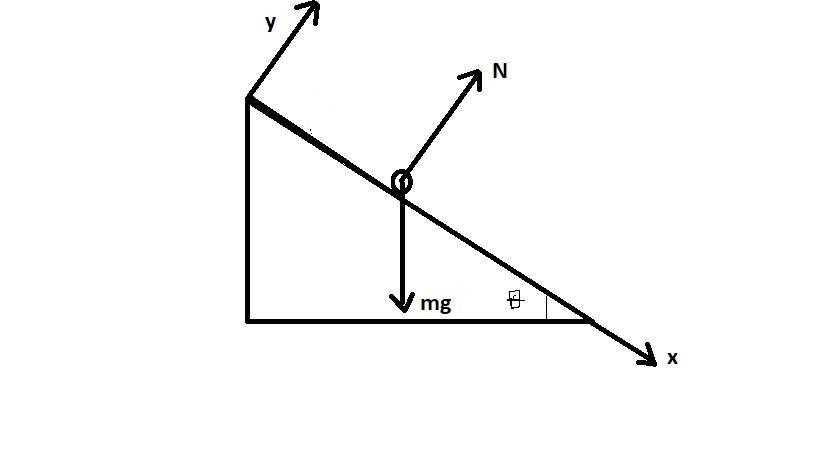
Matt has a mass of 37 kg and skis down a hill with no friction or air resistance. The hill has an angle of 24 degrees. The free-

body diagram is show below.
a. Write the expression for the net force in the x-direction.

b. Write the expression for the net force in the y-direction.

c. What is the acceleration in the y-direction?

d. What is the normal force acting on him?

Physics
2 answers:
Pie2 years ago
6 0

a) mg cos(24)-N=0

b) mg sin(24)=ma

c) Since there is no original figure, in my coordinates a.y=0.

d) According to a): N=331.25 N

LUCKY_DIMON [66]2 years ago
4 0

Answer:

a) Along X direction since it can not move so Net force in x direction must be ZERO

F_{net} = F_n - mgcos\theta

since a = 0

F_n - mgcos\theta = 0

b)For Y direction net force is only due to component of the weight of object along the inclined plane

mgsin\theta = F_{net}

m a_y = mgsin\theta

c) for finding acceleration in Y direction we can use above equation

m a_y = mg sin\theta

divide both sides by mass

a_y = g sin\theta

a_y = 9.8 sin24 = 3.98 m/s^2

d) For finding Normal force we can use the expression of force in X direction

0 = F_n - mg cos\theta

0 = F_n - (37\times 9.8\times cos24)

0 = F_n - 331.25

F_n = 331.25 N

You might be interested in
Which, if any, of the following statements concerning the work done by a conservative force is NOT true? All of these statements
masya89 [10]

Answer:

When the starting and ending points are the same, the total work is zero.

Explanation:

option ( D )correct

A force is said to be conservative when the work done by the force in moving a particle from a point A to a point B is independent of the path followed between A and B and is the same for all the paths. The work done depends only on the particles initial and final positions. And when the initial and final position in conservative field are same the work done is said to be zero.

8 0
2 years ago
Consider the following:
pychu [463]

Answer:

They have different wavelengths.

They have different frequencies.

They propagate at different speeds through non-vacuum media depending on both their frequency and the material in which they travel.

Explanation:

The complete question is

Consider the following:

a) radio waves emitted by a weather radar system to detect raindrops and ice crystals in the atmosphere to study weather patterns;

b) microwaves used in communication satellite transmissions;

c) infrared waves that are perceived as heat when you turn on a burner on an electric stove;

d) the multicolor light in a rainbow;

e) the ultraviolet solar radiation that reaches the surface of the earth and causes unprotected skin to burn; and

f) X rays used in medicine for diagnostic imaging.

Which of the following statements correctly describe the various forms of EM radiation listed above?

check all that apply to the above

They have different wavelengths.

They have different frequencies.

They propagate at different speeds through a vacuum depending on their frequency.

They propagate at different speeds through non-vacuum media depending on both their frequency and the material in which they travel.

They require different media to propagate.

All the above phenomena are due the electromagnetic wave spectrum. Electromagnetic waves travel at a constant speed of 3 x 10^8 m/s in a vacuum. Within the spectrum, the different types of electromagnetic waves exists in different band range of frequencies and wavelengths unique to each of the waves, and the energy they carry. When these waves enter a non-vacuum medium, their speed change, depending on the nature of the material of the medium, and the frequency or the wavelength of the incoming wave.
5 0
2 years ago
A person driving a car suddenly applies the brakes. The car takes 4 s to come to rest while traveling 20 m at constant accelerat
Zinaida [17]

Answer:

Yes we can find the initial velocity of car without finding acceleration.

u = 10 m/s.

Explanation:

Given that

s=20 m

Car takes 4 s to come in rest.

We know that when acceleration is constant then we can apply motion equation

v=u+at        ----------1

s=ut+\dfrac{1}{2}at^2       ------2

From equation 1 and 2

s=ut+\dfrac{1}{2}t^2\left (\dfrac{v-u}{t} \right )

So we can say that

s= \left(\dfrac{v+u}{2}\right)t

Given that the velocity of car at final condition will be zero (v=0)

s= \left(\dfrac{0+u}{2}\right)t

s= \left(\dfrac{u}{2}\right)t

From the above equation we can find the initial velocity of car without finding the acceleration

20= \dfrac{u}{2}\times 4

u = 10 m/s

7 0
2 years ago
A parachute works because the canvas of the parachute is acted upon by __________.
Ne4ueva [31]
The question is asking to choose among the following choices that could complete the question about the inertia, base on my research and further investigation, the possible answer would be letter B. Gravity. I hope you are satisfied with my answer and feel free to ask for more 
8 0
2 years ago
Read 2 more answers
The sun transfers energy to the earth by radiation at a rate of approximately 1.00 kW per square meter of surface.
Mashutka [201]

Answer:

1320336992.2512 m²

1320.33 kilometers or 509.79 miles

Explanation:

Energy transferred by the sun

W=0.24\times 1\times 10^3=240\ W/m^2

Energy required by the United States is 1\times 10^{19}\ J/yr (assumed)

Power

P=\frac{E}{t}\\\Rightarrow P=\frac{1\times 10^{19}}{365.25\times 24\times 3600}\\\Rightarrow P=316880878140.2895\ W

Area

A=\frac{P}{W}\\\Rightarrow A=\frac{316880878140.2895}{240}\\\Rightarrow A=132033699.2512\ m^2

Area of the solar collector would be 1320336992.2512 m²

Converting to km²

1\ m^2=\frac{1}{1000\times 1000}\ km^2

1320336992.2512\ m^2=1320336992.2512\times \frac{1}{1000\times 1000}\ km^2=1320.33\ km^2

Converting to mi²

1\ m^2=\frac{1}{1609.34\times 1609.34}\ mi^2

1320336992.2512\ m^2=1320336992.2512\times \frac{1}{1609.34\times 1609.34}\ mi^2=509.79\ mi^2

Each side of the square would be 1320.33 kilometers or 509.79 miles

4 0
2 years ago
Other questions:
  • Fill in the blanks. The electrostatic force between two objects is proportional to the ____________________ of the distance ____
    5·2 answers
  • The following represents a process used to assemble a chair with an upholstered seat. stationsa, b, and c make the seat; station
    14·1 answer
  • What meal can you get from standing on a hot sidewalk riddle answer?
    9·1 answer
  • a student wants to push a box of books with the mass of 50 kg in 3 m horizontally towards the location of the shelves where the
    11·1 answer
  • To practice Problem-Solving Strategy 30.1: Inductors in Circuits. A circuit has a 1 V battery connected in series with a switch.
    6·1 answer
  • 13. An aircraft heads North at 320 km/h rel:
    5·1 answer
  • the millersburg ferry (m=13000.0 kg loaded) puts its engines in full reverse and stops in 65 seconds. if the speed before brakin
    14·1 answer
  • Stella is driving down a steep hill. She should keep her car __________ to help _________. a. light, it speed up in a higher b.
    14·2 answers
  • Rod A has twice the diameter of rod B, but both are made of iron and have the same initial length. Both rods are now subjected t
    11·1 answer
  • If John mows 11.5 meters of lawn from east
    12·1 answer
Add answer
Login
Not registered? Fast signup
Signup
Login Signup
Ask question!
