answer.
Ask question
Login Signup
Ask question
All categories
  • English
  • Mathematics
  • Social Studies
  • Business
  • History
  • Health
  • Geography
  • Biology
  • Physics
  • Chemistry
  • Computers and Technology
  • Arts
  • World Languages
  • Spanish
  • French
  • German
  • Advanced Placement (AP)
  • SAT
  • Medicine
  • Law
  • Engineering
nadezda [96]
2 years ago
3

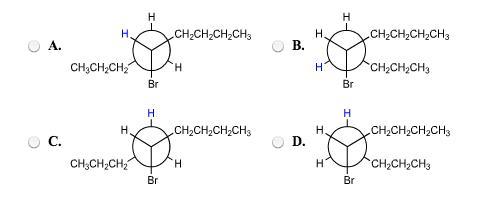
The elimination of 5−bromononane on treatment with potassium ethoxide is stereoselective. Select the correct Newman projections

of 5−bromononane showing the conformations that lead to cis−4−nonene and trans−4−nonene, respectively. Identify the proton that is lost in each case by selecting the Newman projections that have this hydrogen colored blue. Suggest a mechanistic explanation for the observed stereoselectivity. Leads to cis−4−nonene:

Chemistry
1 answer:
dedylja [7]2 years ago
7 0

hey There!:

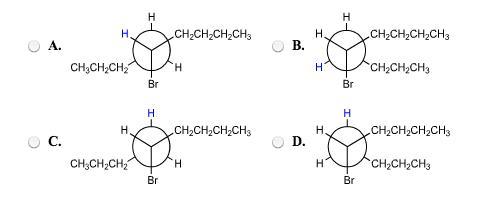
Compound B is the structure that leads to Cis-nonene as major product because in this case the Leaving group i.e Br and the electrophile i.e  H is not anti-periplanar to each other .

Hope this helps!

You might be interested in
Up to a point, the elongation of a spring is directly proportional to the force applied to it. Once you extend the spring more t
lana [24]

yes 2.5 is correct for plato!

8 0
2 years ago
"The compound K2O2 also exists. A chemist can determine the mass of K in a sample of known mass that consists of either pure K2O
o-na [289]

Answer:

Yes, the chemist can determine which compound is in the sample.

Explanation:

In 1 mole of K₂O, the mass of K is 2 × 39.1 g = 78.2 g and the mass of K₂O is 94.2 g. The mass ratio of K to K₂O is 78.2 g / 94.2 g = 0.830.

In 1 mole of K₂O₂, the mass of K is 2 × 39.1 g = 78.2 g and the mass of K₂O₂ is 110.2 g. The mass ratio of K to K₂O₂ is 78.2 g / 110.2 g = 0.710.

If the chemist knows the mass of K and the mass of the sample, he or she must calculate the mass ratio of K to the sample.

  • If the ratio is 0.830, the compound is pure K₂O.
  • If the ratio is 0.710, the compound is pure K₂O₂.
  • If the ratio is not 0.830 or 0.710, the sample is a mixture.
6 0
2 years ago
Cacodyl, which has an intolerable garlicky odor and is used in the manufacture of cacodylic acid, a cotton herbicide, has a mass
Papessa [141]

Answer:

The molecular formula of cacodyl is C₄H₁₂As₂.

Explanation:

<u>Let's assume we have 1 mol of cacodyl</u>, in that case we'd have 209.96 g of cacodyl and the<u> following masses of its components</u>:

  • 209.96 g * 22.88/100 = 48.04 g C
  • 209.96 g * 5.76/100 = 12.09 g H
  • 209.96 g * 71.36/100 = 149.83 g As

Now we convert those masses into moles:

  • 48.04 g C ÷ 12 g/mol = 4.00 mol C
  • 12.09 g H ÷ 1 g/mol = 12.09 mol H
  • 149.83 g As ÷ 74.92 g/mol = 2.00 mol As

Those amounts of moles represent the amount of each component in 1 mol of cacodyl, thus, the molecular formula of cacodyl is C₄H₁₂As₂.

3 0
2 years ago
Calculate the pka of hypochlorous acid. The ph of a 0.015 m solution of hypochlorous acid has a ph of 4.64.
o-na [289]

Answer:

  • pKa = 7.46

Explanation:

<u>1) Data:</u>

a) Hypochlorous acid = HClO

b) [HClO} = 0.015

c) pH = 4.64

d) pKa = ?

<u>2) Strategy:</u>

With the pH calculate [H₃O⁺], then use the equilibrium equation to calculate the equilibrium constant, Ka, and finally calculate pKa from the definition.

<u>3) Solution:</u>

a) pH

  • pH = - log [H₃O⁺]

  • 4.64 = - log [H₃O⁺]

  • [H_3O^+]= 10^{-4.64} = 2.29.10^{-5}

b) Equilibrium equation: HClO (aq) ⇄ ClO⁻ (aq) + H₃O⁺ (aq)

c) Equilibrium constant: Ka =  [ClO⁻] [H₃O⁺] / [HClO]

d) From the stoichiometry: [CLO⁻] = [H₃O⁺] = 2.29 × 10 ⁻⁵ M

e) By substitution: Ka = (2.29 × 10 ⁻⁵ M)² / 0.015M = 3.50 × 10⁻⁸ M

f) By definition: pKa = - log Ka = - log (3.50 × 10 ⁻⁸) = 7.46

5 0
2 years ago
Paige heated 3.00 g mercury (II) oxide (HgO, 216.59 g/mol) to form mercury (Hg, 200.59 g/mol) and oxygen (O2, 32.00 g/mol). She
stepan [7]

the balanced chemical equation for decomposition of HgO is as follows

2HgO --> 2Hg + O₂

stoichiometry of HgO to O₂ is 2:1

number of HgO moles heated are - 3.00 g / 216.59 g/mol = 0.0139 mol

according to stoichiometry of reaction -

number of O₂ moles formed = 0.0139 mol/ 2 = 0.00695 mol

mass of O₂ to be formed - 0.00695 mol x 32.00 g/mol = 0.2224 g

but the actual yield = 0.195 g

percent yield = actual yield / theoretical yield x 100 %

percent yield = 0.195 g / 0.2224 g x 100 % = 87.7 %

answer is 87.7 %
8 1
2 years ago
Read 2 more answers
Other questions:
  • Which of the following actions cannot induce voltage in a wire?
    14·2 answers
  • Carbon dioxide dissolves in water to form carbonic acid. this acid lowers the ph of the water and makes the water corrosive. wha
    12·1 answer
  • Current of 250. a flows for 24.0 hours at an anode where the reaction occurring is as follows: mn2+(aq) + 2h2o(l) → mno2(s) + 4h
    8·2 answers
  • The interior of a refrigerator has a volume of 0.600 m3. the temperature inside the refrigerator in 282 k, and the pressure is 1
    11·1 answer
  • PLEASEEE PLEASEEE HELP
    8·1 answer
  • Rank the compounds below from slowest to Fastest rate of hydration. 1) formaldehyde 2) 3,3-dimethyIbutan-2-one 3) propanal 4)3-m
    7·1 answer
  • What is the volume of 1.56 kg of a compound whose molar mass is 81.86 g/mole and whose density is 41.2 g/ml?
    5·1 answer
  • The density of an unknown crystal is 2.65gmL. If a 4.46 g sample of the crystal is added to a graduated cylinder containing 25.0
    6·1 answer
  • How can a piece of wood floating on water illustrate the condition of lowest potential energy and maximum
    10·1 answer
  • The elements chlorine and iodine have similar chemical properties because they _____. Group of answer choices have the same numb
    7·1 answer
Add answer
Login
Not registered? Fast signup
Signup
Login Signup
Ask question!