answer.
Ask question
Login Signup
Ask question
All categories
  • English
  • Mathematics
  • Social Studies
  • Business
  • History
  • Health
  • Geography
  • Biology
  • Physics
  • Chemistry
  • Computers and Technology
  • Arts
  • World Languages
  • Spanish
  • French
  • German
  • Advanced Placement (AP)
  • SAT
  • Medicine
  • Law
  • Engineering
tamaranim1 [39]
2 years ago
3

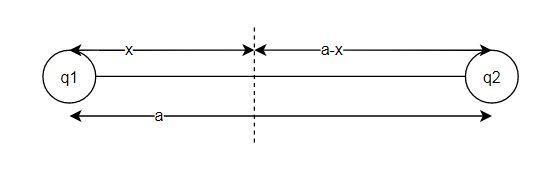
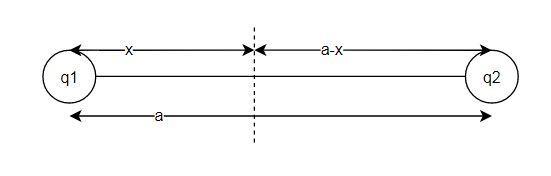
Along the line connecting the two charges, at what distance from the charge q1 is the total electric field from the two charges

zero? Express your answer in terms of some or all of the variables s, q1, q2 and k =14πϵ0

Physics
1 answer:
inysia [295]2 years ago
8 0

Answer:

Distance of zero electric field from charge q1 = \frac{a\sqrt{q1}}{(\sqrt{{q2}}+\sqrt{q1})}

Explanation:

let the distance between the charges be 'a'

and the point of equal electric field be at a distance 'x' from the charge q1

Given:

the charges as q1 and q2

we know that the Electric field (E) is given as

E=\frac{kQ}{r^2}

where,

k = Electric field constant

Q = charge

r = distance of the point from the charge where Electric field is being measures

⇒let the distance between the charges be 'a'

and the point of equal electric field be at a distance 'x' from the charge q1

⇒Now electric field due to the charges q1 = E_1=\frac{kq1}{r_1^2}

electric field due to the charges q2 = E_1=\frac{kq2}{r_2^2}

from the figure attached:  r_1=x and r_2=a-x

for the electric field from the charges to be zero

\frac{kq1}{r_1^2}=\frac{kq2}{r_2^2}

substituting the values

\frac{kq1}{a^2}=\frac{kq2}{(a-x)^2}

or

\frac{a-x}{x}=\sqrt{\frac{q2}{q1}}

or

\frac{a}{x}-\frac{x}{x}=\sqrt{\frac{q2}{q1}}

or

a=(\sqrt{\frac{q2}{q1}}+1)x

or

x = \frac{a}{(\sqrt{\frac{q2}{q1}}+1)}

or

x = \frac{a\sqrt{q1}}{(\sqrt{{q2}}+\sqrt{q1})}

You might be interested in
Write the equivalent formulas for velocity, acceleration, and force using the relationships covered for UCM, Newton’s Laws, and
yKpoI14uk [10]

Answer:

The newton’s second law is F=ma

The Gravitational force is F=\dfrac{Gm_{1}m_{2}}{r^2}

Explanation:

Given that,

The equivalent formulas for velocity, acceleration, and force using the relationships covered for UCM, Newton’s Laws, and Gravitation.

We know that,

Velocity :

The velocity is equal to the rate of position of the object.

v=\dfrac{dx}{dt}....(I)

Acceleration :

The acceleration is equal to the rate of velocity of the object.

a=\dfrac{dv}{dt}....(II)

Newton’s second Laws

The force is equal to the change in momentum.

In mathematically,

F=\dfrac{d(p)}{dt}

Put the value of p

F=\dfrac{d(mv)}{dt}

F=m\dfrac{dv}{dt}

Put the value from equation (II)

F=ma

This is newton’s second laws.

Gravitational force :

The force is equal to the product of mass of objects and divided by square of distance.

In mathematically,

F=\dfrac{Gm_{1}m_{2}}{r^2}

Where, m₁₂ = mass of first object

m= mass of second object

r = distance between both objects

Hence, The newton’s second law is F=ma

The Gravitational force is F=\dfrac{Gm_{1}m_{2}}{r^2}
3 0
2 years ago
For a long ideal solenoid having a circular cross-section, the magnetic field strength within the solenoid is given by the equat
andrezito [222]

Answer:

Radius of the solenoid is 0.93 meters.

Explanation:

It is given that,

The magnetic field strength within the solenoid is given by the equation,

B(t)=5t\ T, t is time in seconds

\dfrac{dB}{dt}=5\ T

The induced electric field outside the solenoid is 1.1 V/m at a distance of 2.0 m from the axis of the solenoid, x = 2 m

The electric field due to changing magnetic field is given by :

E(2\pi x)=\dfrac{d\phi}{dt}

x is the distance from the axis of the solenoid

E(2\pi x)=\pi r^2\dfrac{dB}{dt}, r is the radius of the solenoid

r^2=\dfrac{2xE}{(dE/dt)}

r^2=\dfrac{2\times 2\times 1.1}{(5)}

r = 0.93 meters

So, the radius of the solenoid is 0.93 meters. Hence, this is the required solution.

4 0
2 years ago
Read 2 more answers
Umar has two copper pans, each containing 500cm3 of water. Pan A has a mass of 750g and pan B has a mass of 1.5kg. Which pan wil
Olin [163]

Answer:

heat required in pan B is more than pan A

Explanation:

Heat required to raise the temperature of the substance is given by the formula

Q = ms\Delta T

now we know that both pan contains same volume of water while the mass of pan is different

So here heat required to raise the temperature of water in Pan A is given as

Q_1 = (m_w s_w + m_ps_p)\delta T

Q_1 = (0.5(4186) + 0.750(s))\Delta T

Now similarly for other pan we have

Q_2 = (m_w s_w + m_ps_p)\delta T

Q_2 = (0.5(4186) + 1.50(s))\Delta T

So here by comparing the two equations we can say that heat required in pan B is more than pan A

3 0
2 years ago
An amusement park ride raises people high into the air, suspends them for a moment, and then drops them at a rate of free-fall a
blsea [12.9K]

Answer: apparent weighlessness.


Explanation:


1) Balance of forces on a person falling:


i) To answer this question we will deal with the assumption of non-drag force (abscence of air).


ii) When a person is dropped, and there is not air resistance, the only force acting on the person's body is the Earth's gravitational attraction (downward), which is the responsible for the gravitational acceleration (around 9.8 m/s²).


iii) Under that sceneraio, there is not normal force acting on the person (the normal force is the force that the floor or a chair exerts on a body to balance the gravitational force when the body is on it).


2) This is, the person does not feel a pressure upward, which is he/she does not feel the weight: freefalling is a situation of apparent weigthlessness.


3) True weightlessness is when the object is in a place where there exists not grativational acceleration: for example a point between two planes where the grativational forces are equal in magnitude but opposing in direction and so they cancel each other.


Therefore, you conclude that, assuming no air resistance, a person in this ride experiencing apparent weightlessness.

3 0
2 years ago
Read 2 more answers
A spacecraft of the Trade Federation flies past the planet Coruscant at a speed of 0.610 c. A scientist on Coruscant measures th
mamaluj [8]

Answer:

the length of the now stationary spacecraft = 89.65m

Explanation:

In contraction equation, Length contraction L is the shortening of the measured length of an object moving relative to the observer’s frame.

Thus, it has a formula;

L = L_o(√(1 - (v²/c²))

Where in this question;

L = 71m and v = 0.610 c

Thus;

71 = L_o (√(1 - ((0.61c)²/c²))

c² will cancel out to give;

71 = L_o (√(1 - 0.61²)

71 = L_o (√(1 - 0.61²)

71 = 0.792L_o

L_o = 71/0.792

L_o = 89.65m

6 0
2 years ago
Other questions:
  • A boat takes off from the dock at 2.5 m/s and speeds up at 4.2 m/s2 for 6.0 s. How far has the boat traveled? Round your answer
    10·2 answers
  • A 40-w lightbulb connected to a 120-v source experiences a voltage surge that produces 132 v for a moment. by what percentage do
    9·1 answer
  • Select all that apply. Greenhouse gases _____. absorb solar energy absorb carbon dioxide release carbon dioxide are released dur
    7·1 answer
  • Using the superposition method, calculate the current through R5 in Figure 8-71
    14·1 answer
  • A 1.00 l sample of a gas at 25.0◦c and 1.00 atm contains 50.0 % helium and 50.0 % neon by mass. what is the partial pressure of
    12·2 answers
  • Two spherical drops of mercury each have a charge of 0.10 nC and a potential of 300 V at the surface. The two drops merge to for
    7·1 answer
  • How much heat Q1 is transferred by 25.0 g of water onto the skin? To compare this to the result in the previous part, continue t
    13·1 answer
  • A gas laser has a cavity length of 1/3 m and a single oscillation frequency of 9.0 x 10¹⁴ Hz. What is the cavity mode number?
    13·1 answer
  • Two bars are conducting heat from a region of higher temperature to a region of lower temperature. The bars have identical lengt
    12·1 answer
  • You are working on a laboratory device that includes a small sphere with a large electric charge Q. Because of this charged sphe
    10·1 answer
Add answer
Login
Not registered? Fast signup
Signup
Login Signup
Ask question!