answer.
Ask question
Login Signup
Ask question
All categories
  • English
  • Mathematics
  • Social Studies
  • Business
  • History
  • Health
  • Geography
  • Biology
  • Physics
  • Chemistry
  • Computers and Technology
  • Arts
  • World Languages
  • Spanish
  • French
  • German
  • Advanced Placement (AP)
  • SAT
  • Medicine
  • Law
  • Engineering
ololo11 [35]
2 years ago
3

Max (mass = 15 kg) is hanging from one end of a 13-m long bungee cord that has its other end fixed to a bridge above. The bungee

cord has a circular cross section with a diameter of 2.5 cm, and a Young’s modulus of 17 MPa. What is the stress in the bungee cord due to Max’s weight?

Physics
1 answer:
a_sh-v [17]2 years ago
4 0

The stress in the bungee cord due to the Max's weight is \fbox{\begin \\ 299511\text{ N}/\text{m}^{2}\end{minispace}} or \fbox{\begin\\ 2.99\times10^{5}\text{ N}/\text{m}^{2}\end{minispace}} or \fbox{\begin\\3.0\times10^{5}\text{ N}/\text{m}^{2}\end{minispace}}.

Further Explanation:

The stress developed in the bungee cord is the amount of tensile force developed inside the bungee cord due to the Max's weight.

Given:  

The diameter d of the bungee cord is 2.5\text{ cm}.  

The mass m of Max is 15\text{ kg}.

Concept:

The stress developed in the bungee cord is given by:  

\fbox{\begin \sigma =\dfrac{F}{A}\end{minispace}}                                                                               ... (1)         

Here, \sigma is the stress developed in the bungee cord, Fis the force due to Max's weight and A is the area of cross-section of the bungee cord.  

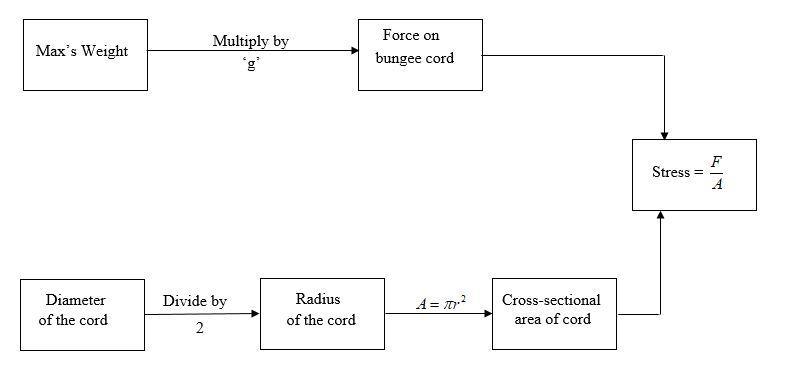
The radius of the bungee cord will be the half of its diameter.  

r=\dfrac{d}{2}

Substitute 2.5\text{ cm} for d.  

r= \dfrac{2.5\text{ cm}}{2}\\r=1.25 \text{ cm} 

Convert the radius of the bungee cord in meter.  

r=\dfrac{1.25}{100} \text{ m}\\r=0.0125\text{ m} 

The area of cross-section of the bungee cord is given by:  

A=\pi r^{2}  

Substitute 0.0125\text{ m} for r.  

A=\pi (0.0125\text{ m})^{2}\\A=4.908\times10^{-4} m^{2}  

The force on the bungee cord due to Max's mass is the gravitational force acting on Max's body. The gravitational force acting on Max's body is given by:  

F=mg  

Here, m is the mass of Max's body and g is acceleration due to gravity.  

Consider the value of acceleration due to gravity on Earth be 9.80\text{ m}/\text{s}^{2}.  

Substitute 15\text{ kg} for m and 9.80\text{ m}/\text{s}^{2} for g in above expression.  

F=(15\text{ kg})\times(9.80\text{ m}/\text{s}^{2})\\F=147\text{ N}  

Substitute 147\text{ N} for F and 4.980\times10^{-4}\text{ m}^{2} for <em>A</em> in equation (1).  

\sigma=\dfrac{147\text{ N}}{4.908\times10^{-4}\text{ m}^{2}}\\\sigma=299511\text{ N}/\text{m}^{2}

Thus, the stress developed in the bungee cord is \fbox{\begin \\ 299511\text{ N}/\text{m}^{2}\end{minispace}} or \fbox{\begin\\ 2.99\times10^{5}\text{ N}/\text{m}^{2}\end{minispace}} or \fbox{\begin\\3.0\times10^{5}\text{ N}/\text{m}^{2}\end{minispace}}.

Learn More:

1. Representation of the scientific notations  brainly.com/question/10830549

2. Wind and solar energy are examples of brainly.com/question/1062501

Answer Details:

Grade: Senior school

Subject: Physics

Chapter: Stress and Strain

Keywords:

Max, Max's weight, force, stress, area, 299511 N/m2, 299511 N/m^2, 2.99x10^5 N/m2, gravitational, radius, bungee, cord, weight, developed, mass, 3x10^5 N/m^2.
You might be interested in
The position of an object is given by x = at3 - bt2 + ct,where a = 4.1 m/s3, b = 2.2 m/s2, c = 1.7 m/s, and x and t are in SI un
Elza [17]

Answer:

The answer to your question is: 15 m/s2

Explanation:

Equation    x = at3 - bt2 + ct

a = 4.1 m/s3

b = 2.2 m/s2

c = 1.7 m/s

First we find  x at t = 4.1 s

x = 4.1(4.1)3 - 2.2(4.1)2 + 1.7(4.1)

x = 4.1(68.921) - 2.2(16.81) + 6.97

x = 282.58 - 36.98 + 6.98

x = 252.58 m

Now we find speed

v = x/t = 252.58/ 4.1 = 61.6 m/s

Finally

acceleration = v/t = 61.6/4.1 = 15 m/s2

6 0
2 years ago
Alex throws a 0.15-kg rubber ball down onto the floor. The ball’s speed just before impact is 6.5 m/s, and just after is 3.5 m/s
Jet001 [13]

Answer: Change in ball's momentum is 1.5 kg-m/s.

Explanation: It is given that,

Mass of the ball, m = 0.15 kg

Speed before the impact, u = 6.5 m/s

Speed after the impact, v = -3.5 m/s (as it will rebound)

We need to find the change in the magnitude of the ball's momentum. It is given by :

So, the change in the ball's momentum is 1.5 kg-m/s. Hence, this is the required solution.

Read more on Brainly.com - brainly.com/question/12946012#readmore

7 0
2 years ago
A small mass m is tied to a string of length L and is whirled in vertical circular motion. The speed of the mass v is such that
adell [148]

Answer:

(mv^2/R)/(mg)=1/2

v^2=R/2g

7 0
2 years ago
Why is the following situation impossible? Two identical dust particles of mass 1.00 µg are floating in empty space, far from an
Igoryamba

Answer:

This is a conceptual problem so I will try my best to explain the impossible scenario. First of all the two dust particles ara virtually exempt from any external forces and at rest with respect to each other. This could theoretically happen even if it's difficult for that to happen. The problem is that each of the particles have an electric charge which are equal in magnitude and sign. Thus each particle should feel the presence of the other via a force. The forces felt by the particles are equal and opposite facing away from each other so both charges have a net acceleration according to Newton's second law because of the presence of a force in each particle:

a=\frac{F}{m}

Having seen Newton's second law it should be clear that the particles are actually moving away from each other and will not remain at rest with respect to each other. This is in contradiction with the last statement in the problem.

4 0
2 years ago
Kenny and Candy decided to sit on a see-saw while visiting a local play park. Candy, of mass
pochemuha

Answer:

(i) 208 cm from the pivot

(ii) Move further from the pivot

Explanation:

(i) Sum of the moments about the pivot of the seesaw is zero.

∑τ = Iα

(50 kg) (10 N/kg) (2.5 m) + (60 kg) (10 N/kg) x = 0

1250 Nm + 600 N x = 0

x = -2.08 m

Kenny should sit 208 cm on the other side of the pivot.

(ii) To increase the torque, Kenny should move away from the pivot.

4 0
2 years ago
Other questions:
  • How and why does the distance between 2 electrodes affect the rate of electrolysis? ...?
    11·1 answer
  • Assume that the light from the flashlight is light from a star. Identify the spot where the light from this “star” is most conce
    12·2 answers
  • I have a hot air balloon that has 18.0 g helium gas inside of it. if the pressure is 2.00 atm and the temperature is 297k, what
    11·2 answers
  • A 0.80-μm-diameter oil droplet is observed between two parallel electrodes spaced 11 mm apart. The droplet hangs motionless if t
    13·1 answer
  • To understand the vector nature of momentum in the case in which two objects collide and stick together. In this problem we will
    7·2 answers
  • A wood salvage company is hoisting an old tree trunk off the bottom and out of a lake. The cable from the hoist is tied around t
    15·1 answer
  • A 0.75μF capacitor is charged to 70 V . It is then connected in series with a 55Ω resistor and a 140 Ω resistor and allowed to d
    7·1 answer
  • A car needs to generate 75.0 hp in order to maintain a constant velocity of 18.2 m/s on a flat road. What is the magnitude of th
    13·1 answer
  • The refractive index n of transparent acrylic plastic (full name Poly(methyl methacrylate)) depends on the color (wavelength) of
    7·1 answer
  • A basketball is tossed upwards with a speed of 5.0\,\dfrac{\text m}{\text s}5.0 s m ​ 5, point, 0, start fraction, start text, m
    9·1 answer
Add answer
Login
Not registered? Fast signup
Signup
Login Signup
Ask question!
