answer.
Ask question
Login Signup
Ask question
All categories
  • English
  • Mathematics
  • Social Studies
  • Business
  • History
  • Health
  • Geography
  • Biology
  • Physics
  • Chemistry
  • Computers and Technology
  • Arts
  • World Languages
  • Spanish
  • French
  • German
  • Advanced Placement (AP)
  • SAT
  • Medicine
  • Law
  • Engineering
lilavasa [31]
2 years ago
12

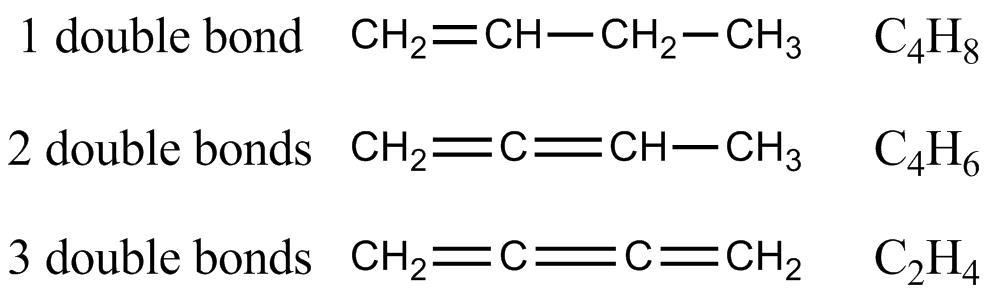
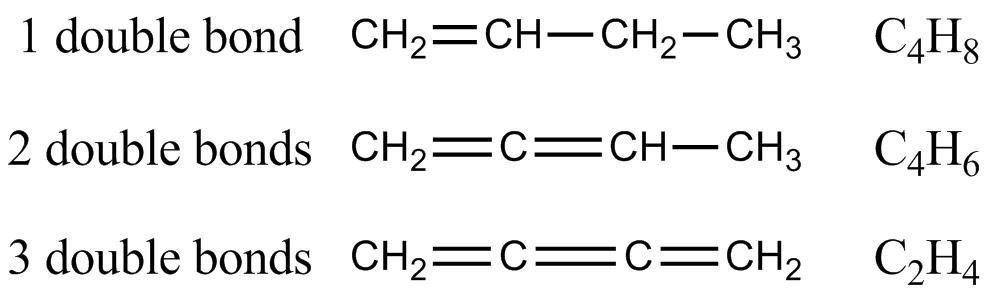
what is the general formula for straight-chain hydrocarbons with n carbon atoms and m (multiple) double bonds?

Chemistry
1 answer:
Katarina [22]2 years ago
8 0

the formula:

C_{a} H_{2a+2-2x}

where

a - number of the carbon atoms

x - number of double bonds

We take as a example the hydrocarbon with 4 carbon atoms

x = 1 → C_{4} H_{2*4+2-2*1} → C_{4} H_{8}

x = 2 → C_{4} H_{2*4+2-2*2} → C_{4} H_{6}

x = 3 → C_{4} H_{2*4+2-2*3} → C_{4} H_{4}

You might be interested in
Given the following reactions Fe2O3 (s) + 3CO (s) → 2Fe (s) + 3CO2 (g) ΔH = -28.0 kJ 3Fe (s) + 4CO2(s) → 4CO (g) + Fe3O4(s) ΔH =
Taya2010 [7]

Answer: The enthalpy of the reaction is -109 kJ

Explanation:

According to Hess’s law of constant heat summation, the heat absorbed or evolved in a given chemical equation is the same whether the process occurs in one step or several steps.

According to this law, the chemical equation can be treated as ordinary algebraic expression and can be added or subtracted to yield the required equation. That means the enthalpy change of the overall reaction is the sum of the enthalpy changes of the intermediate reactions.

Fe_2O_3(s)+3CO(s)\rightarrow 2Fe(s)+3CO_2(g)   \Delta H=-28.0kJ  \times 3    

3Fe_2O_3(s)+9CO(s)\rightarrow 6Fe(s)+9CO_2(g)   \Delta H=-84.0kJ     (1)

3Fe(s)+4CO_2(s)\rightarrow 4CO(g)+Fe_3O_4(s) \Delta H=+12.5kJ  \times 2  

6Fe(s)+8CO_2(s)\rightarrow 8CO(g)+2Fe_3O_4(s) \Delta H=+25.0kJ     (2)

The final reaction is:

Subtracting (2) from (1):

3Fe_2O_3(s)+CO(g)\rightarrow CO_2(g)+2Fe_3O_4(s) \Delta H=-84.0-(+25.0)=-109kJ

Thus the enthalpy of the reaction is -109 kJ

7 0
2 years ago
In the synthesis of barium carbonate from an alkali metal carbonate (M2CO3 where M is one of the alkali metals) a student genera
Paraphin [41]

Answer:

0.019 moles of M2CO3

Explanation:

M2CO3(aq) + BaCl2 (aq) --> 2MCl (aq) + BaCO3(s)

From the equation above;

1 mol of  M2CO3 reacts to produce 1 mol of BaCO3

Mass of BaCO3 formed = 3.7g

Molar mass of BaCO3 = 197.34g/mol

Number of moles = Mass / Molar mass = 3.7 / 197.34 = 0.0187  ≈ 0.019mol

Since 1 mol of M2CO3 reacts with 1 mol of BaCO3,

1 = 1

x = 0.019

x = 0.019 moles of M2CO3

3 0
2 years ago
How many moles of chromium(iii) nitrate are produced when chromium reacts with 0.85 moles of lead(iv) nitrate to produce chromiu
Alexxandr [17]
The  moles  of  chromium (iii)  nitrate  produced  is  calculated  as   follows

write  the  equation  for  reaction

 3  Pb(NO3)2  +  2 Cr  =  2 Cr(NO3)3  +  3  Pb

by  use  of  mole  ratio  between  Pb(NO3)2  to  Cr(NO3)3  which  is  3  :  2  the  moles  of  Cr(NO3)3  is therefore  
=  0.85  x2  /3  =  0.57   moles
5 0
2 years ago
A 40.0 mL sample of 0.25 M KOH is added to 60.0 mL of 0.15 M Ba(OH)2. What is the molar concentration of OH-(aq) in the resultin
solmaris [256]

Answer:

C) 0.28 M

Explanation:

Considering:

Molarity=\frac{Moles\ of\ solute}{Volume\ of\ the\ solution}

Moles =Molarity \times {Volume\ of\ the\ solution}

Potassium hydroxide will furnish hydroxide ions as:

KOH\rightarrow K^{+}+OH^-

Given :

<u>For Potassium hydroxide : </u>

Molarity = 0.25 M

Volume = 40.0 mL

The conversion of mL to L is shown below:

1 mL = 10⁻³ L

Thus, volume = 40.0×10⁻³ L

Thus, moles of hydroxide ions furnished by Potassium hydroxide is same as the moles of Potassium hydroxide as shown below:

Moles =0.25 \times {40.0\times 10^{-3}}\ moles

Moles of hydroxide ions by Potassium hydroxide = 0.01 moles

Barium hydroxide will furnish hydroxide ions as:

Ba(OH)_2\rightarrow Ba^{2+}+2OH^-

Given :

<u>For Barium hydroxide : </u>

Molarity = 0.15 M

Volume = 60.0 mL

The conversion of mL to L is shown below:

1 mL = 10⁻³ L

Thus, volume = 60.0×10⁻³ L

Thus, moles of hydroxide ions furnished by Barium hydroxide is twice the moles of Barium hydroxide as shown below:

Moles =2\times 0.15 \times {60.0\times 10^{-3}}\ moles

Moles of hydroxide ions by Barium hydroxide = 0.018 moles

Total moles = 0.01 moles + 0.018 moles = 0.028 moles

Total volume = 40.0×10⁻³ L + 60.0×10⁻³ L = 100×10⁻³ L

Concentration of hydroxide ions is:

Molarity=\frac{Moles\ of\ solute}{Volume\ of\ the\ solution}

Molarity_{OH^-}=\frac{0.028 }{100\times 10^{-3}}

<u> The final concentration of hydroxide ion = 0.28 M</u>
5 0
2 years ago
Read 2 more answers
Groups of atoms that are added to carbon backbones and give them unique properties are known as
Irina-Kira [14]

Answer:

             Groups of atoms that are added to carbon backbones and give them unique properties are known as <u>Functional Groups</u>.

Explanation:

                   In organic chemistry they are called as Functional Group because they are the active part of a molecule. These groups give a unique characteristic to molecule both chemically and physically. Also, each functional group represent a different class of compounds.

Examples:

S No.                          Functional Group                                 Name

1                                   R--X                                             Alkyl Halides

2                                   R--OH                                          Alcohols

3                                  R--NH₂                                         Amines

4                                  R--O--R                                         Ethers

5                                   R--CO--R                                      Ketones

6                                   R--CO--H                                     Aldehydes

7                                  R--CO--OH                                  Carboxylic acids

8                                   R--CO--X                                     Acid Halides

10                                R--CO--NR₂                                 Acid Amides

11                                 R--CO-OR'                                  Esters

3 0
2 years ago
Other questions:
  • Lewis structure XeH4? The hydrogen atom is not actually electronegative enough to form bonds to xenon. Were the xenon-hydrogen b
    6·2 answers
  • What is the main difference between the alpine tundra and the arctic tundra? a. The alpine tundra includes trees. b. The alpine
    10·2 answers
  • how many moles of hydrogen are evolved when an excess of sodium metal is added to one mole of citric acid?
    7·1 answer
  • Which mass of urea CO(NH2)2 contains same mass of nitrogen as 101.1 g of potassium nitrate?
    5·1 answer
  • Name the complex ion [cu(cn)6]4−. the oxidation number of copper is +2.enter the name.
    12·1 answer
  • a) (1 point) Build anthracene, optimize its geometry and examine its structure. Describe its shape. b) (1 point) Measure the C-C
    13·1 answer
  • Acid deposition would most likely result in_________
    8·1 answer
  • Read the information on Hydrochloric Acid. List four ways you can avoid injury while using HCl and three steps you would take in
    13·1 answer
  • Relate the spectral lines to energy levels in an atom and the term quanta
    10·1 answer
  • HELPP 20+ POINTS!!!
    12·1 answer
Add answer
Login
Not registered? Fast signup
Signup
Login Signup
Ask question!