answer.
Ask question
Login Signup
Ask question
All categories
  • English
  • Mathematics
  • Social Studies
  • Business
  • History
  • Health
  • Geography
  • Biology
  • Physics
  • Chemistry
  • Computers and Technology
  • Arts
  • World Languages
  • Spanish
  • French
  • German
  • Advanced Placement (AP)
  • SAT
  • Medicine
  • Law
  • Engineering
klasskru [66]
2 years ago
6

A long, horizontal, pressurized hot water pipe of 15cm diameter passes through a room where the air temperature is 24degree C. T

he pipe surface temperature is 130 degree C and the emissivity of the surface is 0.95. Neglecting radiation loss from the pipe, what is the rate of the heat transfer to the room air per meter of pipe length
Engineering
1 answer:
solmaris [256]2 years ago
5 0

Answer:

Rate of heat transfer to the room air per meter of pipe length equals 521.99 W/m

Explanation:

Since it is given that the radiation losses from the pipe are negligible thus the only mode of heat transfer will be by convection.

We know that heat transfer by convection is given by

\dot{Q}=hA(T-T_{\infty })

where,

h = heat transfer coefficient = 10.45 W/m^{2}K (free convection in air)

A = Surface Area of the pipe

Applying the given values in the above formula we get

\dot{Q}=10.45\times \pi DL\times (130+273-(24+273))\\\\\frac{\dot{Q}}{L}=10.45\times 0.15\times \pi \times (130-24)\\\\\frac{\dot{Q}}{L}=521.99W/m

You might be interested in
A horizontal pipe has an abrupt expansion from D1 5 8 cm to D2 5 16 cm. The water velocity in the smaller section is 10 m/s and
anyanavicka [17]
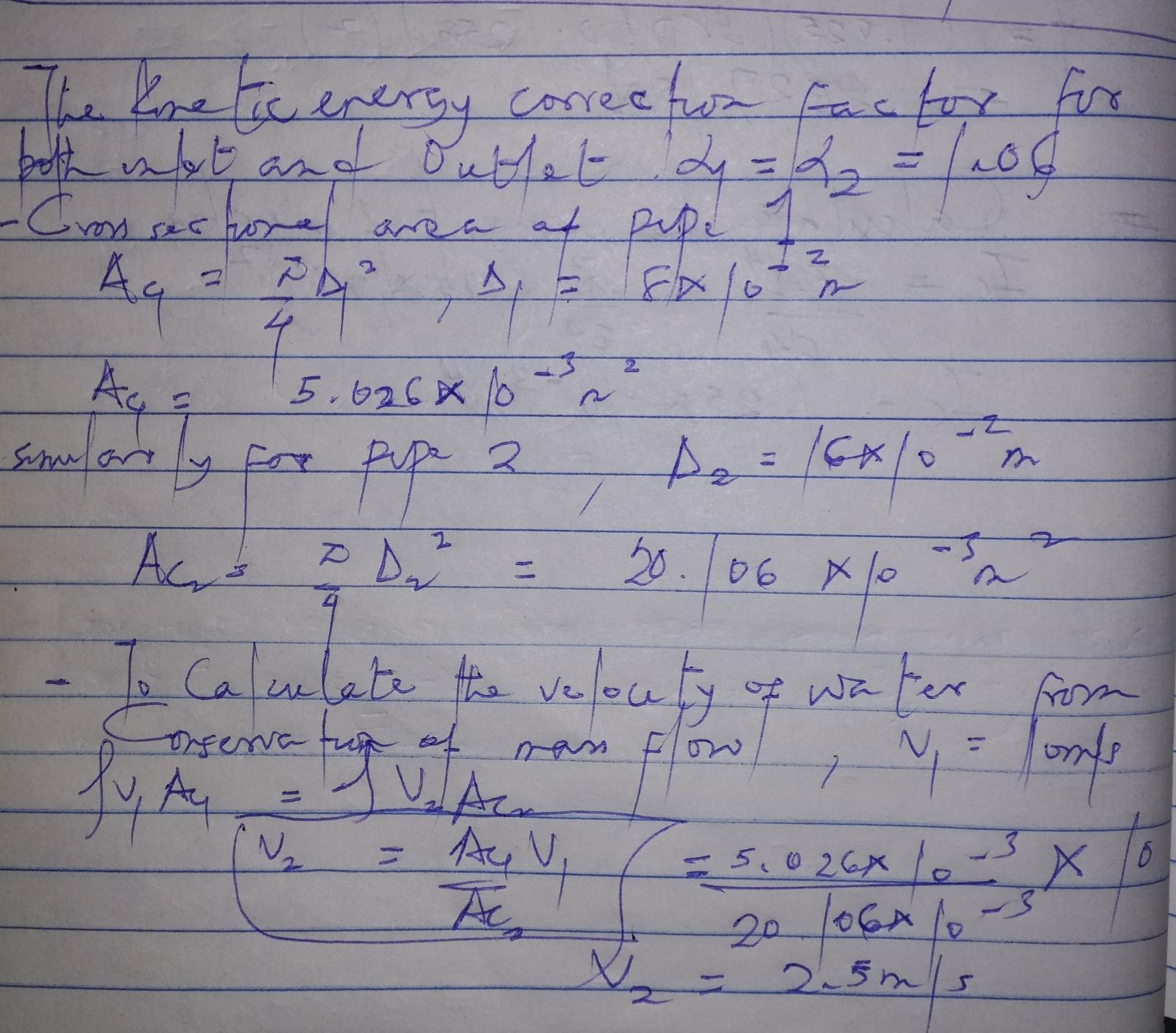
  • Answer:  Explanation:  Application of the bernoulli's equation comes in from conservation of mass flow.  The cross sectional area of the two pipes are calculated. from A = πD²/4 The velocity of water from conservation of mass flow is also calculated ; V2 = Ac1V1/Ac2 The Loss coefficient is then calculated from KL = (1 - Ac1²/Ac2²)² Then the head Loss (hL) is calculated  The detailed calculated and appropriate steps is as shown in the attached files.

5 0
2 years ago
Gina is about to use a fire extinguisher on a small fire. What factor determines the type of extinguisher she should use
amm1812

There’s 5 different types of fire extinguishers that you can differentiate by their color codes.

Red - Water based

Creme - Foam based

Blue - Powder based

Black - CO2 or carbon dioxide based

Yellow - Wet chemical based

What would determine the type of fire extinguisher used would be the class of fire it is.

Class A - Combustible materials ( i.e. paper, wood) Extinguishers to use - Red, Creme, Blue, and Yellow. (Do not use Black)

Class B - Flammable liquids ( i.e. paint, petrol, alcohol) Extinguishers to use - Creme, Blue, and Black. (Do not use Red or Yellow)

Class C - Flammable gases ( i.e. butane, methane) Extinguishers to use - Blue (Do not use Red, Creme, Black or Yellow)

Class D - Flammable metals ( i.e. lithium, potassium) Extinguishers to use - Blue (Do not use Red, Creme, Black or Yellow)

Class F - Deep fat fryers ( i.e. chip pans) Extinguishers to use - Yellow (Do not use Red, Creme, Blue or Black)

Electrical - any sort of electrical equipment

( i.e. computers, generators) Extinguishers to use - Blue and Black (Do not use Red, Creme or Yellow)

8 0
2 years ago
Read 2 more answers
A steel rotating-beam test specimen has an ultimate strength Sut of 1600 MPa. Estimate the life (N) of the specimen if it is tes
ziro4ka [17]

Answer:

the life (N) of the specimen is 46400 cycles

Explanation:

given data

ultimate strength Su = 1600 MPa

stress amplitude σa = 900 MPa

to find out

life (N) of the specimen

solution

we first calculate the endurance limit of specimen Se i.e

Se = 0.5× Su   .............1

Se = 0.5 × 1600

Se = 800 Mpa

and we know

Se for steel is 700 Mpa for Su ≥ 1400 Mpa

so we take endurance limit Se is = 700 Mpa

and strength of friction f  = 0.77 for 232 ksi

because for Se 0.5 Su at 10^{6} cycle = (1600 × 0.145 ksi ) = 232

so here coefficient value (a) will be

a = \frac{(f*Su)^2}{Se}    

a = \frac{(0.77*1600)^2}{700}  

a = 2168.3 Mpa

so

coefficient value (b) will be

a = -\frac{1}{3}log\frac{(f*Su)}{Se}

b =  -\frac{1}{3}log\frac{(0.77*1600)}{700}

b = -0.0818

so no of cycle N is

N =  (\frac{ \sigma a}{a})^{1/b}

put here value

N =  (\frac{ 900}{2168.3})^{1/-0.0818}

N = 46400

the life (N) of the specimen is 46400 cycles

5 0
2 years ago
Rigid bar ACB is supported by an elastic cir-cular strut DC having an outer diameter of 15 in. and inner diameter of 14.4 in. Th
Ne4ueva [31]

Answer:

The change in length of the circular strut DC = 0.0028 in.

The vertical displacement of the rigid bar at point B = 0.00378 in.

Explanation:

We have the following parameters or information in the question given above:

=> The outer diameter = 15 in., the inner diameter = 14.4 in., the modulus elasticity of E = 29,000 ksi, and the Point load P = 5kips.

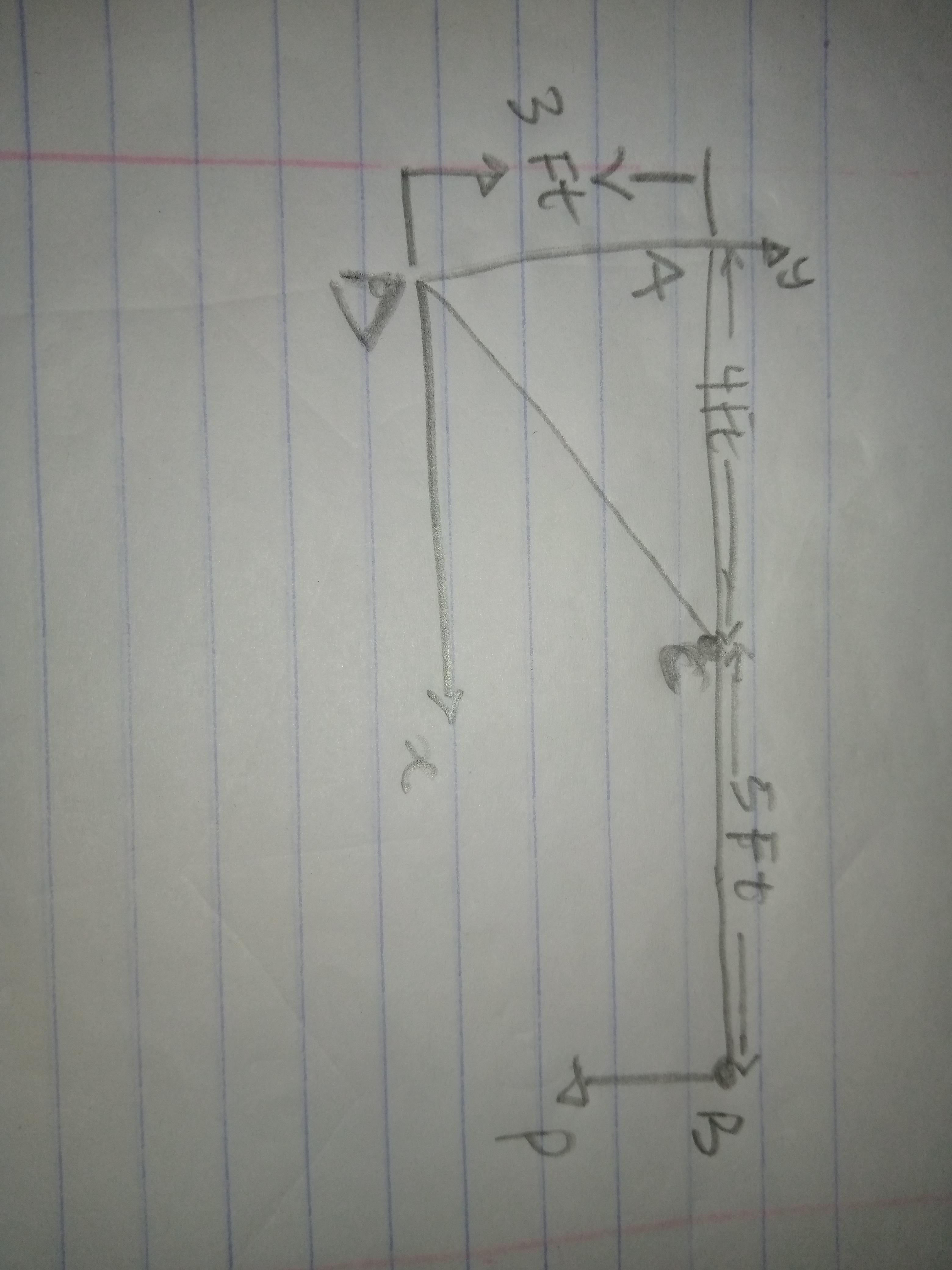
The diagram showing the rigid bar ACB is supported by an elastic cir-cular strut DC  is given in  the attached picture below.

According to Newton's law of motion, it can be seen that the force on CD, that is FCD is equal and opposite to ACD. Hence, FCD = ACD.

Where FCD = p × [4 + 5] ÷ [sin Ф × 4].

kindly note that from the diagram sin Ф = 3/5, cos Ф = 4/5 and tan Ф = 3/4. Also p =5.

Hence, FCD =[ 5 × 9] ÷ [3/5 × 4] = 18.75 kip. So FCD = ACD.

The next thing here is to determine the area and length of CD, say the area of CD is G, thus, G = π/4 × [ 15² - 14.4²] = 13.854 in².

The lenght of CD is = √[4² + 3²] = √[16 + 9] = 5ft. Thus, 5 × 12 = 60in.

Hence, the change in length of the circular strut DC = [18.75 × 60] ÷ 13.854 × 29000 = 0.0028 in.

The vertical deflection of CD = 0.0028 × 3/5 = 0.00168 in.

We have that; 4 /CV = 9BV. Hence, BV = 9/4× CV.

(CV = vertical deflection of CD).

The vertical displacement of the rigid bar at point B = 9/ 4 × 0.00168 in = 0.00378 in.  

7 0
2 years ago
Peter the postman became bored one night and, to break the monotony of the night shift, he carried out the following experiment
aleksandrvk [35]

Answer:

//This Program is written in C++

// Comments are used for explanatory purpose

#include <iostream>

using namespace std;

enum mailbox{open, close};

int box[149];

void closeAllBoxes();

void OpenClose();

void printAll();

int main()

{

closeAllBoxes();

OpenClose();

printAll();

return 0;

}

void closeAllBoxes()

{

for (int i = 0; i < 150; i++) //Iterate through from 0 to 149 which literarily means 1 to 150

{

box[i] = close; //Close all boxes

}

}

void OpenClose()

{

for(int i = 2; i < 150; i++) {

for(int j = i; j < 150; j += i) {

if (box[j] == close) //Open box if box is closed

box[j] = open;

else

box[j] = close; // Close box if box is opened

}

}

// At the end of this test, all boxes would be closed

}

void printAll()

{

for (int x = 0; x < 150; x++) //use this to test

{

if (box[x] = 1)

{

cout << "Mailbox #" << x+1 << " is closed" << endl;

// Print all close boxes

}

}

}

Explanation:

7 0
2 years ago
Other questions:
  • Compute the mass fractions of α ferrite and cementite in pearlite. Assume T=726⁢ C∘.
    15·1 answer
  • . Were you able to observe ???? = 0 in the circuit you constructed during lab? Why or why not? Hint: What value of resistance wo
    6·1 answer
  • Three return steam lines in a chemical processing plant enter a collection tank operating at steady state at 1 bar. Steam enters
    6·1 answer
  • A gas pressure difference is applied to the legs of a U-tube manometer filled with a liquid with specific gravity of 1.7. The ma
    15·2 answers
  • Oil enters a counterflow heat exchanger at 600 K with a mass flow rate of 10 kg/s and exits at 200 K. A separate stream of liqui
    12·1 answer
  • An air standard cycle with constant specific heats is executed in a closed pistoncylinder system and is composed of the followin
    10·1 answer
  • 10. A maker of micromechanical systems can reduce product recalls by 10% with the installation of new packaging equipment. If th
    9·1 answer
  • An airplane in level flight at an altitude h and a uniform speed v passes directly over a radar tracking station A. Calculate th
    5·1 answer
  • Select the level of education that is best demonstrated in each example.
    10·2 answers
  • A dryer is shaped like a long semi-cylindrical duct of diameter 1.5 m. The base of the dryer is occupied with water-soaked mater
    9·1 answer
Add answer
Login
Not registered? Fast signup
Signup
Login Signup
Ask question!