answer.
Ask question
Login Signup
Ask question
All categories
  • English
  • Mathematics
  • Social Studies
  • Business
  • History
  • Health
  • Geography
  • Biology
  • Physics
  • Chemistry
  • Computers and Technology
  • Arts
  • World Languages
  • Spanish
  • French
  • German
  • Advanced Placement (AP)
  • SAT
  • Medicine
  • Law
  • Engineering
Delvig [45]
2 years ago
9

How many grams of nickel (II) chloride hexahydrate are required to prepare 250. mL of aqueous solution whose concentration is 0.

255 M? The molar mass of nickel (II) chloride hexahydrate is 237.69 g mol−1.
Chemistry
1 answer:
allsm [11]2 years ago
6 0

Answer: 15.2 grams

Explanation:

Molarity of a solution is defined as the number of moles of solute dissolved per Liter of the solution.

Molarity=\frac{n\times 1000}{V_s}

where,

n= moles of solute

 V_s = volume of solution in ml

moles of solute (nickel (II) chloride hexahydrate ) =\farc{\text{given mass}}{\text {Molar mass}}=\frac{xg}{237.69g/mol}

Putting the values , we get

0.255= \frac{x\times 1000}{237.69\times 250}

x=15.2g

Thus 15.2 grams of nickel (II) chloride hexahydrate are required to prepare 250. mL of aqueous solution whose concentration is 0.255 M.

You might be interested in
To calculate the relative age of rocks, geologists use the rate of radioactive decay of isotopes present in their samples. What
GenaCL600 [577]
A

I have had this question!!
Hope this helps!!!
4 0
2 years ago
If 200.0 g of copper(II) sulfate react with an excess of zinc metal, what is the theoretical yield of copper? 1.253 g 50.72 g 79
Helen [10]
1)we need a balanced equation: CuSO₄ + Zn ---> ZnSO₄ + Cu

2) we need to convert the grams of CuSO₄ to moles using the molar mass. 

molar mass CuSO₄= 63.5 + 32.0 + (4 x 16.0)= 160 g/mol

200.0 g CuSO_4 ( \frac{1 mol}{160 grams} )= 1.25 mol CuSO_4

3) convert moles of CuSO₄ to moles of Cu

1.25 mol CuSO_4 ( \frac{1 mol Cu}{1 mol CuSO_4} )= 1.25 mol Cu

4) convert moles of Cu to grams using it's molar mass.

molar mass Cu= 63.5 g/mol

1.25 mol (\frac{63.5 grams}{1 mol} )= 79.4 grams Cu

I did it step-by-step as the explanation but you can do all of this in one step. 

200.0 g CuSO_4 ( \frac{1 mol CuSO_4}{160 g} ) ( \frac{1 mol Cu}{1 mol CuSO_4} ) ( \frac{63.5 grams}{1 mol Cu} )= 79.4 grams Cu


4 0
2 years ago
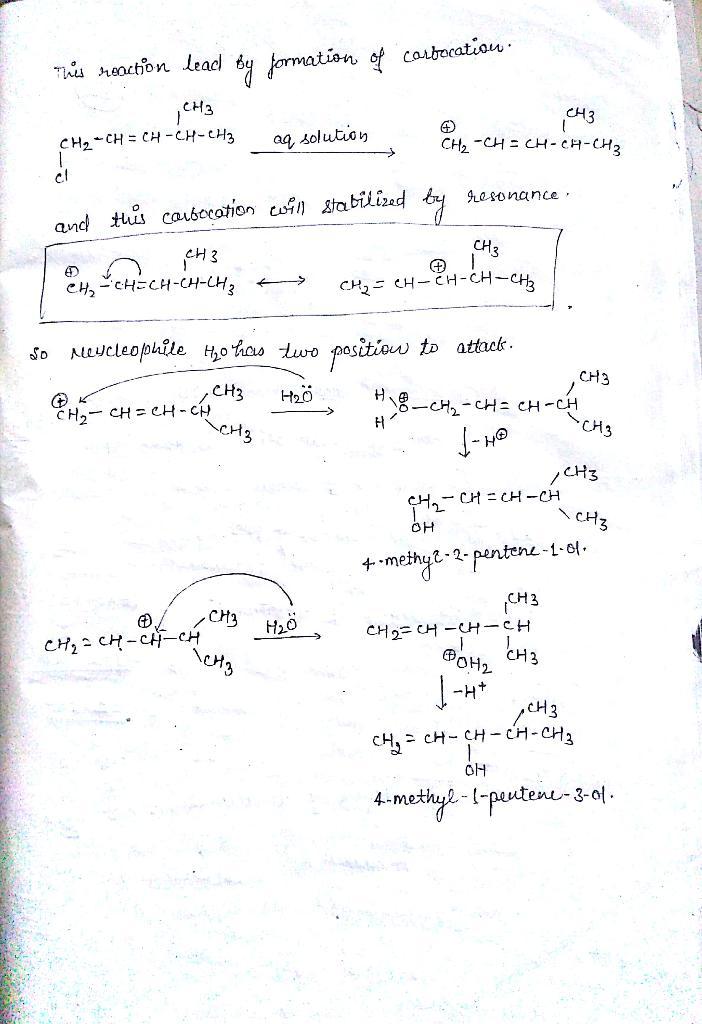
1-chloro-4-methyl-2-pentene undergoes hydrolysis in warm water to give a mixture of 4-methyl-2-penten-1-ol and 4-methyl-1-penten
agasfer [191]

Answer:

Explanation:

attached here is the diagram representing the structure

4 0
2 years ago
Interpret the following Arterial Blood Gases 1. pH 7.33 PaCO2 60 HCO3 34 A. Normal ABG values B. Respiratory acidosis without co
kicyunya [14]

Answer: 1) C; 2)D; 3)B; 4)B; 5) A

Explanation:Interpreting the following Arterial Blood gases, we have

1. pH 7.33 PaCO2 60 HCO3  34----Respiratory acidosis with partial compensation----C

2. pH 7.48 PaCO2 42 HCO3 30------. Metabolic alkalosis without compensation----D

3. pH 7.38 PaCO2 38 HCO3 24 ----- Normal---B

4. pH 7.21 PaCO2 60 HCO3 24------ Respiratory acidosis without compensation-----B

5. pH 7.48 PaCO2 28 HCO3 20 ----Respiratory alkalosis with partial compensation

The Arterial blood gas interpretation  from analysis shows  the pH and the partial pressures of oxygen and carbon dioxide in the arterial blood of an individual which can detect how well the lungs are functioning thereby making a physician make a diagnosis, estimate  the severity of a condition and profer treatment.

4 0
2 years ago
In a hexagonal-close-pack (hcp) unit cell, the ratio of lattice points to octahedral holes to tetrahedral holes is 1:1:2. What i
Alex777 [14]

Explanation:

In a hexagonal-close-pack (HCP) unit cell, the ratio of lattice points to octahedral holes to tetrahedral holes =  1 : 1 : 2

let the :

Number of lattice point = 1x.

Number of octahedral points = 1x

Number of tetrahedral  points = 2x

If anions occupy the HCP lattice points and cations occupy half of the tetrahedral holes.

Number of anions occupying the HCP lattice points, A= 1x

Number of cations occupying the tetrahedral points, B =  \frac{2x}{2}=x

The formula of the compound will be = A_{1x}B_{1x}=AB

If anions occupy the HCP lattice points and cations occupy all of the tetrahedral holes.

Number of anions occupying the HCP lattice points, A= 1x

Number of cations occupying the tetrahedral points, B =  2x

The formula of the compound will be = A_{1x}B_{2x}=AB_2

6 0
2 years ago
Other questions:
  • Convert mass to moles for both reactants. (round to 2 significant figures.) 2.50 g cuci2 equals moles e 0.25 g Al equals moles D
    5·2 answers
  • How much work is done if 240 l of argon gas irreversibly double in volume against 1 bar of pressure?
    5·1 answer
  • Consider the two electron arrangements for neutral atoms A and B. What is the difference between atom A and atom B? A - 1s2, 2s2
    11·2 answers
  • 131i has a half-life of 8.04 days. assuming you start with a 1.53 mg sample of 131i, how many mg will remain after 13.0 days ___
    6·1 answer
  • First-order reaction that results in the destruction of a pollutant has a rate constant of 0.l/day. (a) how many days will it ta
    12·1 answer
  • In all atoms of bismuth, the number of electrons must equal the:
    13·2 answers
  • Please help me please
    14·2 answers
  • If for a particular process, ΔH=308 kJmol and ΔS=439 Jmol K, in what temperature range will the process be spontaneous?
    10·1 answer
  • How many grams of copper (II) nitrate would be produced from 0.80 g of copper metal reacting with excess nitric acid?
    10·1 answer
  • Complete this sentence: Atoms emit visible and ultraviolet light A. as electrons jump from lower energy levels to higher levels.
    13·1 answer
Add answer
Login
Not registered? Fast signup
Signup
Login Signup
Ask question!