answer.
Ask question
Login Signup
Ask question
All categories
  • English
  • Mathematics
  • Social Studies
  • Business
  • History
  • Health
  • Geography
  • Biology
  • Physics
  • Chemistry
  • Computers and Technology
  • Arts
  • World Languages
  • Spanish
  • French
  • German
  • Advanced Placement (AP)
  • SAT
  • Medicine
  • Law
  • Engineering
Marta_Voda [28]
2 years ago
4

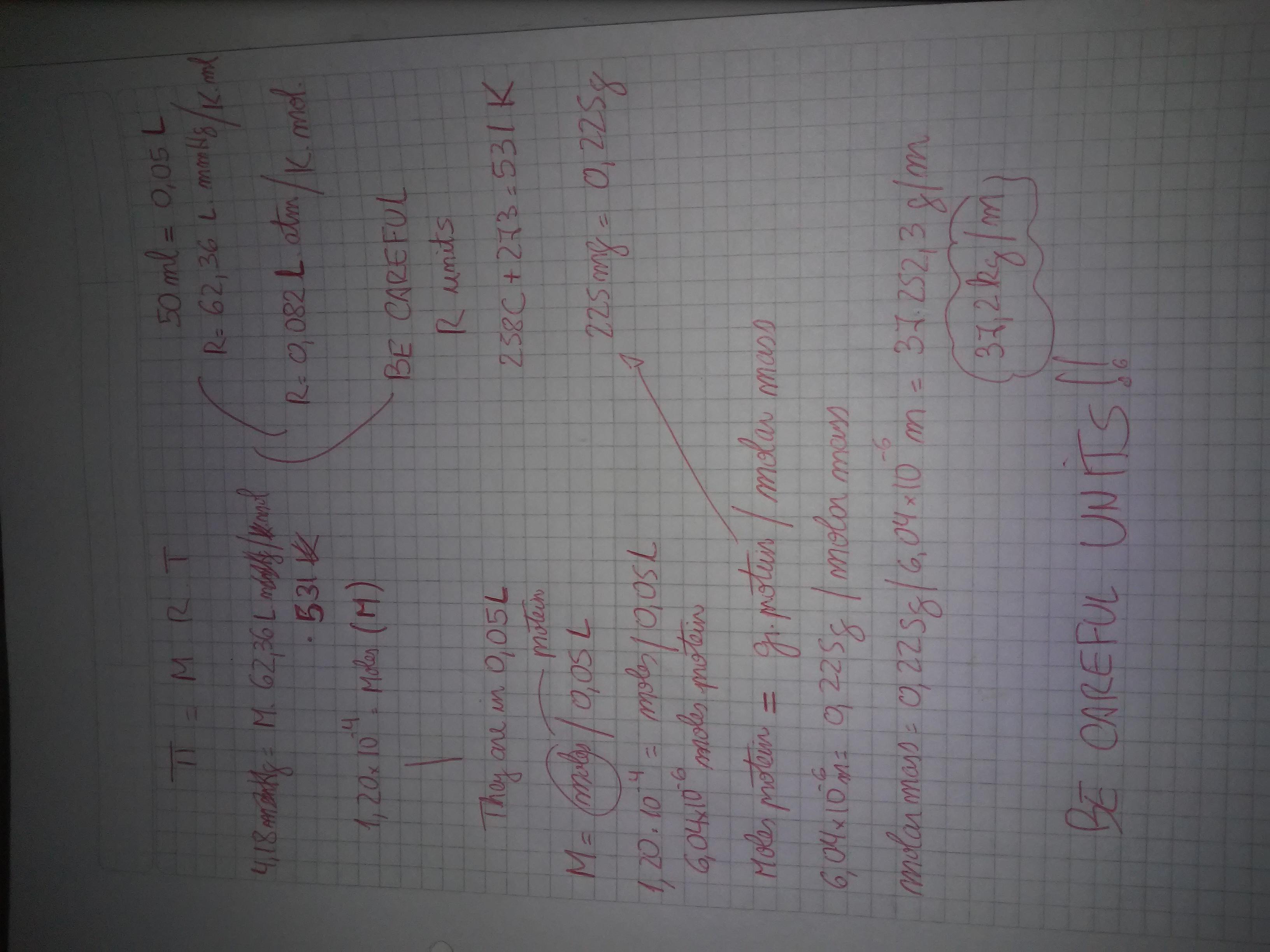
A biochemist isolates a new protein and determines its molar mass by osmotic pressure measurements. A 50.0-mL solution is prepar

ed by dissolving 225 mg of the protein in water. The solution has an osmotic pressure of 4.18 mm Hg at 258C. What is the molar mass of the new protein?

Chemistry
1 answer:
Valentin [98]2 years ago
8 0

Answer:

You have to apply the colligative property of osmotic pressure and other stuff.

The final answer is 37.2  kg/m

Explanation:

Hope you can understand, my notes. A little sloppy. Enjoy it! :)

You might be interested in
To maximize the yield in a certain manufacturing process, a solution of a weak monoprotic acid that has a concentration between
stira [4]

Answer: C 115 ml

Explanation:

If you have a solution of a monoprotic acid, it means that it has the form HA (just one Hydrigen atom). Therefore, one molecule of acid is going to react with just one molecule of  NaOH.

So, if you have a solution of 100 ml of 0,2 HA acid, it is going to react with a 100 ml of 0,2 M NaOH solution. Beacause we know that the acid can be a little more concentrated than 0,2 M (0,2-0,3), it probably needs a little more than 100 ml of NaOH to react.  So, the answer is C.

in 100 ml of 0,2M acid you can find 0,002 mol of HA

in 100 ml of 0,3 M acid you can find 0,003 mol of HA

in 100 ml of 0,2 M NaOH you can find 0,002 mol of NaOH

the answer can not be 200 because in 200 ml of 0,2 M NaOH there are 0,004 mol of NaOH, which is more than 0,003 mol.

0 0
2 years ago
Uranium–232 has a half–life of 68.9 years. A sample from 206.7 years ago contains 1.40 g of uranium–232. How much uranium was or
givi [52]

<u>Answer:</u> The initial amount of Uranium-232 present is 11.3 grams.

<u>Explanation:</u>

All the radioactive reactions follows first order kinetics.

The equation used to calculate half life for first order kinetics:

t_{1/2}=\frac{0.693}{k}

We are given:

t_{1/2}=68.9yrs

Putting values in above equation, we get:

k=\frac{0.693}{68.9}=0.0101yr^{-1}

Rate law expression for first order kinetics is given by the equation:

k=\frac{2.303}{t}\log\frac{[A_o]}{[A]}

where,

k = rate constant = 0.0101yr^{-1}

t = time taken for decay process = 206.7 yrs

[A_o] = initial amount of the reactant = ?

[A] = amount left after decay process = 1.40 g

Putting values in above equation, we get:

0.0101yr^{-1}=\frac{2.303}{206.7yrs}\log\frac{[A_o]}{1.40}

[A_o]=11.3g

Hence, the initial amount of Uranium-232 present is 11.3 grams.

4 0
2 years ago
Read 2 more answers
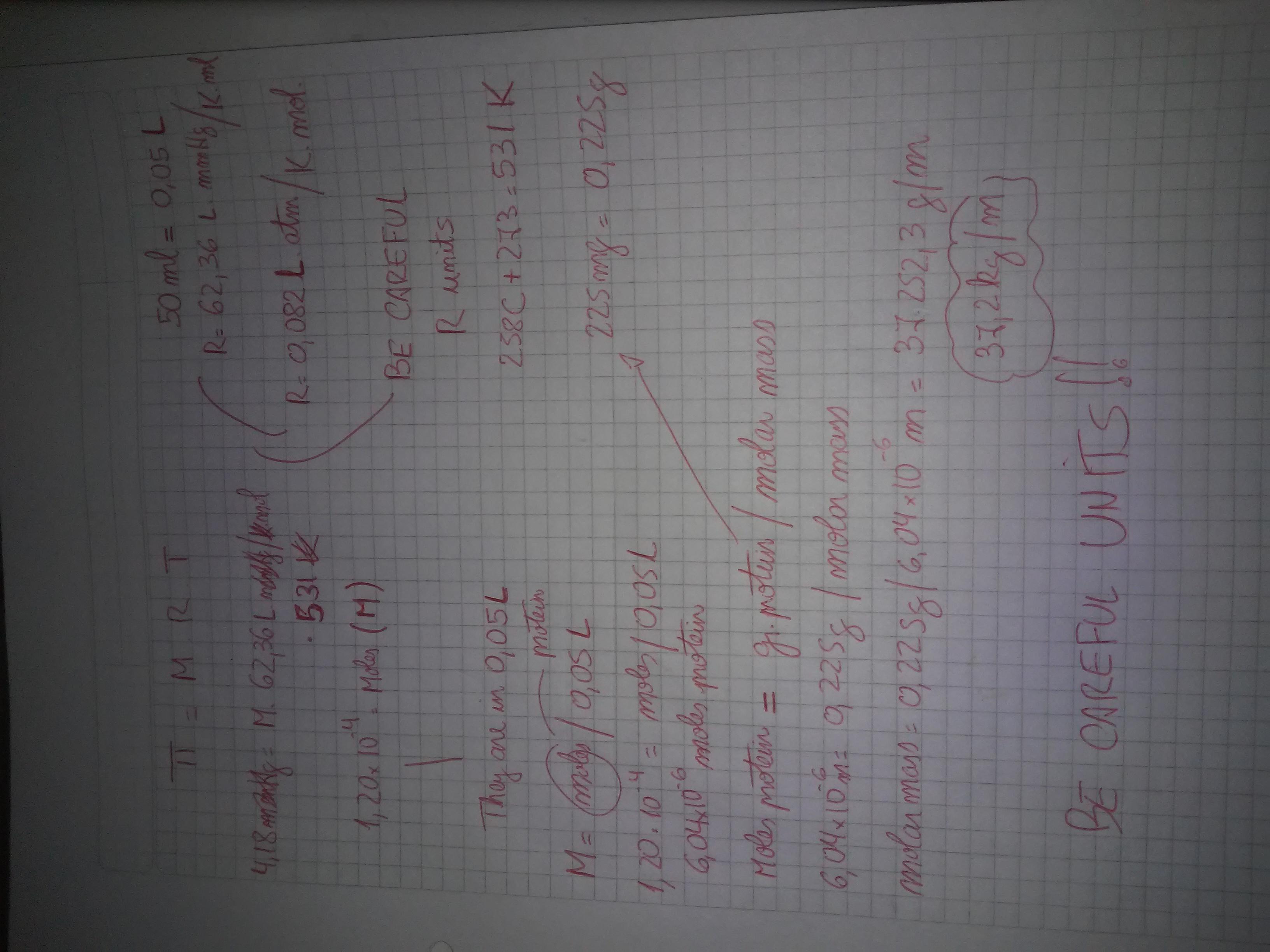
5.00 mol of ammonia are introduced into a 5.00 L reactor vessel in which it partially dissociates at high temperatures. 2NH 3(g)
allochka39001 [22]

Explanation:

system at equilibrium, will the reaction shift towards reactants ~

--?'

2. (2 Pts) Consider the reaction N2(g) + 3H2(g) =; 2NH3(g). The production of ammonia is an

exothermic reaction. Will heating the equilibrium system increase o~e amount of

ammonia produced? . .co:(

3. (2 Pts) Consider the reaction N2(g) + 3H2(g) =; 2NH3(g). Ifwe use a catalyst, which way will

the reaction shift? ':'\

.1.+- w~t s~,H (o')l r'eo.c. e~ ei~i"liht-,·u.fn\ P~~,

4. (3 Pts) ff 1ven th e o £ 11 owmg d t a a £ or th ere action: A(g) + 2B(s) =; AB2(g)

Temperature (K) Kc

300 1.5x10⁴

600 55 k ' pr, cl l<..J~

e- ~ r fee, ct o. ~ 1<

900 3.4 X 10⁻³

Is the reaction endothermic or exothermic (explain your answer)?

t d- IS o.,;r-. \4\a..i~1f't~ °the te.Y'il(lf1,:J'u.r-a a•~S. j lrvdu..c,,.) +~H~to{' '\

exothe-rnh't.-- ,.. ..,. (/.., ,~.

5. (4 Pts) Consider the reaction, N2(g) + 3H2(g) =; 2NH3(g). Kc= 4.2 at 600 K.

What is the value of Kc for 4 NH3(g) =; 2N2(g) + 6H2(g)

N ... ~l + 3 H~(ri ~ ~Nli3~) kl,= ~:s;H,J3 # 4. J..

~ ;)N~~) ~ ~ H ~) ~\-_ == [A!;J:t D~~Jb

J. [,v 1+3] ~

I

4,:i.~ = 0,05
4 0
2 years ago
In [cu(nh3)4]co3, how many 3d electrons does copper have?
Andreyy89

Copper has a total of 29 electrons which would place the atom on the 29th number in the periodic table. In [Cu(NH₃)₄], there are 9 3d electrons of copper. The electron configuration of copper is [Ar] 4s² 3d¹⁰ but since there is a sub shell of its figuration that indicates only 1 electron filled, and since it is in the law that an electron must be paired up with another electron no matter how completely filled is the last sub shell, that is why the ast electron was given up to the other sub shell making it 9. The d shell can occupy around 10 electrons so it means that copper is a stable atom in the 3d sub shell. When you add [Cr(H₂O)₆]³⁺ (aq) and NH₃ (aq) a green solution because both are aqueous in form, you will get a purple solution containing [Cr(NH₃)₆]³⁺ (aq) and H₂O (l). 

4 0
2 years ago
List the salts in order from weakest to strongest lattice energy (most positive to most negative). magnesium chloride, barium ch
almond37 [142]

Answer: Option (6) is the correct answer.

Explanation:

Lattice energy is described as the energy released when formation of 1 mole of an ionic compound occurs due to the combination of its constituent ions.

Also, lattice energy is inversely proportional to the distance between the cation and anion. And, when we move down a group then there occurs an increase in the atomic radii of the atoms.

This means that smaller is the ionic distance between the cation and anion, more will be the lattice energy between the atoms.

Therefore, order from weakest to strongest lattice energy (most positive to most negative) for the given compounds is as follows.

 barium chloride < strontium chloride < calcium chloride < magnesium chloride

6 0
2 years ago
Other questions:
  • Consider the equation: 2NO2(g) N2O4(g). Using ONLY the information given by the equation which of the following changes would in
    15·2 answers
  • Determine whether each of the examples or phrases describes an essential amino acid, a nonessential amino acid, or both essentia
    10·2 answers
  • When you open a bottle of a soft drink and leave it open, the drink eventually goes flat. this happens because the equilibrium b
    6·1 answer
  • A class is given a demonstration of solution chemistry and solubility equilibria.Passage: A 6.57-g sample of NiSO4•6H2O (molar m
    10·1 answer
  • 7.23 Th e condensation reaction of acetone, (CH3)2CO (propanone), in aqueous solution is catalyzed by bases, B, which react reve
    6·1 answer
  • What is the limiting reactant for the following reaction given we have 3.4 moles of Ca(NO3)2 and 2.4 moles of Li3PO4?Reaction: 3
    7·2 answers
  • A 0.050 M solution of AlCl3 had an observed osmotic pressure of 3.85 atm at 20 ∘C . Calculate the van't Hoff factor i for AlCl3.
    10·1 answer
  • Ethyl butyrate, CH3CH2CH2CO2CH2CH3, is an artificial fruit flavor commonly used in the food industry for such flavors as orange
    14·1 answer
  • In this problem, you will use Lenz's law to explore what happens when an electromagnet is activated a short distance from a wire
    13·1 answer
  • Which is an example of how society affects science?
    9·2 answers
Add answer
Login
Not registered? Fast signup
Signup
Login Signup
Ask question!