answer.
Ask question
Login Signup
Ask question
All categories
  • English
  • Mathematics
  • Social Studies
  • Business
  • History
  • Health
  • Geography
  • Biology
  • Physics
  • Chemistry
  • Computers and Technology
  • Arts
  • World Languages
  • Spanish
  • French
  • German
  • Advanced Placement (AP)
  • SAT
  • Medicine
  • Law
  • Engineering
lapo4ka [179]
2 years ago
3

The great Roman Poet, Lucretius wrote, "Things cannot be born from nothing, cannot when begottend brought back to nothing." This

statement became an accepted theory as a result of the work of the chemist, Lavoisier in the 18th century. This is the law of conservation of matter. Similarly, the law of conservation of energy is an important law in physics. Can you discuss the validity of the conservation of energy in terms of potential (gravitational or elastic) and kinetic energy by giving real-life applications
Physics
1 answer:
LUCKY_DIMON [66]2 years ago
3 0

Explanation:

When a swing is at its maximum height, the potential energy, associated with the height, is maximum. At this point its speed is zero, so the kinetic energy is zero. As the swing descends, having less height, the potential energy decreases and the kinetic energy increases. When it passes through the position with the minimum height, the potential energy is minimal and the kinetic energy is maximum.

This is true in the ideal case, in which there is no friction due to air resistance.  When friction is taken into account, implies that the swing stops gradually, since its energy is converted into thermal energy

You might be interested in
an iron rod of length 100m at 10 degree Celsius is used to measure a distance of 2km on a day when the temperature is 40 degree
german

Answer:

0.68 m

Explanation:

α = dL / L1*(dT)

dL = L1(dT) * α

Initial length, L1 = 100

Chang in Length =dL

α linear expansivity ; dL = change in length ; dT = change in temperature ; L1 = initial length

α of iron rod = 1.13 * 10^-5 k

dL = 100(40 - 10) * 1.13 * 10^-5

dL = 100(30) * 1.13 * 10^-5

dL = 3000 * 1.13 * 10^-5

dL = 3390 * 10^-5

dL = 0.0339 m

Error :

Distance measured = 2km = (2 * 1000) = 2000m

[Distance measured / (initial length + change in length)] × change in length

Error = (2000 / (100 + 0.0339)) * 0.0339

Error = (2000 / 100.0339) * 0.0339

Error = 19.993222 * 0.0339

Error = 0.6777702

Error = 0.68 m

4 0
2 years ago
A particle of mass m= 2.5 kg has velocity of v = 2 i m/s, when it is at the origin (0,0). Determine the z- component of the angu
melomori [17]

Answer:

please read the answer below

Explanation:

The angular momentum is given by

|\vec{L}|=|\vec{r}\ X \ \vec{p}|=m(rvsin\theta)

By taking into account the angles between the vectors r and v in each case we obtain:

a)

v=(2,0)

r=(0,1)

angle = 90°

L=(2.5kg)(1)(2\frac{m}{s})sin90\°=5.0kg\frac{m}{s}

b)

r=(0,-1)

angle = 90°

L=(2.5kg)(1)(2\frac{m}{s})sin90\°=5.0kg\frac{m}{s}

c)

r=(1,0)

angle = 0°

r and v are parallel

L = 0kgm/s

d)

r=(-1,0)

angle = 180°

r and v are parallel

L = 0kgm/s

e)

r=(1,1)

angle = 45°

L = (2.5kg)(2\frac{m}{s})(\sqrt{2})sin45\°=5kg\frac{m}{s}

f)

r=(-1,1)

angle = 45°

the same as e):

L = 5kgm/s

g)

r=(-1,-1)

angle = 135°

L=(2.5kg)(2\frac{m}{s})(\sqrt{2})sin135\°=5kg\frac{m}{s}

h)

r=(1,-1)

angle = 135°

the same as g):

L = 5kgm/s

hope this helps!!

4 0
2 years ago
A steel aircraft carrier is 370 m long when moving through the icy North Atlantic at a temperature of 2.0 °C. By how much does t
34kurt

Answer:

The carrier lengthen is 0.08436 m.

Explanation:

Given that,

Length = 370 m

Initial temperature = 2.0°C

Final temperature = 21°C

We need to calculate the change temperature

Using formula of change of temperature

\Delta T=T_{f}-T_{i}

\Delta T=21-2.0

\Delta T=19^{\circ}C

We need to calculate the carrier lengthen

Using formula of length

\Delta L=\alpha_{steel}\times L_{0}\times\Delta T

Put the value into the formula

\Delta L=1.2\times10^{-5}\times370\times19

\Delta L=0.08436\ m

Hence, The carrier lengthen is 0.08436 m.

8 0
2 years ago
An electron and a proton are held on an x axis, with the electron at x = + 1.000 m and the proton at x = - 1.000 m.how much work
aksik [14]
It is required an infinite work. The additional electron will never reach the origin.

In fact, assuming the additional electron is coming from the positive direction, as it approaches x=+1.00 m it will become closer and closer to the electron located at x=+1.00 m. However, the electrostatic force between the two electrons (which is repulsive) will become infinite when the second electron reaches x=+1.00 m, because the distance d between the two electrons is zero:
F=k_e  \frac{q_e q_e}{d^2}
So, in order for the additional electron to cross this point, it is required an infinite amount of work, which is impossible.
5 0
2 years ago
A 1100kg car pulls a boat on a trailer. (a) what total force resists the motion of the car, boat,and trailer, if the car exerts
likoan [24]
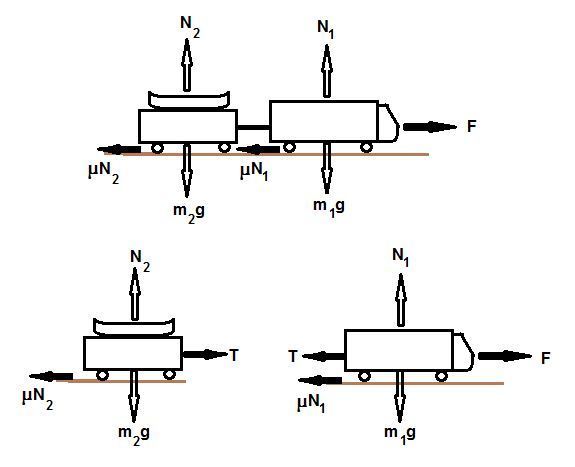
Refer to the figure shown below.

m₁ = 1100 kg, the mass of the car
m₂ = 700 kg, the mass of the trailer and boat
F = 1900 N, the driving force acting on the car
N₁ = m₁g,  the normal reaction on the car
N₂ = m₂g, the normal force on the trailer and boat
μN₁ and μN₂ are frictional forces, where  =  kinetic coefficient of friction
T = the force in the hitch between the car and trailer.

Part (a)
Let R₁ = the total force that resists the motion of the car, boat, and trailer.
Because the acceleration is 0.550m/s², therefore
(m₁ + m₂ kg)*(0.55 m/s²) = F
(1100+700 kg)*(0.55 m/s²) = (1900 - R₁) N
990 = 1900 - R
R₁ = 910 N

Answer: The resistive force is 910 N

Part (b)
80% of the resistive forces are experienced by the boat and trailer.
Let the resistive force be R₂.
Then
R₂ = 0.8*R₁ = 728 N
If the tension in the hitch between the car and the trailer is T, then
T - R₂ = m₂(0.55 m/s²)
(T - 728 N) = (700 kg)*(0.55 m/s²)
T - 728 = 385
T = 1113 N

Answer: The force in the hitch is 1113 N

3 0
2 years ago
Other questions:
  • Object A with a mass of 500 kilograms hits stationary object B with a mass of 920 kilograms. If the collision is elastic, what h
    14·1 answer
  • somewhere between the earth and the moon is a point where the gravitational attraction of the earth is canceled by the gravitati
    14·1 answer
  • A trebuchet was a hurling machine built to attack the walls of a castle under siege. A large stone could be hurled against a wal
    6·1 answer
  • If a force of 65 N is exerted on a 45 kg sofa and the sofa is moved 6.0 meters, how much work is done in moving the sofa? 17,550
    10·2 answers
  • A box sliding on a horizontal frictionless surface encounters a spring attached to a rigid wall and compresses the spring by a c
    9·1 answer
  • A 14000N car traveling at 25m/s rounds a curve of radius 200m. Find the following: a. The centripetal acceleration of the car.
    9·2 answers
  • A ladybug sits at the outer edge of a turntable, and a gentleman bug sits halfway between her and the axis of rotation. The turn
    7·2 answers
  • Given that the voltage across the capacitor as a function of time is V(t)=q0Ce−t/(ROC)V(t)=q0Ce−t/(RC), what is the current I(t)
    15·1 answer
  • Shows the position-versus-time graph of a particle in SHM. Positive direction is the direction to the right.
    6·1 answer
  • An ice dancer with her arms stretched out starts into a spin with an angular velocity of 1.00 rad/s. Her moment of inertia with
    11·1 answer
Add answer
Login
Not registered? Fast signup
Signup
Login Signup
Ask question!