answer.
Ask question
Login Signup
Ask question
All categories
  • English
  • Mathematics
  • Social Studies
  • Business
  • History
  • Health
  • Geography
  • Biology
  • Physics
  • Chemistry
  • Computers and Technology
  • Arts
  • World Languages
  • Spanish
  • French
  • German
  • Advanced Placement (AP)
  • SAT
  • Medicine
  • Law
  • Engineering
EleoNora [17]
2 years ago
7

The best approach to keeping your car in safe working order is to

Engineering
2 answers:
Soloha48 [4]2 years ago
3 0

Answer:

Explanation:

Your car's owner's manual will provide a maintenance schedule designed to keep your brakes in good condition. Following it is the easiest way to avoid expense repairs and the potential for catastrophic brake failure. But at the very least, you should have your brakes inspected every year.

Helga [31]2 years ago
3 0

Answer:

1. Perform regular based-on-time or based-on-use inspections and adjustments.

2. Perform regular good quality replacements according to use or/and environment conditions

Explanation:

The best approach to keeping a car in a <em>safe working order</em> is to perform <em>preventive maintenance activities</em> to avoid unexpected failures that could put at risk people in a car. These preventive maintenance activities could be categorized into two groups:

  • Regular based-on-time or based-on-use inspections and adjustments.
  • Regular good quality replacements.

Those maintenance activities <em>based-on-time</em> (generally, based on days) or<em> based-on-use</em> (according to miles or kilometers) <em>inspections and adjustments</em> include those performed, at least, on main components fluids levels and working conditions of:

  • <em>Motor oil</em> level and oil quality conditions.
  • <em>Motor coolant system</em> level.
  • <em>Braking system</em> liquid level.
  • <em>Steering system</em> liquid level.
  • Tires pneumatic pressure.
  • <em>Oil leakage</em> presence below motor, gears box (manual transmission) or automatic transmission or in front or/and rear axles.
  • Condition of <em>shock absorbers</em> (suspension system).

Those maintenance activities based on regular <em>good quality replacements</em> depend on the evaluation of the previous ones and include main components such as:

  • Motor oil.
  • Spark plugs.
  • Oil/Air/Gas filters.
  • Headlights and stop lights.
  • Battery.
  • Tires.
  • Brake's pads and brake rotor rectification.

Good quality means replacements that meet <em>quality norms</em> and well-performed maintenance activities.

Again, these are activities that are performed in main and critical components, that is, a failure on them may have a high impact with high consequences (including loss of life) for those inside the car.

You might be interested in
Steam enters a turbine operating at steady state at 1 MPa, 200 °C and exits at 40 °C with a quality of 83%. Stray heat transfer
Andrei [34K]

Answer:

(a) Work out put=692.83\frac{KJ}{Kg}

(b) Change in specific entropy=0.0044\frac{KJ}{Kg-K}

Explanation:

Properties of steam at 1 MPa and 200°C

        h_1=2827.4\frac{KJ}{Kg},s_1=6.69\frac{KJ}{Kg-K}

We know that if we know only one property in side the dome then we will find the other property by using steam property table.

Given that dryness or quality of steam at the exit of turbine is 0.83 and temperature T=40°C.So from steam table we can find pressure corresponding to saturation temperature 40°C.

Properties of saturated steam at 40°C

      h_f= 167.5\frac{KJ}{Kg} ,h_g= 2537.4\frac{KJ}{Kg}

 s_f= 0.57\frac{KJ}{Kg-K} ,s_g= 8.25\frac{KJ}{Kg-K}

So the enthalpy of steam at the exit of turbine  

h_2=h_f+x(h_g-h_f)\frac{KJ}{Kg}

h_2=167.5+0.83(2537.4-167.5)\frac{KJ}{Kg}

h_2=2134.57\frac{KJ}{Kg}

s_2=s_f+x(s_g-s_f)\frac{KJ}{Kg-K}

s_2=0.57+0.83(8.25-0.57)\frac{KJ}{Kg-K}

s_2=6.6944\frac{KJ}{Kg-K}

(a)

Work out put =h_1-h_2

                      =2827.4-2134.57 \frac{KJ}{Kg}

Work out put =692.83 \frac{KJ}{Kg}

(b) Change in specific entropy

     s_2-s_1=6.6944-6.69\frac{KJ}{Kg-K}

Change in specific entropy =0.0044\frac{KJ}{Kg-K}

3 0
2 years ago
A steady tensile load of 5.00kN is applied to a square bar, 12mm on a side and having a length of 1.65m. compute the stress in t
Shtirlitz [24]

Answer:

The stress in the bar is 34.72 MPa.

The design factor (DF) for each case is:

A) DF=0.17

B) DF=0.09

C) DF=0.125

D) DF=0.12

E) DF=0.039

F) DF=1.26

G) DF=5.5

Explanation:

The design factor is the relation between design stress and failure stress. In the case of ductile materials like metals, the failure stress considered is the yield stress. In the case of plastics or ceramics, the failure stress considered is the breaking stress (ultimate stress). If the design factor is less than 1, the structure or bar will endure the applied stress. By the opposite side, when the DF is higher than 1, the structure will collapse or the bar will break.

we will calculate the design stress in this case:

\displaystyle \sigma_{dis}=\frac{T_l}{Sup}=\frac{5.00KN}{(12\cdot10^{-3}m)^2}=34.72MPa

The design factor for metals is:

DF=\displaystyle \frac{\sigma_{dis}}{\sigma_{f}}=\frac{\sigma_{dis}}{\sigma_{y}}

The design factor for plastic and ceramics is:

DF=\displaystyle \frac{\sigma_{dis}}{\sigma_{f}}=\frac{\sigma_{dis}}{\sigma_{u}}

We now need to know the yield stress or the ultimate stress for each material. We use the AISI and ASTM charts for steels, materials charts for non-ferrous materials and plastics safety charts for the plastic materials.

For these cases:

A) The yield stress of AISI 120 hot-rolled steel (actually is AISI 1020) is 205 MPa, therefore:

DF=\displaystyle\frac{34.72MPa}{205MPa}=0.17

B) The yield stress of AISI 8650 OQT 1000 steel is 385 MPa, therefore:

DF=\displaystyle\frac{34.72MPa}{385MPa}=0.09

C) The yield stress of ductile iron A536-84 (60-40-18) is 40Kpsi, this is 275.8 MPa, therefore:

DF=\displaystyle\frac{34.72MPa}{275.8MPa}=0.125

D) The yield stress of aluminum allot 6061-T6 is 290 MPa, therefore:

DF=\displaystyle\frac{34.72MPa}{290MPa}=0.12

E) The yield stress of titanium alloy Ti-6Al-4V annealed (certified by manufacturers) is 880 MPa, therefore:

DF=\displaystyle\frac{34.72MPa}{880MPa}=0.039

F) The ultimate stress of rigid PVC plastic (certified by PVC Pipe Association) is 4Kpsi or 27.58 MPa, therefore:

DF=\displaystyle\frac{34.72MPa}{27.58 MPa}=1.26

In this case, the bar will break.

F) You have to consider that phenolic plastics are used as matrix in composite materials and seldom are used alone with no reinforcement. In this question is not explained if this material is reinforced or not, therefore I will use the ultimate stress of most pure phenolic plastics, in this case, 6.31 MPa:

DF=\displaystyle\frac{34.72MPa}{6.31 MPa}=5.5

This material will break.

3 0
2 years ago
A curve in a speed track has a radius of 1000 ft and a rated speed of 120 mi/h. (From Sample Prob. 12.7 is the definition of rat
forsale [732]

Answer:

tan \theta = \frac{(176ft/s)^2}{1000 ft 32.2 ft/s^2}= 0.962

\theta = tan^{-1} (0.962) = 43.89

Explanation:

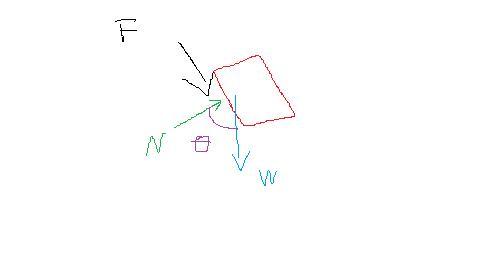
If the question is: Determine the banking angle θ

We have the forces involved on the figure attached.

For this case we know that the weight is given by:

W = mg

And for this case the centripetal acceleration would be given by:

a=\frac{v^2}{r}

If we analyze the sum of forces on x and y we have:

\sum F_x = m a_x

F + W sin \theta = ma cos theta

And if we solve for the force we got:

F = ma cos \theta - mg sin \theta = \frac{mv^2}{r} cos \theta - mg sin \theta

\sum F_y = m a_y

N - W cos \theta = ma sin \theta

If we solve for the normal force we got:

N =W cos \theta + ma sin \theta = \frac{mv^2}{r} sin \theta + mg cos \theta

In order to find the banking angle we use the fact that F =0

0 = \frac{mv^2}{r} cos \theta - mg sin \theta

tan \theta= \frac{v^2}{rg}

The velocity on this case is 120 mi/h if we convert this into ft/ s we got:

120 mi/h * \frac{5280 ft}{1mi} *\frac{1hr}{3600 s}= 176 ft/s

And then we have this:

tan \theta = \frac{(176ft/s)^2}{1000 ft 32.2 ft/s^2}= 0.962

\theta = tan^{-1} (0.962) = 43.89

5 0
2 years ago
A fuel oil is burned with air in a furnace. The combustion produces 813 kW of thermal energy, of which 65% is transferred as hea
DENIUS [597]

Answer:

im not sure

Explanation:

8 0
2 years ago
1. A glass window of width W = 1 m and height H = 2 m is 5 mm thick and has a thermal conductivity of kg = 1.4 W/m*K. If the inn
emmasim [6.3K]

Answer:

1. \dot Q=19600\ W

2. \dot Q=120\ W

Explanation:

1.

Given:

  • height of the window pane, h=2\ m
  • width of the window pane, w=1\ m
  • thickness of the pane, t=5\ mm= 0.005\ m
  • thermal conductivity of the glass pane, k_g=1.4\ W.m^{-1}.K^{-1}
  • temperature of the inner surface, T_i=15^{\circ}C
  • temperature of the outer surface, T_o=-20^{\circ}C

<u>According to the Fourier's law the rate of heat transfer is given as:</u>

\dot Q=k_g.A.\frac{dT}{dx}

here:

A = area through which the heat transfer occurs = 2\times 1=2\ m^2

dT = temperature difference across the thickness of the surface = 35^{\circ}C

dx = t = thickness normal to the surface = 0.005\ m

\dot Q=1.4\times 2\times \frac{35}{0.005}

\dot Q=19600\ W

2.

  • air spacing between two glass panes, dx=0.01\ m
  • area of each glass pane, A=2\times 1=2\ m^2
  • thermal conductivity of air, k_a=0.024\ W.m^{-1}.K^{-1}
  • temperature difference between the surfaces, dT=25^{\circ}C

<u>Assuming layered transfer of heat through the air and the air between the glasses is always still:</u>

\dot Q=k_a.A.\frac{dT}{dx}

\dot Q=0.024\times 2\times \frac{25}{0.01}

\dot Q=120\ W

5 0
2 years ago
Other questions:
  • How much extra water does a 21.5 ft, 175-lb concrete canoe displace compared to an ultra-lightweight 38-lb Kevlar canoe of the s
    8·1 answer
  • A square loop of wire surrounds a solenoid. The side of the square is 0.1 m, while the radius of the solenoid is 0.025 m. The sq
    6·1 answer
  • At a certain college, 30% of the students major in engineering, 20% play club sports, and 10% both major in engineering and play
    14·1 answer
  • One mole of iron (6 1023 atoms) has a mass of 56 grams, and its density is 7.87 grams per cubic centimeter, so thecenter-to-cent
    15·1 answer
  • Refrigerant-134a at 400 psia has a specific volume of 0.1384 ft3/lbm. Determine the temperature of the refrigerant based on (a)
    6·1 answer
  • A well-insulated tank in a vapor power plant operates at steady state. Saturated liquid water enters at inlet 1 at a rate of 125
    8·1 answer
  • The mechanical properties of some metals may be improved by incorporating fine particles of their oxides. If the moduli of elast
    12·1 answer
  • Toeboards are usually ___ inches high and used on landings and balconies.
    8·1 answer
  • Water at 70 kPa and 1008C is compressed isentropically in a closed system to 4 MPa. Determine the final temperature of the water
    6·1 answer
  • What should always be done before beginning any diagnosis?
    9·1 answer
Add answer
Login
Not registered? Fast signup
Signup
Login Signup
Ask question!