answer.
Ask question
Login Signup
Ask question
All categories
  • English
  • Mathematics
  • Social Studies
  • Business
  • History
  • Health
  • Geography
  • Biology
  • Physics
  • Chemistry
  • Computers and Technology
  • Arts
  • World Languages
  • Spanish
  • French
  • German
  • Advanced Placement (AP)
  • SAT
  • Medicine
  • Law
  • Engineering
user100 [1]
2 years ago
3

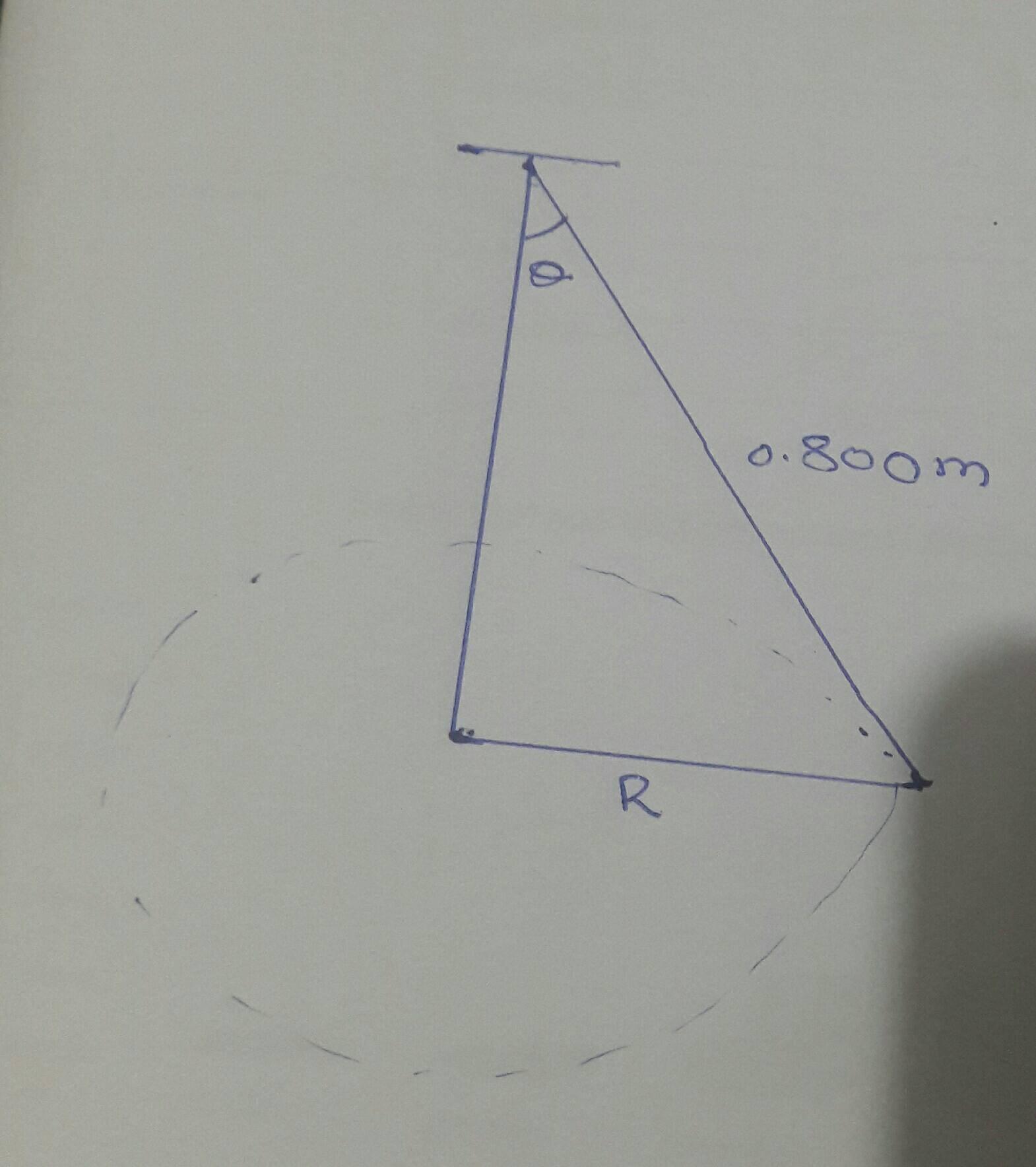
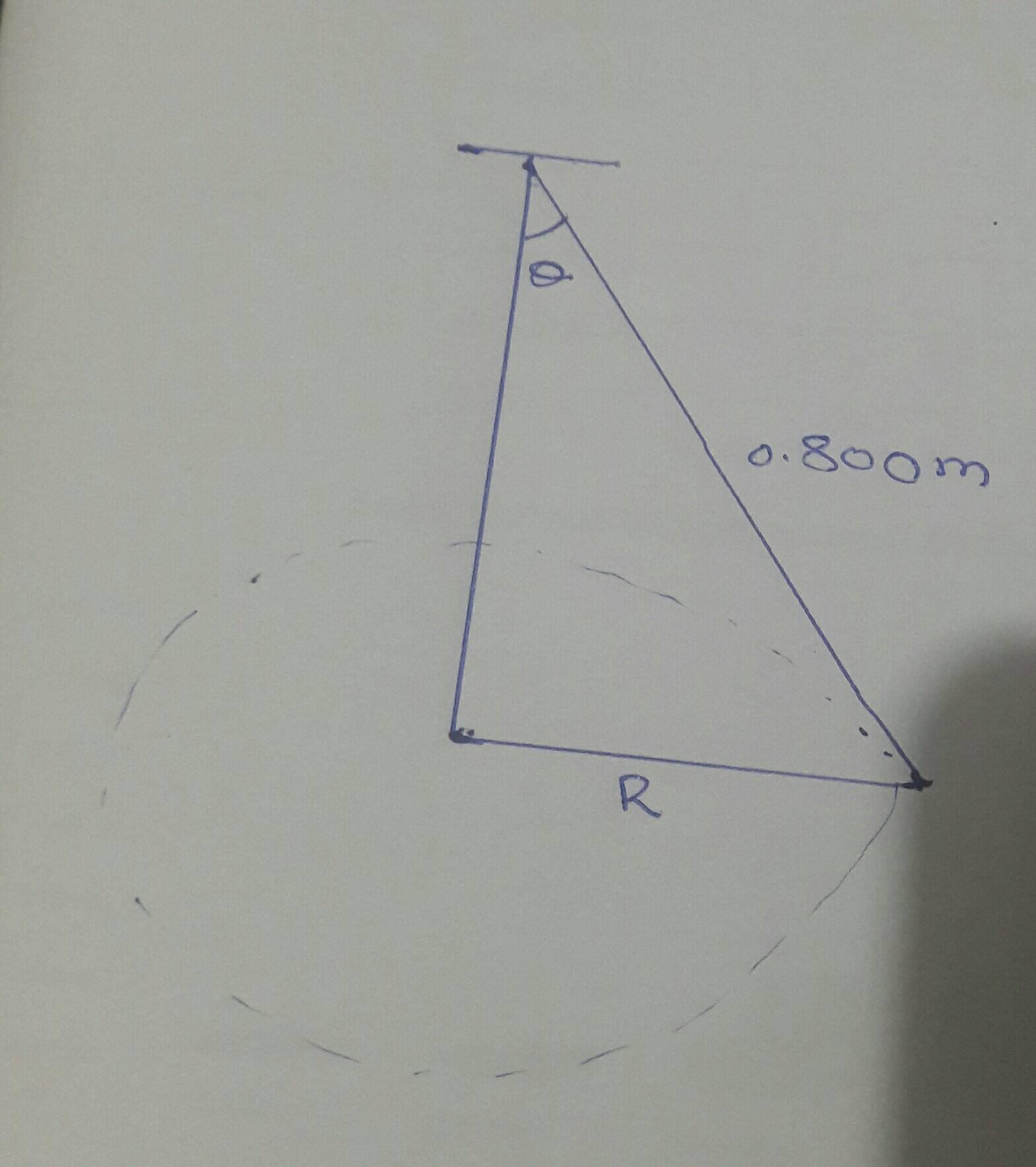
A small ball is attached to the lower end of a 0.800-m-long string, and the other end of the string is tied to a horizontal rod.

The string makes a constant angle of 49.3° with the vertical as the ball moves at a constant speed in a horizontal circle. If it takes the ball 1.45 s to complete one revolution, what is the magnitude of the radial acceleration of the ball?

Physics
1 answer:
vitfil [10]2 years ago
3 0

Answer:

a= 11.36 m/s²

Explanation:

Radius of circle=R=0.8 sin∅

                             =0.8 sin(49.3)

                             =0.606 m

 and we know that

                               ω=\frac{2\pi }{T}

                                   =\frac{2*3.141592}{1.45}

                                 ω=4.33 s^{-1}

                                 a=R ω²

                                   =0.606*(4.33^{2}

                                  a=11.36 m/s²


You might be interested in
The Lyman series comprises a set of spectral lines. All of these lines involve a hydrogen atom whose electron undergoes a change
mihalych1998 [28]

Answer:

a) 1.2*10^-7 m

b) 1.0*10^-7 m

c) 9.7*10^-8 m

d) ultraviolet region

Explanation:

To find the different wavelengths you use the following formula:

\frac{1}{\lambda}=R_H(1-\frac{1}{n^2})

RH: Rydberg constant = 1.097 x 10^7 m^−1.

(a) n=2

\frac{1}{\lambda}=(1.097*10^7m^{-1})(1-\frac{1}{(2)^2})=8227500m^{-1}\\\\\lambda=1.2*10^{-7}m

(b)

\frac{1}{\lambda}=(1.097*10^7m^{-1})(1-\frac{1}{(3)^2})=9751111,1m^{-1}\\\\\lambda=1.0*10^{-7}m

(c)

\frac{1}{\lambda}=(1.097*10^7m^{-1})(1-\frac{1}{(4)^2})=10284375m^{-1}\\\\\lambda=9.7*10^{-8}m

(d) The three lines belong to the ultraviolet region.

8 0
2 years ago
A brass lid screws tightly onto a glass jar at 20 degrees C. To help open the jar, it can be placed into a bath of hot water. Af
omeli [17]

Answer:

0.0016 cm

Explanation:

\alpha_b = Thermal coefficient of expansion of brass = 19\times 10^{-6}\ /^{\circ}C

\alpha_g = Thermal coefficient of expansion of glass = 9\times 10^{-6}\ /^{\circ}C

\Delta T = Change in temperature = (60-20)^{\circ}C

R_0 = Initial radius = 4 cm

Change in radius of material is given by

R=R_0(1+\alpha\Delta T)

Difference in radii of the lid and jar

\Delta R=R_b-R_g\\\Rightarrow \Delta R=R_0(1+\alpha_b\Delta T)-R_0(1+\alpha_g\Delta T)\\\Rightarrow \Delta R=R_0(\alpha_b-\alpha_g)\Delta T\\\Rightarrow \Delta R=4\times (19\times 10^{-6}-9\times 10^{-6})\times (60-20)\\\Rightarrow \Delta R=0.0016\ cm

The size of the gap is 0.0016 cm or 0.000016 m

8 0
2 years ago
A box of mass 8 kg slides across a frictionless surface at an initial speed 1.5 m/s into a relaxed spring of spring constant 69
Sav [38]

Answer:

1.1 sec

Explanation:

m = mass of the box = 8 kg

k = spring constant of the spring = 69 N/m

v = initial speed of the box = 1.5 m/s

t = time period of oscillation of box in contact with the spring

Time period is given as

t = \pi \sqrt{\frac{m}{k}}

Inserting the values

t = (3.14) \sqrt{\frac{8}{69}}

t = 1.1 sec

5 0
2 years ago
A mouse runs along a baseboard in your house. The mouse's position as a function of time is given by x(t)=pt2+qt, with p = 0.36
AlexFokin [52]

Answer:

0.60 m/s

Explanation:

The average velocity from t = a to t = b is:

v_avg = (x(b) − x(a)) / (b − a)

Given that x(t) = 0.36t² − 1.20t, and the time is from 1.0 to 4.0:

v_avg = (x(4.0) − x(1.0)) / (4.0 − 1.0)

v_avg = [(0.36(4.0)² − 1.20(4.0)) − (0.36(1.0)² − 1.20(1.0))] / 3.0

v_avg = [(5.76 − 4.8) − (0.36 − 1.20)] / 3.0

v_avg = [0.96 − (-0.84)] / 3.0

v_avg = 0.60

The average speed is 0.60 m/s.

5 0
2 years ago
How does increasing the distance between charged objects affect the electric force between them? the electric force increases be
konstantin123 [22]

the electric force decreases because the distance has an indirect relationship to the force

Explanation:

The electric force between two objects is given by

F=k \frac{q_1 q_2}{r^2}

where

k is the Coulomb's constant

q1 and q2 are the charges of the two objects

r is the distance between the two objects

As we can see from the formula, the magnitude of the force is inversely proportional to the square of the distance: so, when the distance between the object increases, the magnitude of the force decreases.
3 0
2 years ago
Read 2 more answers
Other questions:
  • A 2.50 × 10⁵ W motor is used for 26.4 s to pull a boat straight toward shore. How far does the boat move toward shore if a force
    15·1 answer
  • Which best contrasts an electric generator and an electric motor? In a generator, slip rings function as a solenoid, and in a mo
    5·2 answers
  • How does melting And burning sugar follow the law of conservation of mass
    8·2 answers
  • A block weighing 400 kg rests on a horizontal surface and supports on top of it ,another block of weight 100 kg which is attache
    10·1 answer
  • 150-N box is being pulled horizontally in a wagon accelerating uniformly at 3.00 m/s2. The box does not move relative to the wag
    13·1 answer
  • 01 – (Valor – 2,0) O maior campo de testes de veículos da América Latina, localizado na cidade de Indaiatuba (SP), tem forma cir
    15·1 answer
  • Consider a steel tape measure with cross-sectional area, A = 0.0625 inches squared, and length L = 3, 600 inches at room tempera
    8·1 answer
  • Suppose a 500 mb chart valid today at 12 Z indicates a large trough over the eastern US and a large ridge over the western US. A
    13·1 answer
  • In downtown Chicago, the east-west blocks are 400 ft long while the north-south blocks are 280 ft long. Because of the many one-
    12·1 answer
  • Two moles of an ideal gas at 3.0 atm and 10 °C are heated up to
    8·1 answer
Add answer
Login
Not registered? Fast signup
Signup
Login Signup
Ask question!
