answer.
Ask question
Login Signup
Ask question
All categories
  • English
  • Mathematics
  • Social Studies
  • Business
  • History
  • Health
  • Geography
  • Biology
  • Physics
  • Chemistry
  • Computers and Technology
  • Arts
  • World Languages
  • Spanish
  • French
  • German
  • Advanced Placement (AP)
  • SAT
  • Medicine
  • Law
  • Engineering
tekilochka [14]
2 years ago
10

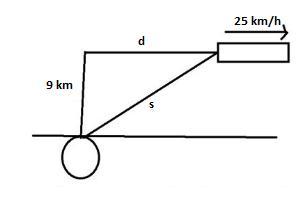
A ship is moving at a speed of 25 km/h parallel to a straight shoreline. The ship is 9 km from shore and it passes a lighthouse

at noon. (a) Express the distance s between the lighthouse and the ship as a function of d, the distance the ship has traveled since noon. s = f(d) = (b) Express d as a function of t, the time elapsed since noon. d = g(t) = (c) Find f ∘ g. (f ∘ g)(t) =

Physics
1 answer:
sp2606 [1]2 years ago
6 0

Explanation:

It is given that,

Speed of the ship, v = 25 km/h

Distance between the ship and the shore is 9 km

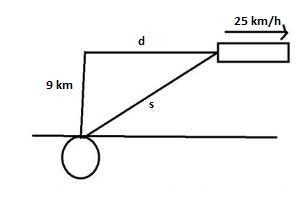
Let s is the distance between the lighthouse and the ship and d is the distance traveled by the ship since noon.

(a) Using Pythagoras theorem in the attached diagram as :

s^2=9^2+d^2

s^2=81+d^2

s=\sqrt{81+d^2}

or f(d)=\sqrt{81+d^2}

(b) Let g(t) is the function at t = 0 and at 12 pm.

f(g)=fog

Since, distance, d = 25t

So, f(g(t))=\sqrt{9^2+(25t)^2}

f(g(t))=\sqrt{81+(652t)^2}

Hence, this is the required solution.

You might be interested in
A professional boxer hits his opponent with a 1025 N horizontal blow that lasts 0.150 s. The opponent's total body mass is 116 k
mylen [45]

Answer:

The impulse is  I  =  153.8 \ N \cdot s

The opponents velocity is  v=  1.33 m/s

The opponents head recoils velocity  v_r = 30.8 \ m/s

Explanation:

From the question we are told that

    The force of the blow is  F=  1025 \ N

    The duration of the blow is  t =  0.150

      The mass of the opponent is  m_o  =  116 \ kg

       The mass of the opponents head is  m_h  = 5 \ kg

The impulse the boxer imparts is mathematically represented as

         I  =  F *  t

substituting values

         I  =  1025 * 0.150

          I  =  153.8 \ N \cdot s

The impulse can also be mathematically evaluated as

         I  =  m_o * v

substituting values

          153.8  =  116 * v

          v=  \frac{153.8}{116}

          v=  1.33 m/s

The recoil velocity is mathematically represented as  

              v_r =  \frac{I}{m_h}

substituting values

                v_r =  \frac{153.8}{5}

                v_r = 30.8 \ m/s

5 0
2 years ago
A hot air balloon must be designed to support a basket, cords, and one person for a total payload weight of 1300 N plus the addi
RSB [31]

Answer:

r = 4.44 m

Explanation:


For this exercise we use the Archimedes principle, which states that the buoyant force is equal to the weight of the dislodged fluid

         B = ρ g V

Now let's use Newton's equilibrium relationship

         B - W = 0

         B = W

The weight of the system is the weight of the man and his accessories (W₁) plus the material weight of the ball (W)

         σ = W / A

         W = σ A

The area of ​​a sphere is

           A = 4π r²

       W = W₁ + σ 4π r²

The volume of a sphere is

           V = 4/3 π r³

Let's replace

     ρ g 4/3 π r³ = W₁ + σ 4π r²

If we use the ideal gas equation

     P V = n RT

    P = ρ RT

    ρ = P / RT


    P / RT g 4/3 π r³ - σ 4 π r² = W₁

    r² 4π (P/3RT  r - σ) = W₁

Let's replace the values

     r² 4π (1.01 10⁵ / (3 8.314 (70 + 273)) r - 0.060) = 13000

     r² (11.81 r -0.060) = 13000 / 4pi

     r² (11.81 r - 0.060) = 1034.51

As the independent term is very small we can despise it, to find the solution

       r = 4.44 m

3 0
2 years ago
Q1: A runner is jogging in a straight line at a steady vr= 6.8 km/hr. When the runner is L= 2.4 km from the finish line, a bird
serious [3.7K]

Answer:

Q1: 3.2km

Q2: 4.8K

Explanation:

Q1:

So db is the distance of bird, and dr is the distance of runner

db = 2vr  and the distance of bird is going to be 2 times greater than the runner.

formulas: db = 2vr & db = 2dr

  1. db = 2dr
  2. L + (L - x) = 2x
  3. 2L - x = 2x
  4. 2L = 3x
  5. x = \frac{2}{3}L

Insert it in x = \frac{2}{3}L

\frac{2}{3}(2.4km) = 1.6km

Now we use formula db = 2dr

  1. db = 2L - x
  2. db = 2(2.4km) - 1.6km
  3. <u>db = 3.2km</u>

Q2:

Formulas: Vr = L /Δt & Vb = db/Δt

  1. Vr = L/ Δt ⇒ Δt = \frac{L}{Vr}
  2. \frac{2.4km}{6.8km/hr}
  3. \frac{6}{17}hr

(Km cancel each other)

  1. Vb = db/Δt ⇒ db = VbΔt
  2. 13.6km/hr(\frac{6}{17}hr )
  3. <u>4.8km</u>

(hr cancel each other)

Hope it helps you :)

6 0
2 years ago
An observer O is standing on a platform of length L = 90 m on a station. A rocket train passes at a relative (constant) speed of
Natali [406]

Answer:

Explanation:

Since the front and back of the rocket simultaneously line up with forward and backward end of the platform respectively .

Then length of the platform = length of the train rocket .

A )

Time to cross a particular point on the platform

= length of rocket train / .96 x 3 x 10⁸

= 90 /  .96 x 3 x 10⁸

= 31.25 x 10⁻⁸ s

B)  Rest length of the rocket = length of platform = 90 m

C ) length of platform  as viewed by moving observer =

\frac{90}{\sqrt{1-\frac{v^2}{c^2 } } }

= \frac{90}{\sqrt{1-\frac{0.92}{1 } } }

= 321 m

D )  For the observer on platform time taken = 31.25 x 10⁻⁸ s

for the observer in the rocket , time will be dilated so time recorded by observer in motion ,

31.25\times10^{-8} \times \sqrt{1-\frac{.96^2}{1} }

8.75 x 10⁻⁸ s .

8 0
2 years ago
A cart moves along a track at a velocity of 3.5 cm/s. when a force is applied to the cart, its velocity increases to 8.2 cm/s. i
oksian1 [2.3K]
Acceleration, in physics, is the rate of change of velocity of an object with respect to time. <span> Anytime an object's velocity is changing, the object is said to be </span><span>accelerating. It can be calculated as follows:

acceleration = 8.2 - 3.5 / 1.5 = 3.1 m/s</span>²

Hope this answers the question.
5 0
2 years ago
Read 2 more answers
Other questions:
  • A flat rectangular loop of wire carrying a 4.0-a current is placed in a uniform 0.60-t magnetic field. the magnitude of the torq
    13·1 answer
  • Compare the density, weight, mass, and volume of a pound of gold to a pound of iron on the surface of Earth.
    11·1 answer
  • A backyard swimming pool with a circular base of diameter 6.00 m is filled to depth 1.50 m. (a) Find the absolute pres- sure at
    6·1 answer
  • A barge is 10.0 m wide and 60.0 m long and has vertical sides. The bottom of the hull is 12.0 m below the water surface. What ar
    8·1 answer
  • Although 0 dB is often referred to as the lower threshold of human hearing, it is important to realize that the human ear is not
    13·1 answer
  • Of the three primary forms of subaerial volcanoes, ________ are large cone-shaped mountains that consist of alternating layers o
    5·1 answer
  • A 1500 kg car enters a section of curved road in the horizontal plane and slows down at a uniform rate from a speed of 100 km/h
    13·1 answer
  • Which statements describe properties of stars check all that apply
    7·1 answer
  • an ideal gas is confined to a container with adjustable volume. the number of moles, n, and temperature, t, are constant. by wha
    10·1 answer
  • A water park is designing a new water slide that finishes with the rider flying horizontally off the bottom of the slide. The sl
    6·1 answer
Add answer
Login
Not registered? Fast signup
Signup
Login Signup
Ask question!