answer.
Ask question
Login Signup
Ask question
All categories
  • English
  • Mathematics
  • Social Studies
  • Business
  • History
  • Health
  • Geography
  • Biology
  • Physics
  • Chemistry
  • Computers and Technology
  • Arts
  • World Languages
  • Spanish
  • French
  • German
  • Advanced Placement (AP)
  • SAT
  • Medicine
  • Law
  • Engineering
Irina-Kira [14]
2 years ago
14

What is the oxidation state of each element in Mn(Cro4)2?

Chemistry
2 answers:
Kobotan [32]2 years ago
8 0

Answer:

CrO4 is the "chromate" ion and has a -2

since there are 2 and the overall charge of Mn(CrO4)2 is zero.. Mn is +4

O is -2 as it usually is...

so Cr is +6

ElenaW [278]2 years ago
7 0

The The oxidation state of each element in Mn(Cro4)2 is

Oxidation state of  Mn is  +4

Oxidation state of  is -2

Oxidation state of Cr is +6

<u>Explanation</u> :

The oxidation number denotes the number of electrons the atom loses in a chemical compound.

Also, oxidation number is equal to the charge of the ion. In the above compound oxidation state of Cro4 is -2 and there are two ions together. Thus, there oxidation state would be -4.

Mn have the oxidation state of +4. And oxidation charge of oxygen is always -2. In equation Cro4 there are 4 oxygen each having oxidation charge of -2. Making it -8 in total. Cro4 has its oxidation charge of -2. Thus adding up the charges it turns out to be +6 for chromium.    

You might be interested in
On the axes provided, label pressure on the horizontal axis from O mb to 760 mb and volume on the vertical axis from O to 1 mL.
Delicious77 [7]

Answer:

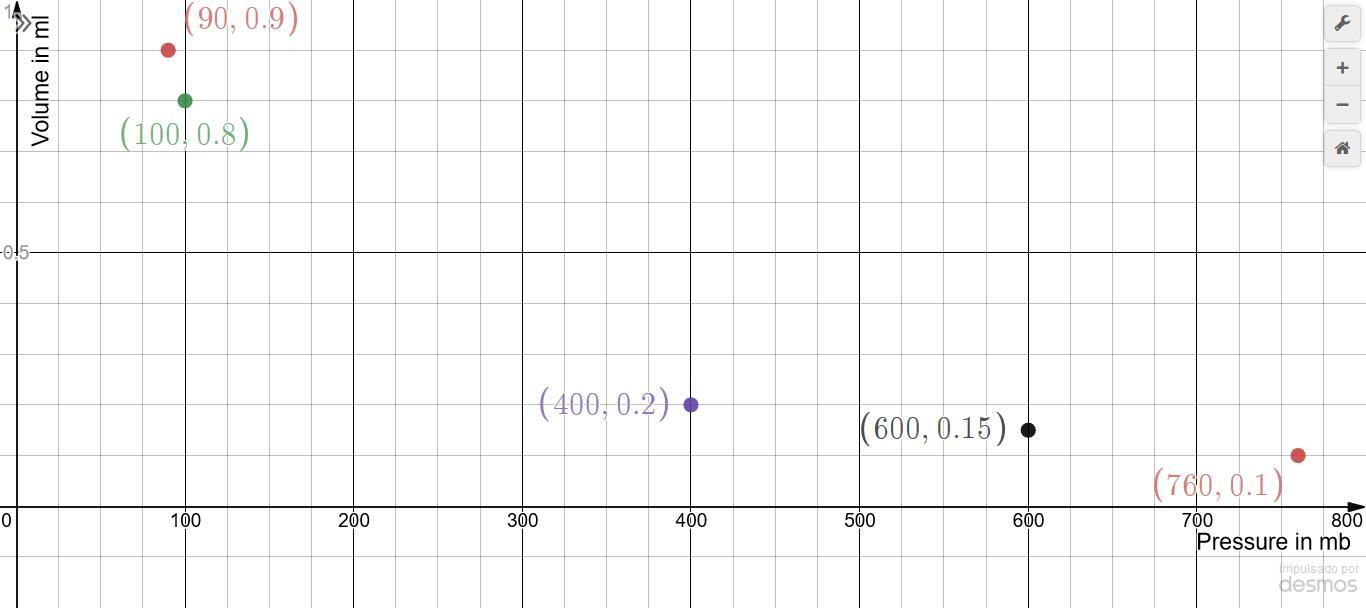
  • Please, find the graph with the labels and points located on the axes in the picture attached.

Explanation:

This is how you meet all the instructions and some important comments to understand how this kind of graphs word:

<u>1) Label pressure on the horizontal axis from O mb to 760 mb and volume on the vertical axis from O to 1 mL. </u>

The horizontal axis is used to record the independent variable and the vertical axis is used to record the dependent variable. The axes most be properly labeled with the name of the variable and the units.

In this case the origin is the point (0,0) which means that the axes cross each other, perpendicularly, at a pressure of 0 mb and a volume of 0.0 mililiters.

<u>2) Assign values to axes divisions in such a way that you occupy almost all the space on both axes. </u>

A good graph searches to occupy the whole space on both cases; to do that, find the maximum value for each variable, pressure and volume, and choose the values of the marks.

The range of the pressure (horizontal axis) is [90, 760 mb], so you should choose big divisions (marks) of 100 mb, and assign 800 mb to the right most mark on the horizontal axis. Then, you can divide each interval of 100 mb into 10 spaces, with small divisions of 10 mb (my graph uses 4 spcaes, with small divisions of 25 mb, but I recommend you use small divisions of 10 mb).

The range of the volume (vertical axis) is [0.1, 0.8], so you should choose only divisions with value of 0.1 ml.

<u>3) Now locate and label the points: </u>

  • (90, 0.9) ⇒ 90 mb, 0.9 ml
  • (100, 0.8) ⇒ 100 mb, 0.8 ml
  • (400, 0.2) ⇒ 400 mb, 0.2 ml
  • (600, 0.15) ⇒ 600 mb, 0.15 ml
  • (760, 0.1) ⇒ 760 mb, 0.1 ml

The points of the kind (x, y) are called ordered pairs, which means that the order matters, because it has a meaning: the first number represents the independent variable and the second number represents the dependent variable.

So, in the point (90, 0.9), 90 is a pressure of 90 mb and 0.9 is a volume of 0.9 ml.

To locate (600, 0.15), since the horizontal marks have value of 0.1, you must locate the second coordinate of your point between the marks 0.1 and 0.2 ml.

With that you can now locate each point on your graph.

5 0
2 years ago
Read 2 more answers
Which of the following is a correctly written chemical equation that demonstrates the conservation of mass?
Fantom [35]

Answer:

Option D is correct.

H₂O + CO₂      →    H₂CO₃

Explanation:

First of all we will get to know what law of conservation of mass states.

According to this law, mass can neither be created nor destroyed in a chemical equation.

This law was given by French chemist  Antoine Lavoisier in 1789. According to this law mass of reactant and mass of product must be equal, because masses are not created or destroyed in a chemical reaction.

Example:

6CO₂ + 6H₂O + energy → C₆H₁₂O₆ + 6O₂

there are six carbon atoms, eighteen oxygen atoms and twelve hydrogen atoms on the both side of equation so this reaction followed the law of conservation of mass.

Now we will apply this law to given chemical equations:

A) H₂ + O₂   →    H₂O

There are two hydrogen and two oxygen atoms present on left side while on right side only one oxygen and two hydrogen atoms are present so mass in not conserved. This equation not follow the law of conservation of mass.

B) Mg + HCl   →   H₂ + MgCl₂

In this equation one Mg, one H and one Cl atoms are present on left side while on right side two hydrogen, one Mg and two chlorine atoms are present. This equation also not follow the law of conservation of mass.

C) KClO₃      →     KCl + O₂

There are one K, one Cl and three O atoms are present on left side of chemical equation while on right side one K one Cl and two oxygen atoms are present. This equation also not following the law of conservation of mass.

D)  H₂O + CO₂      →    H₂CO₃

There are two hydrogen, one carbon and three oxygen atoms are present on both side of equation thus, mass remain conserved. Thus is correct option.

6 0
2 years ago
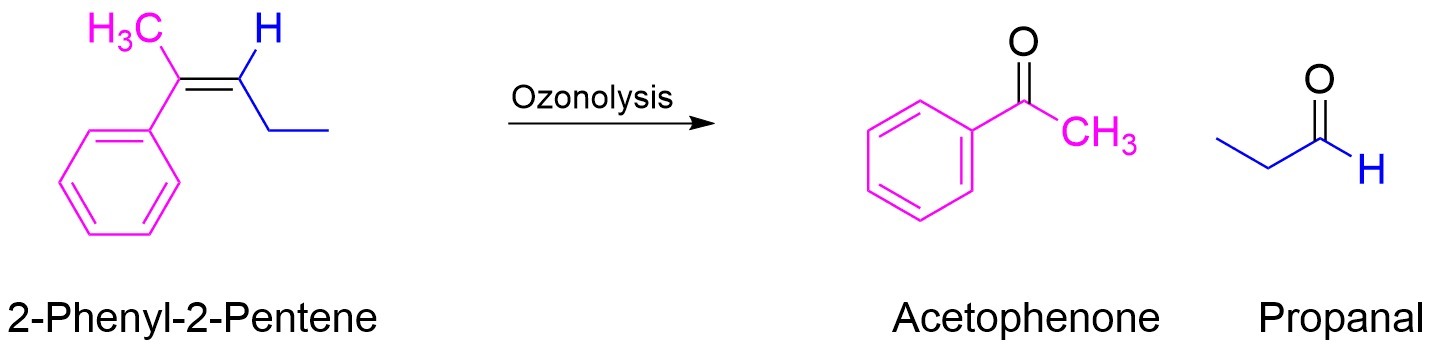
Compound a on ozonolysis yields acetophenone and propanal. what is the structure of compound a? 1-phenyl-1-hexene 1-phenyl-2-pen
astra-53 [7]
Answer:
            2-Phenyl-2-Penetene on ozonolysis <span>yields acetophenone and propanal.

Explanation:
                   The tricky way to solve such questions is to simply break the double bond in alkene and place oxygen atom at each broken half double bond making it carbonyl group. The reaction of given statement is as follow,</span>

6 0
2 years ago
What is the mass, in g, of 0.500 mol of 1,2-dibromoethane, CH2BrCH2Br?
inna [77]
Molar mass <span>CH2BrCH2Br = 188.0 g/mol

1 mole ---------- 188.0 g
</span>0.500 moles ----- ?

mass = 0.500 * 188.0 / 1

= 94.0 g

Answer C

hope this helps!
4 0
2 years ago
The means of X ? ⊙_⊙⊙_⊙⊙_⊙​
julsineya [31]

Answer:

x means unknown it is an unknown value.

For example if you have 2 x you have 2 u know values.

Explanation:

If you want us to explain it further please provide a picture.

5 0
2 years ago
Read 2 more answers
Other questions:
  • Which equilibrium expression represents the ionization of water?
    12·2 answers
  • Write the equation for the production of one hexose sugar molecule from carbon dioxide
    5·2 answers
  • How much heat is required to convert 422 g of liquid h2o at 23.5 °c into steam at 150 °c?
    11·2 answers
  • What is the pH of a solution with a 7.8 × 10⁻¹³ M hydronium ion concentration?
    14·2 answers
  • The half-life of C-14 is 5470 years. If a particular archaeological sample has one-quarter of its original radioactivity remaini
    15·2 answers
  • Glycolic acid, which is a monoprotic acid and a constituent in sugar cane, has a pKa of 3.9. A 25.0 mL solution of glycolic acid
    6·1 answer
  • Can one atom in this type of reaction win the "tug of war"? What might happen if it did?
    10·2 answers
  • For each of the following substituents, indicate whether it withdraws electrons inductively, donates electrons by hyperconjugati
    9·1 answer
  • Identify and calculate the number of representative particles in 2.15 moles of gold.<br>​
    13·1 answer
  • Which natural polymers are involved with making clothing?
    9·2 answers
Add answer
Login
Not registered? Fast signup
Signup
Login Signup
Ask question!