answer.
Ask question
Login Signup
Ask question
All categories
  • English
  • Mathematics
  • Social Studies
  • Business
  • History
  • Health
  • Geography
  • Biology
  • Physics
  • Chemistry
  • Computers and Technology
  • Arts
  • World Languages
  • Spanish
  • French
  • German
  • Advanced Placement (AP)
  • SAT
  • Medicine
  • Law
  • Engineering
garik1379 [7]
2 years ago
11

At a festival, spherical balloons with a radius of 280. Cm are to be inflated with hot air and released. The air at the festival

will have a temperature of 25° C and must be heated to 100°C to make the balloons float. 3.00 kg of propane (C3H8) fuel are available to burn to heat the air. Calculate the number of balloons that can be inflated with hot air.
Chemistry
2 answers:
evablogger [386]2 years ago
5 0

Answer:

8608.18 balloons

Explanation:

Hello! Let's solve this!

Data needed:

Enthalpy of propane formation: 103.85kJ / mol

Specific heat capacity of air: 1.009J · g ° C

Density of air at 100 ° C: 0.946kg / m3

Density of propane at 100 ° C: 1.440kg / m3

First we will calculate the propane heat (C3H8)

3000g * (1mol / 44g) * (103.85kJ / mol) * (1000J / 1kJ) = 7.08068 * 10 ^ 6 J

Then we can calculate the mass of the air with the heat formula

Q = mc delta T

m = Q / c delta T = (7.08068 * 10 ^ 6 J) / (1.009J / kg ° C * (100-25) ° C) =

m = 93566.96kg

We now calculate the volume of a balloon.

V = 4/3 * pi * r ^ 3 = 4/3 * 3.14 * 1.4m ^ 3 = 11.49m ^ 3

Now we calculate the mass of the balloon

mg = 0.946kg / m3 * 11.49m ^ 3 = 10.87kg

The amount of balloons is

93566.96kg / 10.87kg = 8608.18 balloons

tatyana61 [14]2 years ago
3 0

The question is incomplete, here is the complete question:

At a festival, spherical balloons with a radius of 280 cm are to be inflated with hot air and released. The air at the festival will have a temperature of 25° C and must be heated to 100°C to make the balloons float. 3.00 kg of propane (C₃H₈) fuel are available to burn to heat the air. Calculate the number of balloons that can be inflated with hot air.

Density of air at 100°C = 0.946kg/m^3

Specific heat capacity of air = 1.009 J/g°C

<u>Answer:</u> The number of balloons inflated with hot air are 7.

<u>Explanation:</u>

The equation used to calculate enthalpy change is of a reaction is:

\Delta H^o_{rxn}=\sum [n\times \Delta H_f_{(product)}]-\sum [n\times \Delta H_f_{(reactant)}]

The chemical equation for the combustion of propane follows:

C_3H_8(g)+5O_2(g)\rightarrow 3CO_2(g)+4H_2O(g)

The equation for the enthalpy change of the above reaction is:

\Delta H_{rxn}=[(3\times \Delta H_f_{(CO_2(g))})+(4\times \Delta H_f_{(H_2O(g))})]-[(1\times \Delta H_f_{(C_3H_8(g))})+(5\times \Delta H_f_{(O_2(g))})]

We are given:

\Delta H_f_{(H_2O(g))}=-241.8kJ/mol\\\Delta H_f_{(CO_2(g))}=-393.51kJ/mol\\\Delta H_f_{(C_3H_8(g))}=-103.8kJ/mol\\\Delta H_f_{(O_2(g))}=0kJ/mol

Putting values in above equation, we get:

\Delta H_{rxn}=[(3\times (-393.51))+(4\times (-241.8))]-[(1\times (-103.8))+(5\times (0))]\\\\\Delta H_{rxn}=-2043.93kJ/mol

To calculate the number of moles, we use the equation:

\text{Number of moles}=\frac{\text{Given mass}}{\text{Molar mass}}

Given mass of propane = 3.00 kg = 3000 g    (Conversion factor:  1 kg = 1000 g)

Molar mass of propane = 44 g/mol

Putting values in above equation, we get:

\text{Moles of propane}=\frac{3000g}{44g/mol}=68.18mol

To calculate the heat released, we use the equation:

\Delta H_{rxn}=\frac{q}{n}

where,

q = amount of heat released = ? kJ

n = number of moles = 68.18 moles

\Delta H_{rxn} = enthalpy change of the reaction = -2043.93 kJ/mol

Putting values in above equation, we get:

-2043.93kJ/mol=\frac{q}{68.18mol}\\\\q=(-2043.93kJ/mol\times 68.18mol)=-1.39\times 10^5kJ

To calculate the heat released by the reaction, we use the equation:

q=mc\Delta T

where,

q = heat released = 1.39\times 10^5kJ=1.39\times 10^8J

m = mass of air = ?

c = heat capacity of air = 1.009 J/g°C

\Delta T = change in temperature = T_2-T_1=(100-25)^oC=75^oC

Putting values in above equation, we get:

1.39\times 10^8J=m\times 1.009J/g^oC\times 75^oC\\\\m=\frac{1.39\times 10^8}{1.009\times 75}=1.84\times 10^6g=1.84\times 10^3kg

Conversion factor: 1 kg = 1000 g

To calculate the volume of air, we use the equation:

\text{Density of substance}=\frac{\text{Mass of substance}}{\text{Volume of substance}}

Density of air = 0.946kg/m^3

Mass of air = 1.84\times 10^3kg

Putting values in above equation, we get:

0.946kg/m^3=\frac{1.84\times 10^3kg}{\text{Volume of air}}\\\\\text{Volume of air}=\frac{1.84\times 10^3kg}{0.946kg/m^3}=1945.03m^3

To calculate the volume of sphere, we use the equation:

V=4\pi r^3

where,

r = radius of the sphere = 280 cm = 2.8 m    (Conversion factor: 1 m = 100 cm)

Putting values in above equation, we get:

V=4\times 3.14\times (2.8)^3\\\\V=275.7m^3

To calculate the number of balloons inflated, we divide the volume of air by the volume of 1 balloon:

\text{Number of balloons inflated}=\frac{V_{air}}{V_{balloon}}\\\\\text{Number of balloons inflated}=\frac{1945.03m^3}{275.7m^3}=7

Hence, the number of balloons inflated with hot air are 7.

You might be interested in
Suppose you have 200.0 mL of a 0.750 M sodium hydroxide solution. How many
Nikolay [14]

Answer:

0.15 moles of sodium hydroxide are in the solution.

Explanation:

Molarity is a unit for expressing concentration of solutions. Molarity is defined as the number of moles of solute per liter of solution.

The molarity of a solution is calculated by dividing the moles of the solute by the liters of the solution:

Molarity (M)=\frac{number of moles of solute}{volume}

Molarity is expressed in units (\frac{moles}{liter}).

So, a molarity of 0.750 M indicates that 0.750 moles are present in 1 L of solution. Then the following rule of three can be applied: if in 1000 mL (being 1 L = 1000 mL) there are 0.750 moles, in 200 mL how many moles are there?

amount of moles=\frac{200 mL*0.750 moles}{1000 mL}

amount of moles=0.15

<u><em> 0.15 moles of sodium hydroxide are in the solution.</em></u>

5 0
2 years ago
If 500.0 mL of 0.10 M Ca2+ is mixed with 500.0 mL of 0.10 M SO42−, what mass of calcium sulfate will precipitate? Ksp for CaSO4
statuscvo [17]

Answer:

The mass of calcium sulfate that will precipitate is 6.14 grams

Explanation:

<u>Step 1:</u> Data given

500.0 mL of 0.10 M Ca^2+ is mixed with 500.0 mL of 0.10 M SO4^2−

Ksp for CaSO4 is 2.40*10^−5

<u>Step 2:</u> Calculate moles of Ca^2+

Moles of Ca^2+ = Molarity Ca^2+ * volume

Moles of Ca^2+ = 0.10 * 0.500 L

Moles Ca^2+ = 0.05 moles

<u>Step 3: </u>Calculate moles of SO4^2-

Moles of SO4^2- = 0.10 * 0.500 L

Moles SO4^2- = 0.05 moles

<u>Step 4: </u>Calculate total volume

500.0 mL + 500.0 mL = 1000 mL = 1L

<u>Step 5: </u> Calculate Q

Q = [Ca2+] [SO42-]  

[Ca2+]= 0.050 M   [O42-]

Qsp = (0.050)(0.050 )=0.0025 >> Ksp

This means precipitation will occur

<u> Step 6:</u> Calculate molar solubility

Ksp = 2.40 * 10^-5 = [Ca2+][SO42-] =(x)(x)

2.40 * 10^-5 = x²

x = √(2.40 * 10^-5)

x = 0.0049 M = Molar solubility

<u> Step 7:</u> Calculate total CaSO4 dissolved

total CaSO4 dissolved = 0.0049 M * 1 L * 136.14 mol/L = 0.667 g

<u>Step 8:</u> Calculate initial mass of CaSO4

Since initial moles CaSo4 = 0.050

Initial mass of CaSO4 = 0.050 * 136.14 g/mol

Initial mass of CaSO4 = 6.807 grams

<u>Step 9:</u> Calculate mass precipitate

6.807 - 0.667 = 6.14 grams

The mass of calcium sulfate that will precipitate is 6.14 grams

5 0
2 years ago
What is the balanced chemical equation for the reaction used to calculate ΔH∘f of SrCO3(s)? If fractional coefficients are requi
Pani-rosa [81]

Answer:

Sr(s) + C(s) + 3/2 O₂(g) → SrCO₃(s)

Explanation:

The standard enthalpy of formation (ΔH°f) is the energy involved in the formation of 1  mole of a substance from its elements in their most stable states. The chemical equation for the formation of SrCO₃(s) is the following.

Sr(s) + C(s) + 3/2 O₂(g) → SrCO₃(s)

6 0
2 years ago
Modern commercial airliners are largely made of aluminum, a light and strong metal. But the fact that aluminum is cheap enough t
Dafna11 [192]

Answer:

The plane with aluminium can lift more mass of passangers than the plane of steel.

Explanation:

The total mass the airplane canc lift is:

m_{tot}=m_{fuselage}+m_{passangers}

For aluminium:

m_{tot}=m_{fus-Al}+m_{pas-Al}

m_{fus-Al}=\delta _{Al}*V_{fuselage}

and

V_{fuselage}=\frac{\pi *L}{4}*[D^2-(D-e)^2]

where:

  • L is lenght
  • D is diameter
  • e is thickness

m_{tot}=\delta _{Al}*\frac{\pi *L}{4}*[D^2-(D-e)^2]+m_{pas-Al}

For steel (same procedure):

m_{tot}=\delta _{Steel}*\frac{\pi *L}{4}*[D^2-(D-e)^2]+m_{pas-Steel

Knowing that the total mass the airplane can lift is constant and that aluminum has a lower density than the steel, we can afirm that the plane with aluminium can lift more mass of passangers.

Also you can estimate an average weight of passanger to estimate a number of passangers it can lift.

5 0
2 years ago
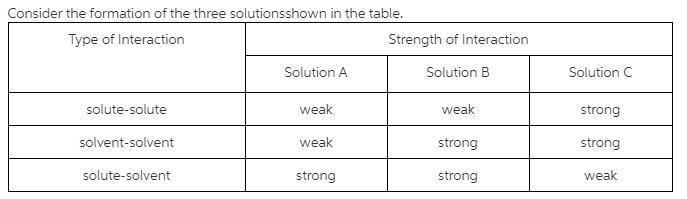
Rank the formation of the solutions A, B, and C from the most exothermic to the most endothermic. Rank the enthalpy of solution
Elodia [21]

This is an incomplete question, the table is attached below.

Answer : The correct ranking of the solution from most exothermic to most endothermic will be: A, B and C.

Explanation :

As we know that the intermolecular force of attraction play an important role in the interaction of solute-solute, solute-solvent and solvent solvent solution.

In the solution A, the solute-solute and solvent-solvent interactions are weak. So, their solute-solvent interaction will be strong. That means, the solution will be more exothermic.

In the solution C, the solute-solute and solvent-solvent interactions are strong. So, their solute-solvent interaction will be weak. That means, the solution will be more endothermic.

Thus, the correct ranking of the solution from most exothermic to most endothermic will be: A, B and C.

4 0
2 years ago
Other questions:
  • White phosphorus, P4, is prepared by fusing
    12·1 answer
  • For an experiment, a biology student makes 1 liter of a solution containing the following substances, which are shown in the tab
    5·1 answer
  • ASAP PLEASE HELP:
    11·2 answers
  • The boiling point of chlorine is −34 °C. Which of the following best predicts the boiling point of iodine?
    7·2 answers
  • What is the mole fraction of O2O2 in a mixture of 15.1 gg of O2O2, 8.19 gg of N2N2, and 2.46 gg of H2H2
    12·1 answer
  • The following reaction is exothermic. C6H12O6(s)+6O2(g)⇌6CO2(g)+6H2O(g)C6H12O6(s)+6O2(g)⇌6CO2(g)+6H2O(g) Predict the effect (shi
    13·1 answer
  • How many L of carbon dioxide at 1.00 atm and 298.15 K are released from a car's engine upon consumption of a 60.0 L LIQUID tank
    10·1 answer
  • For maleic acid, hoocch=chcooh, ka1 = 1.42  10–2 and ka2 = 8.57  10–7 . what is the concentration of maleate ion (–oocch=chcoo
    12·2 answers
  • Arrange these reactions according to increasing ΔS.
    12·1 answer
  • If 28.0% of a sample of gallium-66 decays in 4.46 hours, what is the half-life of this isotope (in hours)?
    10·1 answer
Add answer
Login
Not registered? Fast signup
Signup
Login Signup
Ask question!