answer.
Ask question
Login Signup
Ask question
All categories
  • English
  • Mathematics
  • Social Studies
  • Business
  • History
  • Health
  • Geography
  • Biology
  • Physics
  • Chemistry
  • Computers and Technology
  • Arts
  • World Languages
  • Spanish
  • French
  • German
  • Advanced Placement (AP)
  • SAT
  • Medicine
  • Law
  • Engineering
avanturin [10]
2 years ago
7

2. Sodium nitrate decomposes into sodium nitrite and oxygen gas with heat. When 0.123 g of sodium nitrate was heated, it produce

d 16.2mL of oxygen collected over water. The room temperature and pressure are 22.5ºC and 758torr, respectively.The water over which the gas was collected had a temperature of 20.0ºC. Calculate the theoretical amount of oxygen in grams which should have been produced. What is the percent yield?
Chemistry
1 answer:
astra-53 [7]2 years ago
4 0

Answer:

Theoretical mass: 0.0232 g

Percent yield: 92.67%

Explanation:

Sodium nitrate is NaNO₃, and sodium nitrite is NaNO₂, the decomposes occurs by the reaction:

2NaNO₃(s) → 2NaNO₂(s) + O₂(g)

The molar masses are: Na = 23 g/mol, N = 14 g/mol, O = 16 g/mol.

NaNO₃ = 23 + 14 + 3x16 = 85 g/mol

So the number of moles of NaNO₃ is:

n = 0.123g/85 g/mol = 0.00145 mol

The theoretical amount of oxygen is given by the reaction stoichiometry:

2 mol of NaNO₃ ------------- 1 mol of O₂

0.00145 mol      -------------- x

By a simple direct three rule:

2x = 0.00145

x = 7.25x10⁻⁴ mol of O₂

The theoretical mass is:

m = 32 g/mol *7.25x10⁻⁴ mol

m = 0.0232 g

The real mass can be calculated by the ideal gas equation:

PV = nRT,

Where P is the pressure (758 torr = 0.997 atm), V is the volume (16.2 mL = 0.0162 L), n is the number of moles, R is the gas constant ( 0.082 atm*L/mol*K), and T is the temperature (20.0ºC = 293 K).

The volume was measured in water, so we must use the temperature at that system:

0.997*0.0162 = n*0.082*293

24.026n = 0.0161514

n = 6.72x10⁻⁴ mol

So the mass of the oxygen collected is (mc):

mc = 32 g/mol *6.72x10⁻⁴ mol

mc = 0.0215 g

The yield(y) is the mass collected divideb by the theoretical mass:

y = 0.0215/0.0232

y = 0.9267

y = 92.67%

You might be interested in
The pressure of a 609.64 gram sample of F2 in a 88.84 L container is measured to be 2770.96 torr. What is the temperature of thi
Oxana [17]

Answer : The temperature of the gas is, 245.9 K

Explanation :

To calculate the temperature of gas we are using ideal gas equation:

PV=nRT\\\\PV=\frac{w}{M}RT

where,

P = pressure of gas = 2770.96 torr = 3.646 atm

Conversion used : (1 atm = 760 torr)

V = volume of gas = 88.84 L

T = temperature of gas = ?

R = gas constant = 0.0821 L.atm/mole.K

w = mass of gas = 609.64 g

M = molar mass of F_2 gas = 38 g/mole

Now put all the given values in the ideal gas equation, we get:

(3.646atm)\times (88.84L)=\frac{609.64g}{38g/mole}\times (0.0821L.atm/mole.K)\times (T)

T=245.9K

Therefore, the temperature of the gas is, 245.9 K

4 0
2 years ago
A sealed vessel contains 0.200 mol of oxygen gas, 0.100 mol of nitrogen gas, and 0.200 mol of argon gas. The total pressure of t
babunello [35]

Answer:

D

Explanation:

We can use the mole ratio to calculate the partial pressure. The total number of moles is 0.2 + 0.2 + 0.1 = 0.5 moles

Now, we know that the mole fraction of the argon gas would be 0.2/0.5

The partial pressure is as follows. To calculate this, we simple multiply the number of moles by the total pressure.

0.2/0.5 * 5 = 1.0/0.5 = 2.00atm

D

8 0
2 years ago
A student described two properties of a substance shown below which of the following is true about the two properties described
mel-nik [20]

Answer:

B

Explanation:

catches fire easily, there is a chemical in the substance that reacts to the flame, and a key to it being a chemical property is when exposed to other substances, there is a chemical in the other substances that makes it chemically react

7 0
2 years ago
Read 2 more answers
At 10°c one volume of water dissolves 3.10 volumes of chlorine gas at 1.00 atm pressure. what is the henry's law constant of cl2
s344n2d4d5 [400]
Answer is:  0,133 mol/ l· atm.
T(chlorine) = 10°C = 283K.
p(chlorine) = 1 atm.
V(chlorine) = 3,10 l.
R - gas constant, R = 0.0821 atm·l/mol·K. 
Ideal gas law: p·V = n·R·T
n(chlorine) = p·V ÷ R·T.
n(chlorine) = 1atm · 3,10l ÷ 0,0821 atm·l/mol·K · 283K = 0,133mol.
Henry's law: c = p·k.
k - <span>Henry's law constant.
</span>c - solubility of a gas at a fixed temperature in a particular solvent.
c = 0,133 mol/l.
k = 0,133 mol/l ÷ 1 atm = 0,133 mol/ l· atm.

4 0
2 years ago
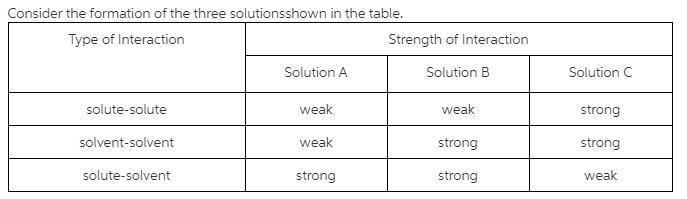
Rank the formation of the solutions A, B, and C from the most exothermic to the most endothermic. Rank the enthalpy of solution
Elodia [21]

This is an incomplete question, the table is attached below.

Answer : The correct ranking of the solution from most exothermic to most endothermic will be: A, B and C.

Explanation :

As we know that the intermolecular force of attraction play an important role in the interaction of solute-solute, solute-solvent and solvent solvent solution.

In the solution A, the solute-solute and solvent-solvent interactions are weak. So, their solute-solvent interaction will be strong. That means, the solution will be more exothermic.

In the solution C, the solute-solute and solvent-solvent interactions are strong. So, their solute-solvent interaction will be weak. That means, the solution will be more endothermic.

Thus, the correct ranking of the solution from most exothermic to most endothermic will be: A, B and C.

4 0
2 years ago
Other questions:
  • How many grams of h2 gas can be produced by the reaction of 63.0 grams of al(s) with an excess of dilute hydrochloric acid in th
    12·2 answers
  • Which of the following does not involve colligative properties?
    9·2 answers
  • Consider a triprotic acid like phosphoric acid or citric acid. which expression correctly describes the relative magnitudes of t
    11·1 answer
  • You are asked to go into the lab and prepare an acetic acid - sodium acetate buffer solution with a ph of 4.00  0.02. what mola
    12·1 answer
  • How many moles of O are in 2.45 moles of H2CO3?​
    5·1 answer
  • 6. Find the number of centimeters in 1.00 x 10² yards. (1 yd = 3 ft, 1 ft = 12 in, 2.54 cm = 1
    5·1 answer
  • Consider the following reaction: A(g)⇌2B(g). Find the equilibrium partial pressures of A and B for each of the following differe
    11·1 answer
  • certain alcohol contains only three elements, carbon, hydrogen, and oxygen. Combustion of a 40.00 gram sample of the alcohol pro
    14·1 answer
  • 2 M n O 2 + 4 K O H + O 2 + C l 2 → 2 K M n O 4 + 2 K C l + 2 H 2 O , there are 100.0 g of each reactant available. Which reacta
    8·2 answers
  • Calculate the wavelength of a photon of green light that has a frequency (v) of 5.76x10^14 s^-1
    9·1 answer
Add answer
Login
Not registered? Fast signup
Signup
Login Signup
Ask question!