answer.
Ask question
Login Signup
Ask question
All categories
  • English
  • Mathematics
  • Social Studies
  • Business
  • History
  • Health
  • Geography
  • Biology
  • Physics
  • Chemistry
  • Computers and Technology
  • Arts
  • World Languages
  • Spanish
  • French
  • German
  • Advanced Placement (AP)
  • SAT
  • Medicine
  • Law
  • Engineering
Ksivusya [100]
2 years ago
3

Is 2,5-dibromohexane chiral? If chiral, give the atom number(s) of the chirality center(s) (increasing numberical order, separat

ed by a comma, no space). Write 'none' if there are no chirality centers. . Is 1-bromo-3-chloro-2-methylpropane chiral? If chiral, give the atom number(s) of the chirality center(s) (increasing numberical order, separated by a comma, no space). Write 'none' if there are no chirality centers.

Chemistry
1 answer:
guapka [62]2 years ago
3 0

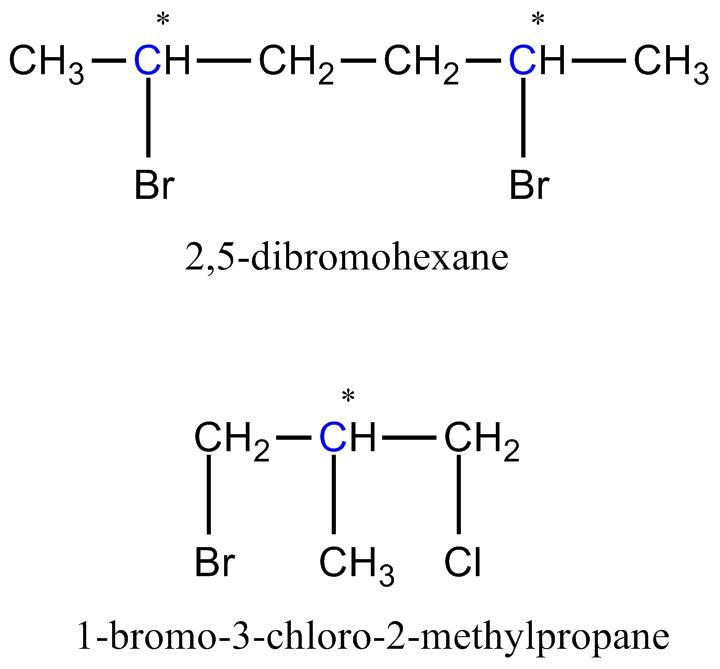
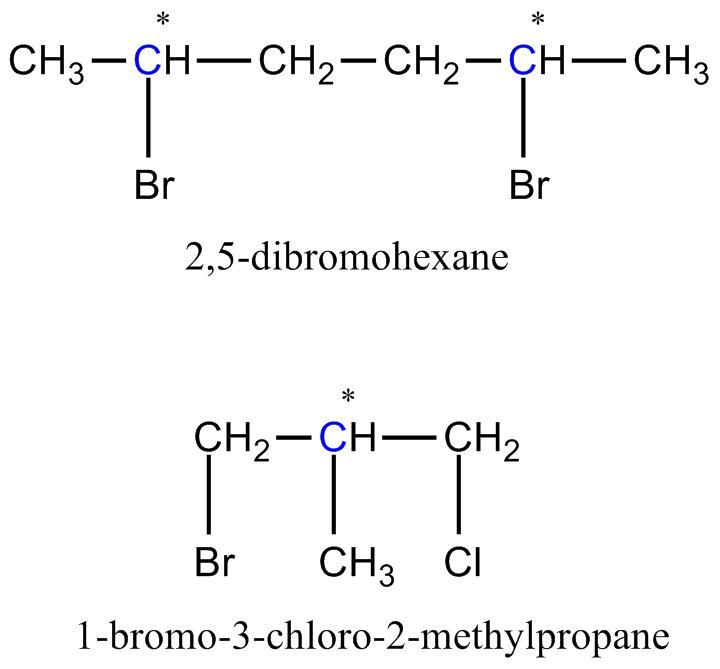
2,5-dibromohexane have 2 chirality centers.

1-bromo-3-chloro-2-methylpropane have 1 chirality center.

Explanation:

For organic compounds a chirality center is represented by a asymmetric carbon which have four different type of substituents.

2,5-dibromohexane have 2 chirality centers represented by the two  asymmetric carbons.

1-bromo-3-chloro-2-methylpropane have 1 chirality center represented by one asymmetric carbon.

You may find the chemical diagrams of both compound in the attached picture. Asymmetric carbon are colored in blue.

Learn more about:

enantiomers

brainly.com/question/4986334

#learnwithBrainly

You might be interested in
a compound contain 8.57g of carbon and 1.43g of hydrogen. The relative formula mass is 70 calculate the empirical formula of the
yanalaym [24]

Answer:

Empirical formula: CH2

Molecular formula: C5H10

5 0
1 year ago
Calculate the pH of a polyprotic acid given and sketch the titration curves for the following reaction:
victus00 [196]

Answer: (1). pH = 1.70

(2). pH = 2.3

(3). pH = 3.3

(4). pH = 4.3

(5). pH = 8.41

(6). pH = 10.22

Explanation:

we assume that the formula representation of acid is H₂A

the titration curve has reasonably sharp breaks at both equivalence points, corresponding to the reactions;

H₂A + OH⁻ → HA⁻ + H₂O

HA⁻ + OH⁻ → A²⁻ + H₂O

the volume of NaOH (V₀) at the first equivalent point is,

V₀ = (20.0 mL)(0.100M) / 0.100M = 20.0mL

where volume of NaOH at 1/2 equivalent point is,

V₀/2 = 10.0mL

also Volume of NaOH at the second equivalence (2V₀) point is 40.0mL

the volume of NaOH at 1/2 second equivalent point is,

V₀ + V₀/2 = 30.0mL

Volume of NaOH after second equivalence exceeds 40mL

therefore, at 0 mL NaOH addition;

where the extent of ionization is assumed to be x, we have

                        H₂A   ⇆     HA⁻   +   H⁺

where initial:   0.1 M       -            -

          change:   -x         +x           +x

          Equili:      0.1-x      x             x

Kаl = [HA⁻][H⁺] / [H₂A]

10⁻²³ = (x)(x) / (0.1-x)

x = 0.020

[H⁺] = 0.020 M

pH = -log [H⁺]

pH = -log(0.020)

pH = 1.70

(2). at 10 mL NaOH addition

[H₂A]ini = 0.10 M * 20.0 mL = 2 mmol

[OH⁻] = 0.1 M * 10 mL = 1 mmol

after reaction:

[H₂A] = 1 mmol

[H⁻] = 1 mmol

pH = pKa₁ + log [HA⁻] / [[HA⁻]

pH = 2.3 + log 1mmol / 1mmol

pH = 2.3

(3). pH at the first equivalence point is,

pH = 1/2 (pKa₁ + pKa₂)

pH = 1/2(2.3 + 4.3) = 3.3

pH = 3.3

(4). pH at the second 1/2 equivalence point is

pH = pKa₂ = 4.3

pH = 4.3

(5). pH at the second equivalence point;

all H₂A is converted into A²⁻

[A²⁻] = initial moles of H₂A / total volume = (20.0 mL)(0.10 M) / (20.0 + 40.0) mL = 0.033 M

at equilibrium:

                   A²⁻ + H²O    ⇆   HA⁺ OH⁻

          0.033 - x

from the Kb₁ expression,

Kb₁ = [OH⁻][HA⁻] / [A²]

Kw/Ka₂ = x²/(0.0333 - x)

10⁻¹⁴/10⁻⁴³ = x²/(0.0333 - x)

x = 2.57 * 10⁻⁶

[OH⁻] = 2.57 * 10⁻⁶M

pH = -log Kw/[OH⁻] = 8.41

pH = 8.41

(6). pH after second equivalence point;

assuming the volume of NaOH is 40.10 mL

after second equivalence point OH⁻ in excess

[OH⁻] = 0.10 M * 0.10 mL / (20 + 40.10) mL = 1.66 * 10⁻⁴ M

pH = 0=-log Kw/[OH⁻] = 10.22

pH = 10.22
8 0
2 years ago
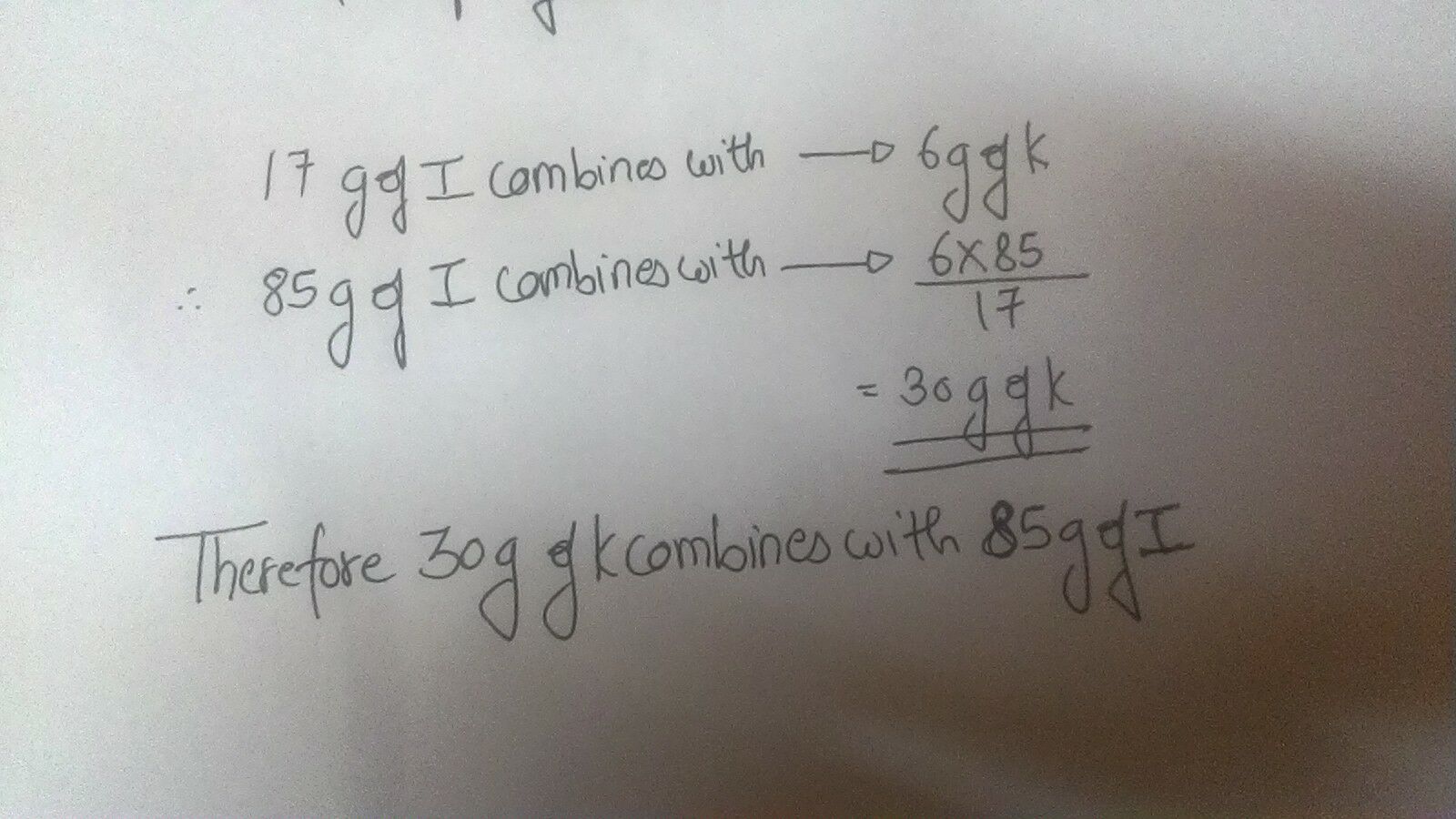
If 6 g of element k combine with 17 g of element l, how many grams of element k combine with 85 g of element l?
Ede4ka [16]
Hope this helps you.

5 0
2 years ago
Two students are working together to build two models. Both models will represent the molecular structure of sodium bicarbonate,
vfiekz [6]

Answer:

Altogether for both models; two red jellybeans, two white jellybeans, two black jellybeans and six blue jellybeans.

<em>Note: Since no specific color was stated for oxygen atoms, the answer assigns blue colored jellybeans to represent oxygen atoms.J</em>

Explanation:

Sodium bicarbonate, NaHCO₃ is a compound composed of one atom of sodium, one atom of hydrogen, one atom of carbon and three atoms of oxygen.

Since red jellybeans represent sodium atoms, white jellybeans represent hydrogen atoms, black jellybeans represent carbon atoms and blue jellybeans represent oxygen atoms, each of the two students will require the following number of each jellybean for their model of sodium carbonate: One red jellybean, one white jellybean, one black jellybean and three blue jellybeans.

Altogether for both models; two red jellybeans, two white jellybeans, two black jellybeans and six blue jellybeans.

8 0
2 years ago
The reaction N2 + 3 H2 → 2 NH3 is used to produce ammonia. When 450. g of hydrogen was reacted with nitrogen, 1575 g of ammonia
tiny-mole [99]

Answer:

The percent yield of this reaction is 70%

Explanation:

The reaction is: N₂ + 3H₂ → 2NH₃

We only have the mass of H₂, so we assume that N₂ is in excess

We convert the mass to moles, to work with the reaction:

450 g . 1mol / 2 g = 225 moles

Ratio is 2:3. 3 moles of H₂ can produce 2 moles of ammonia

Therefore 225 moles of H₂ will produce (225 .2)/ 3 = 150 moles

This is the 100% yield reaction → We convert the moles of NH₃ to mass

150 mol . 17g /1mol = 2550 g

Percent yield = (Produced yield/Theoretical yield) .100

Percent yield = (1575g/2550g) . 100 = 70%

7 0
2 years ago
Other questions:
  • . Divide 94.20 g by 3.167 22 mL.
    15·2 answers
  • A solution contains cr3+ ions. the addition of 0.063 l of 1.50 m naf solution was needed to completely precipitate the chromium
    14·1 answer
  • ben helps his dad make chicken soup. their recipe makes 15 cups of soup. if they each eat 2 cups and freeze the rest will the le
    5·1 answer
  • It takes 330 j of energy to raise the temperature of 14.6 g of benzene from 21.0 °c to 28.7 °c at constant pressure. What is the
    9·1 answer
  • If you gently shake a carbon dioxide fire extinguisher, you will feel the presence of liquid within the extinguisher What condit
    10·1 answer
  • Six moles of an ideal gas are in a cylinder fitted at one end with a movable piston. the initial temperature of the gas is 27.0c
    7·1 answer
  • The Safe Drinking Water Act (SDWA) sets a limit for mercury-a toxin to the central nervous system-at 0.002 mg/L. Water suppliers
    8·1 answer
  • When a sample of oxygen gas in a closed container of constant volume is heated until its absolute temperature is doubled, which
    13·1 answer
  • The diagram shows the scales used for recording temperatures. The labels for the scales are missing. 3 thermometers are oriented
    8·2 answers
  • A student requires 2.00 L of 0.100 M NH4NO3 from a 1.75 M NH4NO3 stock solution. What is the correct way to get the solution?
    11·2 answers
Add answer
Login
Not registered? Fast signup
Signup
Login Signup
Ask question!