answer.
Ask question
Login Signup
Ask question
All categories
  • English
  • Mathematics
  • Social Studies
  • Business
  • History
  • Health
  • Geography
  • Biology
  • Physics
  • Chemistry
  • Computers and Technology
  • Arts
  • World Languages
  • Spanish
  • French
  • German
  • Advanced Placement (AP)
  • SAT
  • Medicine
  • Law
  • Engineering
Anettt [7]
2 years ago
5

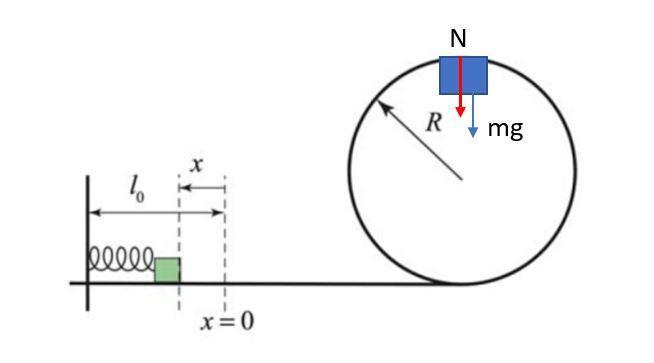
A small block of mass m is pushed against a spring with spring constant k and held in place with a catch. The spring compresses

an unknown distance x. When the catch is removed, the block leaves the spring and slides along a frictionless circular loop of radius R. When the block reaches the top of the loop, the force of the loop on the block (the normal force) is equal to twice the gravitational force on the mass. How far was the spring initially compressed?

Physics
2 answers:
uranmaximum [27]2 years ago
6 0

Answer: x = sqrt 7mR/k

Explanation:

nexus9112 [7]2 years ago
6 0

Answer:

The spring was initially compressed an distance: x=\sqrt{\frac{7mgR}{k} }.

Explanation:

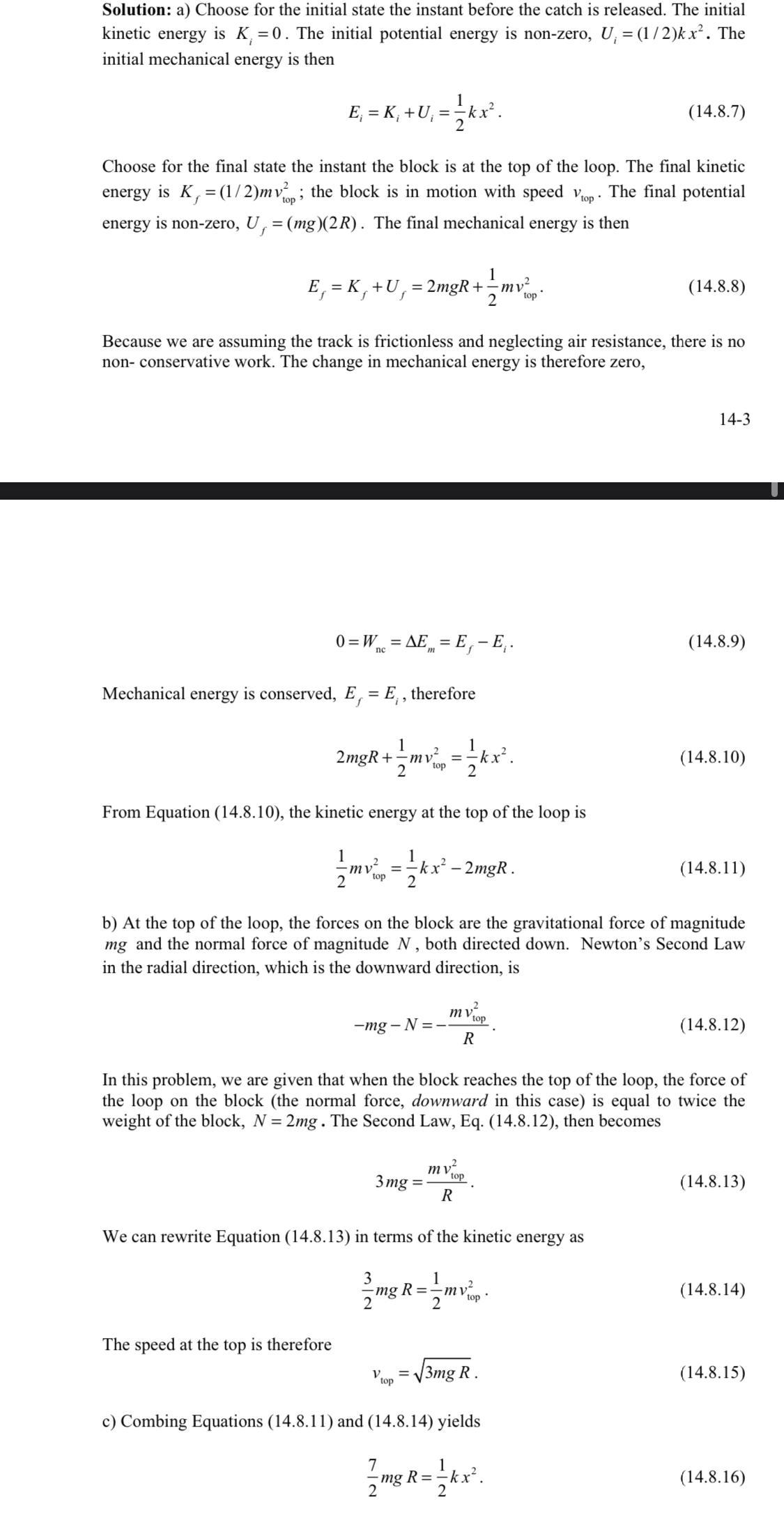
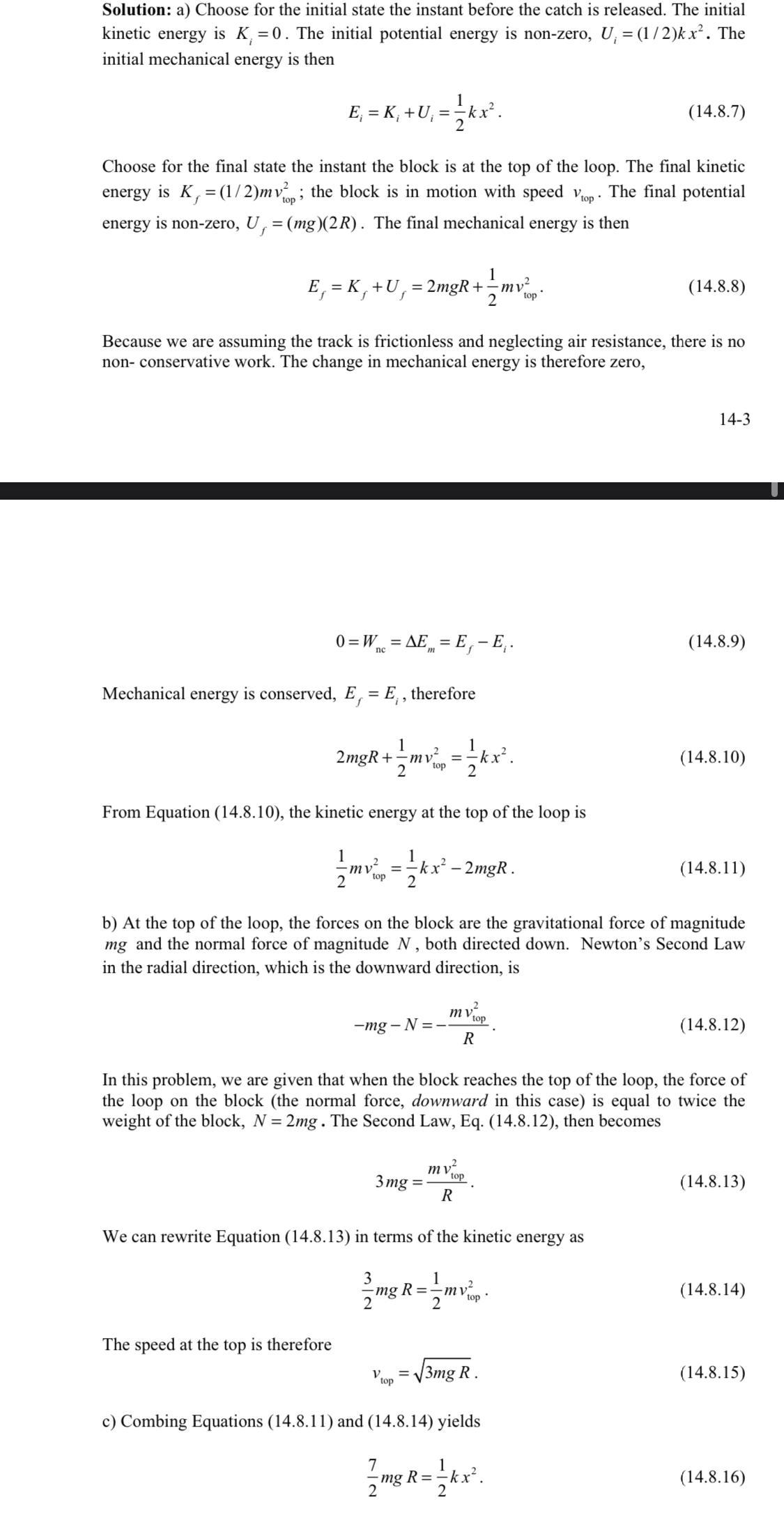
We need to apply the conservation of energy law to find the kinetic energy at the top of the loop. First we need to find the initial state as: E_{1}=E_{k1} +E_{U1} =\frac{kx^{2} }{2} where E1 is the mechanical energy at the state 1, Ek1 is the initial kinetic energy that in this case is Ek1=0 and Eu1 is the spring's potential energy and is Eu1=(1/2)kx^2. Then We need to find the final state as:E_{2}=E_{k2}+E_{U2}=\frac{mv_{top} ^{2} }{2}+2mgR. Remember that the surface is frictionless so E_{1}=E_{2}, mechanical energy is conserved. Finally we can replace and getting: 2mgR+\frac{mv_{top} ^{2} }{2}=\frac{kx^{2} }{2}. On other side we need to apply Newton's Second Law and using the free body diagram (see attached) of the block at the top of the loop we get:F=m*a=-mg-N=-\frac{mv_{top} ^{2} }{R}. In this problem the force of the loop on the block is equal to twice the magnitude gravitational force on the block so N=2mg. Now solving this we can get:3mg=\frac{mv_{top} ^{2} }{R} and replacing this we will find:2mgR+\frac{3mgR}{2} =\frac{kx^{2} }{2} and solving for x, we can find the spring compressed distance like: \frac{7mgR}{2} =\frac{kx^{2} }{2} so:x=\sqrt{\frac{7mgR}{k} }

You might be interested in
Which of the following strategies can help Earth's coal supply last longer?
ivanzaharov [21]
D. Teach the public energy conservation
7 0
2 years ago
Read 2 more answers
Voices of swimmers at a pool travel 400 m/s through the air and 1,600 m/s underwater. The wavelength changes from 2 m in the air
frosja888 [35]

The frequency of the wave has not changed.

In fact, the frequency of a wave is given by:

f=\frac{v}{\lambda}

where v is the wave's speed and \lambda is the wavelength.

Applying the formula:

- In air, the frequency of the wave is:

f=\frac{400 m/s}{2 m}=200 Hz

- underwater, the frequency of the wave is:

f=\frac{1600 m/s}{8 m}=200 Hz

So, the frequency has not changed.

3 0
2 years ago
Read 2 more answers
a 0.0215m diameter coin rolls up a 20 degree inclined plane. the coin starts with an initial angular speed of 55.2rad/s and roll
marissa [1.9K]

Answer:

h = 0.0362\,m

Explanation:

Given the absence of non-conservative force, the motion of the coin is modelled after the Principle of Energy Conservation solely.

U_{g,A} + K_{A} = U_{g,B} + K_{B}

U_{g,B} - U_{g,A} = K_{A} - K_{B}

m\cdot g \cdot h = \frac{1}{2}\cdot I \cdot \omega_{o}^{2}

The moment of inertia of the coin is:

I = \frac{1}{2}\cdot m \cdot r^{2}

After some algebraic handling, an expression for the maximum vertical height is derived:

m\cdot g \cdot h = \frac{1}{4}\cdot m \cdot r^{2}\cdot \omega_{o}^{2}

h = \frac{r^{2}\cdot \omega_{o}^{2}}{g}

h = \frac{(0.0108\,m)^{2}\cdot (55.2\,\frac{rad}{s} )^{2}}{9.807\,\frac{m}{s^{2}} }

h = 0.0362\,m

3 0
2 years ago
A composite wall separates combustion gases at 2400°C from a liquid coolant at 100°C, with gas and liquid-side convection coeffi
evablogger [386]

Answer:

\text{heat loss} = 24864.05 \  W/m^2

Explanation:

If

  • T_1, T_2 are temperatures of gasses and liquid in Kelvins,
  • t_1 and t_2 are thicknesses of gas layer and steel slab in meters,
  • h_1, h_2 are convection coefficients gas and liquid in W/m^2 \cdot K,
  • R_c is the contact resistance in m^2 \cdot K/W,
  • and k_1, k_2 are thermal conductivities of gas and steel in W/m \cdot K,

then: part(a):

\text{heat loss } =  \frac{T_1 - T_2} { \frac{1}{h_1} + \frac{t_1}{t_2} + R_c + \frac{t_2}{k_2} + \frac{1}{h_2}}

using known values:

\text {heat loss} = 2486.05 W/m^2

part(b): Using the rate equation :

\text {heat loss} = h_1 (T_1 - T_{s1})

the surface temperature T_{s1} = 1678.438 \ K

and T_{c1} = T_{s1} - \frac {t_1 (\text{heat loss})}{k_1} = 1664.560 \ K

Similarly

T_{c2} = T_{c1} - R_c (\text{heat loss}) = 421.357 \ K

T_{s2} = T_{c2} - \frac {t_2 (\text{heat loss})}{ k_2} = 397.864 \ K

The temperature distribution is shown in the attached image

3 0
2 years ago
A 4.0-m-diameter playground merry-go-round, with a moment of inertia of 350 kg⋅m2 is freely rotating with an angular velocity of
Flauer [41]

Answer:

v = 4.375\,\frac{m}{s}

Explanation:

The situation of the system Ryan - merry-go-round is modelled after the Principle of the Angular Momentum Conservation:

(350\,kg\cdot m^{2})\cdot (1.5\,\frac{rad}{s} ) - (2\,m)\cdot (60\,kg)\cdot v = 0\,kg\cdot \frac{m^{2}}{s}

The initial speed of Ryan is:

v = 4.375\,\frac{m}{s}

5 0
2 years ago
Read 2 more answers
Other questions:
  • Which of the following are linear defects?. . An edge dislocation. . A Frenkel defect. . A screw dislocation. . A Schottky defec
    6·1 answer
  • Name three different avenues by which Thomas Edison received an education
    10·1 answer
  • What is the sources of error and suggestion on how to overcome it in the hooke's law experiment?
    15·1 answer
  • Blank can cause magma within Earth to blank resulting in the formation of blank rock
    7·1 answer
  • A box sliding on a horizontal frictionless surface encounters a spring attached to a rigid wall and compresses the spring by a c
    9·1 answer
  • A friend throws a heavy ball toward you while you are standing on smooth ice. You can either catch the ball or deflect it back t
    5·1 answer
  • A 35-kg girl is standing near and to the left of a 43-kg boy on the frictionless surface of a frozen pond. The boy throws a 0.75
    12·1 answer
  • On a guitar, the lowest toned string is usually strung to the E note, which produces sound at 82.4 82.4 Hz. The diameter of E gu
    12·1 answer
  • a) Suppose that the current in the solenoid is I(t). Within the solenoid, but far from its ends, what is the magnetic field B(t)
    12·1 answer
  • Bullets from two revolvers are fired with the same velocity. The bullet from gun #1 is twice as heavy as the bullet from gun #2.
    6·1 answer
Add answer
Login
Not registered? Fast signup
Signup
Login Signup
Ask question!