answer.
Ask question
Login Signup
Ask question
All categories
  • English
  • Mathematics
  • Social Studies
  • Business
  • History
  • Health
  • Geography
  • Biology
  • Physics
  • Chemistry
  • Computers and Technology
  • Arts
  • World Languages
  • Spanish
  • French
  • German
  • Advanced Placement (AP)
  • SAT
  • Medicine
  • Law
  • Engineering
Marat540 [252]
2 years ago
14

An object pulled to the right by two forces has an acceleration of 2.5 m/s2. The free-body diagram shows the forces acting on th

e object.
A free body diagram with 4 force vectors. The first vector is pointing downward labeled F Subscript g Baseline, the second pointing up labeled F Subscript N Baseline. The third pointing right labeled F Subscript 1 Baseline = 50 N the last is from the tip of the third using the tail to tip method labeled F Subscript 2 Baseline = 75 N pointing right.

What is the weight of the object?

50 N
98 N
313 N
490 N
Physics
2 answers:
Sonbull [250]2 years ago
6 0

Answer:

Weight = 490 N

Explanation:

The two forces labeled F_g and F_N are the force of gravity and the normal force that the surface acts upon the object. These are equal and in opposite directions cancelling each other.

The other two forces F_1 and F_2 are both pointing to the right, and therefore add up to give a net force of:

50 N + 75 N = 125 N pointing to the right.

Since the net acceleration of the object is given as 2.5 \frac{m}{s^2}, we can use it in Newton's equation for the net force on an object  F_{net}=m*a to solve for the object's mass:

F_{net}=m*a\\125\,N=m*2.5 \frac{m}{s^2} \\m=\frac{125}{2.5} kg\\m=50\,kg

Notice that since all units are in the SI system, the mass comes directly in kilograms (unit of mass in the SI system)

Now, to find the weight of the object, we multiply its mass times the acceleration of gravity (9.8 \frac{m}{s^2}):

Weight = 50 \,kg * g =50\,kg*9.8\frac{m}{s^2} =490\,N

Again, since all quantities are expressed in SI units, the weight (a force) will come out in units of "Newtons" (N)

iogann1982 [59]2 years ago
5 0

Answer:

490 n

Explanation:

You might be interested in
A pump lifts water from a lake to a large tank 20 m above the lake. How much work against gravity does the pump do as it transfe
Aleonysh [2.5K]

Answer:

980 kJ

Explanation:

Work = change in energy

W = mgh

W = (1000 kg/m³ × 5.0 m³) (9.8 m/s²) (20 m)

W = 980,000 J

W = 980 kJ

The pump does 980 kJ of work.

3 0
2 years ago
Read 2 more answers
A cyclist moving with a constant velocity of 6.0 m/s forward passes a car that is just starting. If the car has a constant accel
sergiy2304 [10]

After 6 seconds, the car will surpass the cyclist.

<h3><u>Explanation:</u></h3>

The speed of the cyclist = 6 m/s.

Let after time t sec, the car will overtake the cyclist.

So, distance covered by the cyclist in t sec = 6t m

Initial velocity of the car is 0 m/s, because the car is just starting.

Acceleration of the car =2 m/s^2.

Final velocity of the car =6 m/s.

So to cover the distance 6t, the time required by the car = \frac{1}{2} \times a \times t^2 = \frac{1}{2} \times 2 \times t^2

6t = \frac{1}{2} \times 2 \times t^2\\6t = t^2

t =6 sec

So, after 6 seconds, the car will surpass the cycle.  

6 0
2 years ago
A jogger accelerates from rest to 3.0 m/s in 2.0 s. A car accelerates from 38.0 to 41.0 m/s also in 2.0 s. (a) Find the accelera
Tom [10]

Answer:

a) The acceleration of the jogger is 1.5 m/s²

b) the acceleration of the car is also 1.5 m/s²

c) Yes, the car travels 76 m farther than the jogger.

Explanation:

a) The acceleration of an object is the variation of its velocity over time:

a = final velocity - initial velocity / time

for the jogger:

a = 3.0 m/s - 0 m/s / 2.0 s = <u>1.5 m/s ²</u>

b) For the car:

a = 41.0 m/s - 38.0 m/s / 2.0 s = <u>1.5 m/s²</u>

c) Let´s see the position of the car after 2 seconds.

The equation for the position of an accelerated object moving in a straight line is:

x = x0 + v0* t +1/2 * a * t²

Where:

x = position of the car at time "t"

x0 = initial position

v0 = initial velocity

t = time

a = acceleration  

 Let´s consider x0 = 0 because the origin of the reference system is located where the car starts accelerating. Then:

x = 38,0 m/s * 2 s + 1/2 * 1.5 m/s ² * (2.0 s)²

x = 79 m

In the same way, we can calculate the position of the jogger:

x = 0 m/s * t + 1/2 * 1.5 m/s ² * (2.0 s)²

x = 3 m

<u>The car travels 79 m - 3 m = 76 m farther than the jogger</u>

4 0
2 years ago
When 0.1523 g of liquid pentane (CH) combusts in a bomb calorimeter, the temperature rises from 23.7C to 29.8 C. What is U for t
pashok25 [27]

Answer:

U for the reaction is 15,048.58 kJ/mol of pentane.

Explanation:

Quantity of heat required = heat capacity of bomb calorimeter × temperature rise = 5.23 kJ/C × (29.8 C - 23.7 C) = 5.23 kJ/C × 6.1 C = 31.903 kJ

Moles of pentane = mass/MW

Mass = 0.1523 g

MW of pentane (C5H12) = 72 g/mol

Moles of pentane = 0.1523/72 = 0.00212 mol

U for the reaction = quantity of heat required ÷ moles of pentane = 31.903 kJ ÷ 0.00212 mol = 15,048.58 kJ/mol

8 0
2 years ago
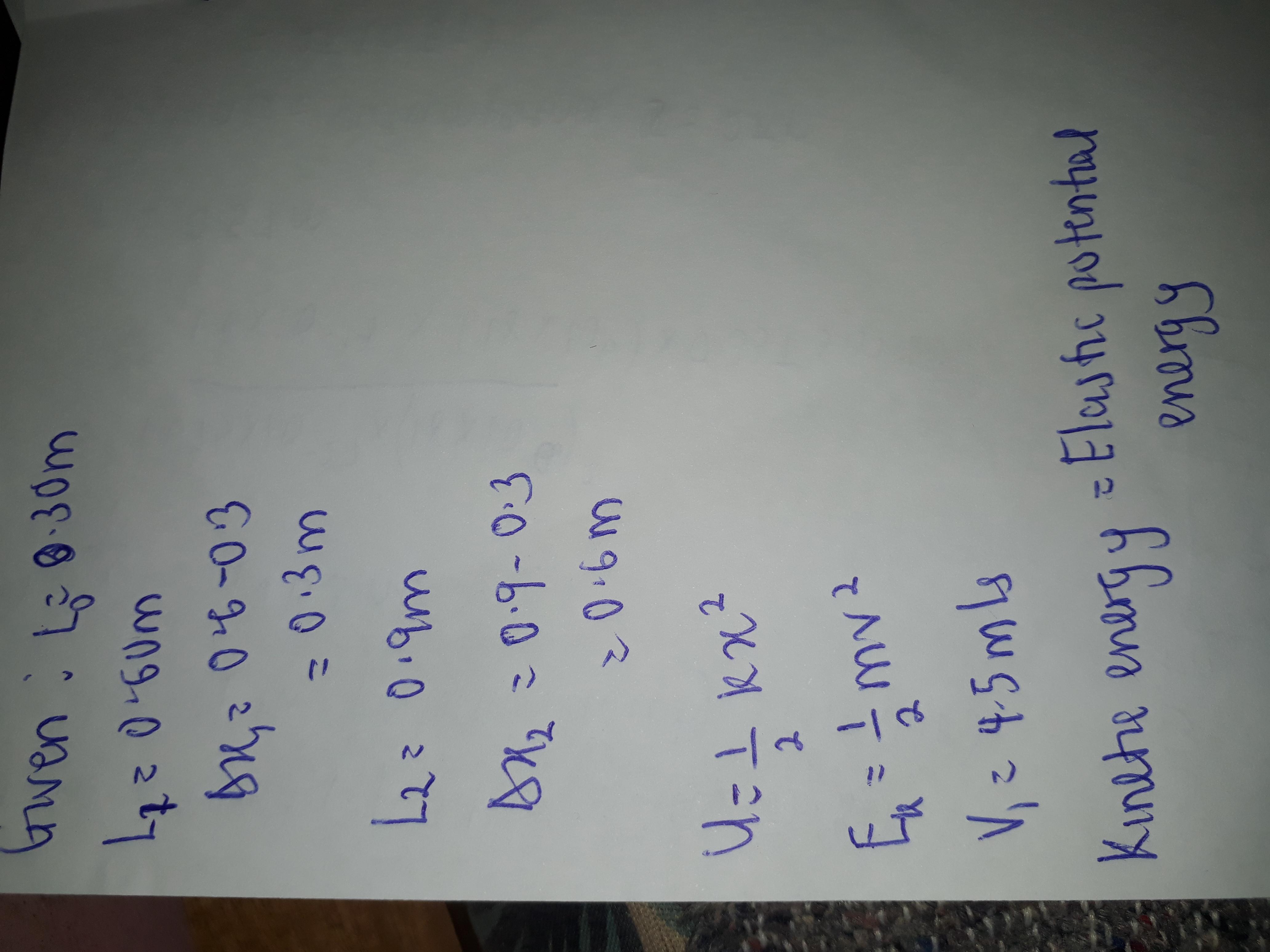
An unstretched spring has a length of 0.30 m. When the spring is stretched to a total length of 0.60 m, it supports traveling wa
IceJOKER [234]

Explanation:

Below is an attachment containing the solution

7 0
2 years ago
Other questions:
  • A robot probe drops a camera off the rim of a 239 m high cliff on mars, where the free-fall acceleration is −3.7 m/s2 .
    13·1 answer
  • What is the potential energy of the two-spring system after the point of connection has been moved to position (x, y)? keep in m
    7·2 answers
  • A roller coaster, traveling with an initial speed of 15 meters per second, decelerates uniformly at â7.0 meters per second2 to a
    11·1 answer
  • The robot arm is elevating and extending simultaneously. At a given instant, θ = 30°, ˙ θ = 10 deg / s = constant θ˙=10 deg/s=co
    6·1 answer
  • A coworker did not clean his work area before going home this could cause an accident so you quickly clean up the next day you s
    10·2 answers
  • A child is riding a merry-go-round that has an instantaneous angular speed of 1.25 rad/s and an angular acceleration of 0.745 ra
    11·1 answer
  • A block weighing 400 kg rests on a horizontal surface and supports on top of it ,another block of weight 100 kg which is attache
    10·1 answer
  • Stella is driving down a steep hill. She should keep her car __________ to help _________. a. light, it speed up in a higher b.
    14·2 answers
  • Two waves are traveling in the same direction along a stretched string. The waves are 45.0° out of phase. Each wave has an ampli
    6·1 answer
  • Which of the following has a particles in most irregular pattern​
    10·1 answer
Add answer
Login
Not registered? Fast signup
Signup
Login Signup
Ask question!