answer.
Ask question
Login Signup
Ask question
All categories
  • English
  • Mathematics
  • Social Studies
  • Business
  • History
  • Health
  • Geography
  • Biology
  • Physics
  • Chemistry
  • Computers and Technology
  • Arts
  • World Languages
  • Spanish
  • French
  • German
  • Advanced Placement (AP)
  • SAT
  • Medicine
  • Law
  • Engineering
777dan777 [17]
2 years ago
7

Production of Jam from Crushed Fruit in Two Stages. In a process producing jam (C1), crushed fruit containing 14 wt % soluble so

lids is mixed in a mixer with sugar (1.22 kg sugar/1.00 kg crushed fruit) and pectin (0.0025 kg pectin/1.00 kggensymb crushed fruit). The resultant mixture is then evaporated in a kettle to produce a jam containing 67 wt% soluble solids. For a feed of 1000 kg crushed fruit, calculate the kg mixture from the mixer, kg water evaporated, and kg jam produced
Chemistry
1 answer:
Andrej [43]2 years ago
6 0

Answer:

The total kg from the mixer: m=2222.5 kg

Evaporated water: m_{water ev.}=791.1 kg

Jam produced: m_{jam}=1431.4 kg

Explanation:

Step by step:

1) Kg of mixture from the mixer

It says that crushed fruit is added to the mixer with the sugar and pectin.

The fruit added is 1000 kg

The sugar added is 1.22 kg sugar/1 kg crushed fruit:

m_{sugar}=1000 kg fruit * \frac{1.22 kg sugar}{1 kg fruit}=1220 kg sugar

The pectin added is 0.0025 kg pectin/1 kg crushed fruit:

m_{pectin}=1000 kg fruit * \frac{0.0025 kg pectin}{1 kg fruit}=2.5 kg pectin

The total kg from the mixer:

m=1000 kg fruit + 2.5 kg pectin + 1220 kg sugar=2222.5 kg

2) Evaporated water

To calculate the evaporated water it's important to have in mind that the mix goes from a concentration of 14 wt% to 67 wt%. This difference is because of the evaporated water. So:

Initial: 1000 kg of fruit with 14 wt% of solids

m_{solids}=1000 kg *0.14=140 kg

<em>This amount of solids is constant </em>

Final: The mass of solids is the same but now it represents the 67 wt%

m_{final}=140 kg *\frac{100}{67}=208.9 kg

and

m_{water ev.}=1000kg-m_{final}

m_{water ev.}=1000kg-208.9kg=791.1 kg

3) Jam produced

m_{jam}=m_{final}+m_{pectin}+m_{sugar}=208.9 kg + 1220 kg + 2.5 kg

m_{jam}=1431.4 kg

You might be interested in
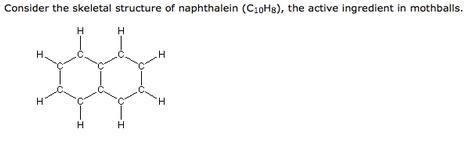
Consider the skeletal structure of naphthalein (C10H8), the active ingredient in mothballs. How many double bonds must be added
Greeley [361]

Answer:

four (4)

Explanation:

Naphthalein is an organic compound with formula C 10H 8. It is the simplest polycyclic aromatic hydrocarbon, and is a white crystalline solid with a characteristic odor that is detectable at concentrations as low as 0.08 ppm by mass. As an aromatic hydrocarbon, naphthalene's structure consists of a fused pair of benzene rings. It is best known as the main ingredient of traditional mothballs.

The molecule is planar, like benzene. Unlike benzene, the carbon–carbon bonds in naphthalene are not of the same length. The bonds C1−C2, C3−C4, C5−C6 and C7−C8 are about 1.37 Å (137 pm) in length, whereas the other carbon–carbon bonds are about 1.42 Å (142 pm) long. This difference, established by X-ray diffraction is consistent with the valence bond model in naphthalene and in particular, with the theorem of cross-conjugation. This theorem would describe naphthalene as an aromatic benzene unit bonded to a diene but not extensively conjugated to it (at least in the ground state), which is consistent with two of its three resonance structures.

Because of this resonance, the molecule has bilateral symmetry across the plane of the shared carbon pair, as well as across the plane that bisects bonds C2-C3 and C6-C7, and across the plane of the carbon atoms. Thus there are two sets of equivalent hydrogen atoms: the alpha positions, numbered 1, 4, 5, and 8, and the beta positions, 2, 3, 6, and 7. Two isomers are then possible for mono-substituted naphthalenes, corresponding to substitution at an alpha or beta position. Bicyclo[6.2.0]decapentaene is a structural isomer with a fused 4–8 ring system.

Therefore four (4) double bonds will be added to give each carbon atom an octet structure.

8 0
2 years ago
The concentration of ozone in a sample of air that has a partial pressure of O3 of 0.33 torr and a total pressure of air of 695
Goryan [66]

Answer:

0.047 %

Explanation:

Step 1: Given data

  • Partial pressure of ozone (pO₃): 0.33 torr
  • Total pressure of air (P): 695 torr

Step 2: Calculate the %v/v of ozone in the air

Air is a mixture of gases. We can find the %v/v of ozone (a component) in the air (mixture) using the following expression.

<em>%v/v = pO₃/P × 100%</em>

%v/v = 0.33 torr/695 torr × 100%

%v/v = 0.047 %

8 0
2 years ago
Urea contains two nitrogen atoms. what is the source of these two nitrogen atoms?
Oksi-84 [34.3K]
The source of these two nitrogen atoms are ammonia (NH₃) from <span>nitrogen compounds (mostly metabolism of amino acids) through which excess nitrogen is eliminated from organisms. This process is called urea cycle, which extracted </span>nitrogenous wastes.
The liver<span> forms it by combining two </span>ammonia<span> molecules</span><span> with a </span>carbon dioxide<span> </span><span>molecule.</span><span />
3 0
2 years ago
Elena makes the table below to determine the number of atoms of each element in the chemical formula 3(NH4)2SO4
Hunter-Best [27]

Answer:

She should not have multiplied the nitrogen atom by subscript 2.

Explanation:

Chemical formula:

3(NH₄)₂SO₄

Elements present in given formula:

Nitrogen

Hydrogen

Sulfur

Oxygen

Total number of atoms of elements:

N = 3×1×2 = 6

H = 4×2×3 = 24

S = 1×3 = 3

O = 3×4 = 12

The number nitrogen atoms are six. Elena did mistake by counting the number of nitrogen. She should didn't multiplied the nitrogen atom by subscript 2.

5 0
2 years ago
Read 2 more answers
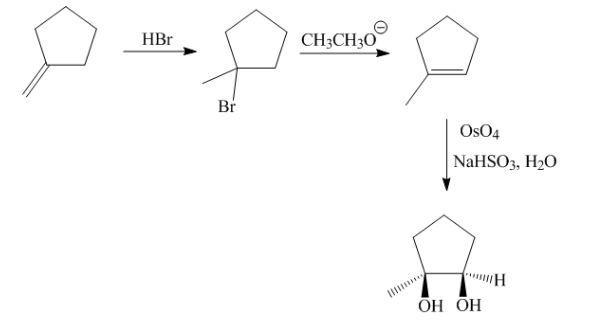
The target diol is synthesized in one step from 1-methylcyclopentene, but your lab partner exhausted the supply of that alkene.
andrezito [222]

Answer:

The reagents are CH_{3}CH_{3}O^{-},OsO_{4},NaHSO_{3}and H_{2}O.

Explanation:

1-Methylenecyclopentene is treated with HBr form 1-bromo-1-methylcyclopentane, which is treated with strong base ethoxide ion and forms 1-methylcyclopent-1-ene.

This alkene is treated with osmium tetraoxide in the presence of sodium bisulfite to form target product.

The chemical reaction is as follows.

4 0
2 years ago
Other questions:
  • What is the molality of a solution in which 3.0 moles of NaCl is dissolved in 1.5 Kg of water?
    14·1 answer
  • Write a balanced half-reaction describing the oxidation of gaseous dihydrogen to aqueous hydrogen cations.
    12·2 answers
  • Consider the reaction 2Al(OH)3(s)→Al2O3(s)+3H2O(l) with enthalpy of reaction ΔHrxn∘=21.0kJ/mol What is the enthalpy of formation
    6·2 answers
  • Consider the structure of the amino acid alanine. indicate the hybridization about each interior atom.
    6·2 answers
  • Based on the crystal-field strengths cl- &lt; f- &lt; h2o &lt; nh3 &lt; h2nc2h4nh2, which octahedral ti (iii) complex below has
    9·1 answer
  • 8. Balance the following nuclear equations:<br> ^65/30Ca -&gt; ^65/29Sc +_______
    15·1 answer
  • A sample of sodium reacts completely with 0.355 kg of chlorine, forming 585 g of sodium chloride. What mass of sodium reacted?
    12·1 answer
  • When a 1.00 L sample of water from the surface of the Dead Sea (which is more than 400 meters below sea level and much saltier t
    12·1 answer
  • For maleic acid, hoocch=chcooh, ka1 = 1.42  10–2 and ka2 = 8.57  10–7 . what is the concentration of maleate ion (–oocch=chcoo
    12·2 answers
  • You have four water samples at different temperatures. In which sample are the molecules vibrating at the fastest speed? A. wate
    9·1 answer
Add answer
Login
Not registered? Fast signup
Signup
Login Signup
Ask question!