answer.
Ask question
Login Signup
Ask question
All categories
  • English
  • Mathematics
  • Social Studies
  • Business
  • History
  • Health
  • Geography
  • Biology
  • Physics
  • Chemistry
  • Computers and Technology
  • Arts
  • World Languages
  • Spanish
  • French
  • German
  • Advanced Placement (AP)
  • SAT
  • Medicine
  • Law
  • Engineering
Yakvenalex [24]
2 years ago
3

A 1000-kg object hangs from the lower end of a steel rod 5.0 m long that is suspended vertically. The diameter of the rod is 0.8

0 cm and Young's modulus for the rod is 210,000 MN/m2. What is the elongation of the rod due to this object?
A) 0.047 cm
B) 1.2 cm
C) 0.12 cm
D) 1.8 cm
E) 0.46 cm
Physics
2 answers:
slava [35]2 years ago
6 0

Answer:

\Delta L=4.642\,mm

Explanation:

Given:

mass of the hanging object, m= 1000 kg

original length of the steel rod, L=5 m

diameter of the rod, d= 0.80 cm

Young's modulus for the rod, E = 210,000 MPa

Firstly we find the value of stress:

\sigma = \frac{Force}{area}

\sigma = \frac{1000\times 9.8}{\pi\times 4^2}

\sigma = 194.9648 MPa

Now strain,

\epsilon= \frac{\sigma}{E}

\epsilon= \frac{194.9648 }{210000}

\epsilon= 0.00093

We know,

\epsilon= \frac{\Delta L}{L}

0.00093= \frac{\Delta L}{5000}

\Delta L=4.642\,mm

jok3333 [9.3K]2 years ago
4 0

Answer:E

Explanation:

Given

mass of object m=1000 kg

Length of steel rod L=5 m

diameter of rod d=0.8 cm

Young modulus E=210,000 MN/m^2

And we know E=\frac{stress}{strain}

stress=\frac{Load}{Area}

Strain=\frac{\Delta L}{L}

Therefore \Delta =\frac{FL}{AE}

\Delta =\frac{1000\times 9.8\times 5}{\frac{\pi (0.8\times 10^{-2})^2}{4}\times 210000\times 10^6}

\Delta =\frac{20\times 9.8}{\pi \times 0.64\times 210\times 100}

\Delta =4.64\times 10^{-3} m

\Delta =0.464 cm

You might be interested in
Consider two circular metal wire loops each carrying the same current I as shown below. In what r... Consider two circular metal
NeX [460]

Answer:

1) The magnetic field outside the loop is zero.

In region III the magnetic fields due to the two wire loops point in the opposite direction andhence cancel each other. Therefore the magnetic field is zero in region I, III and V

The diagram is attached

6 0
2 years ago
A "biconvex" lens is one in which both surfaces of the lens bulge outwards. Suppose you had a biconvex lens with radii of curvat
Stolb23 [73]

Answer: f=150cm in water and f=60cm in air.

Explanation: Focal length is a measurement of how strong light is converged or diverged by a system. To find the variable, it can be used the formula:

\frac{1}{f} = (nglass - ni)(\frac{1}{R1} - \frac{1}{R2}).

nglass is the index of refraction of the glass;

ni is the index of refraction of the medium you want, water in this case;

R1 is the curvature through which light enters the lens;

R2 is the curvature of the surface which it exits the lens;

Substituting and calculating for water (nwater = 1.3):

\frac{1}{f} = (1.5 - 1.3)(\frac{1}{10} - \frac{1}{15})

\frac{1}{f} = 0.2(\frac{1}{30})

f = \frac{30}{0.2} = 150

For air (nair = 1):

\frac{1}{f} = (1.5 - 1)(\frac{1}{10} - \frac{1}{15})

f = \frac{30}{0.5} = 60

In water, the focal length of the lens is f = 150cm.

In air, f = 60cm.

5 0
2 years ago
Read 2 more answers
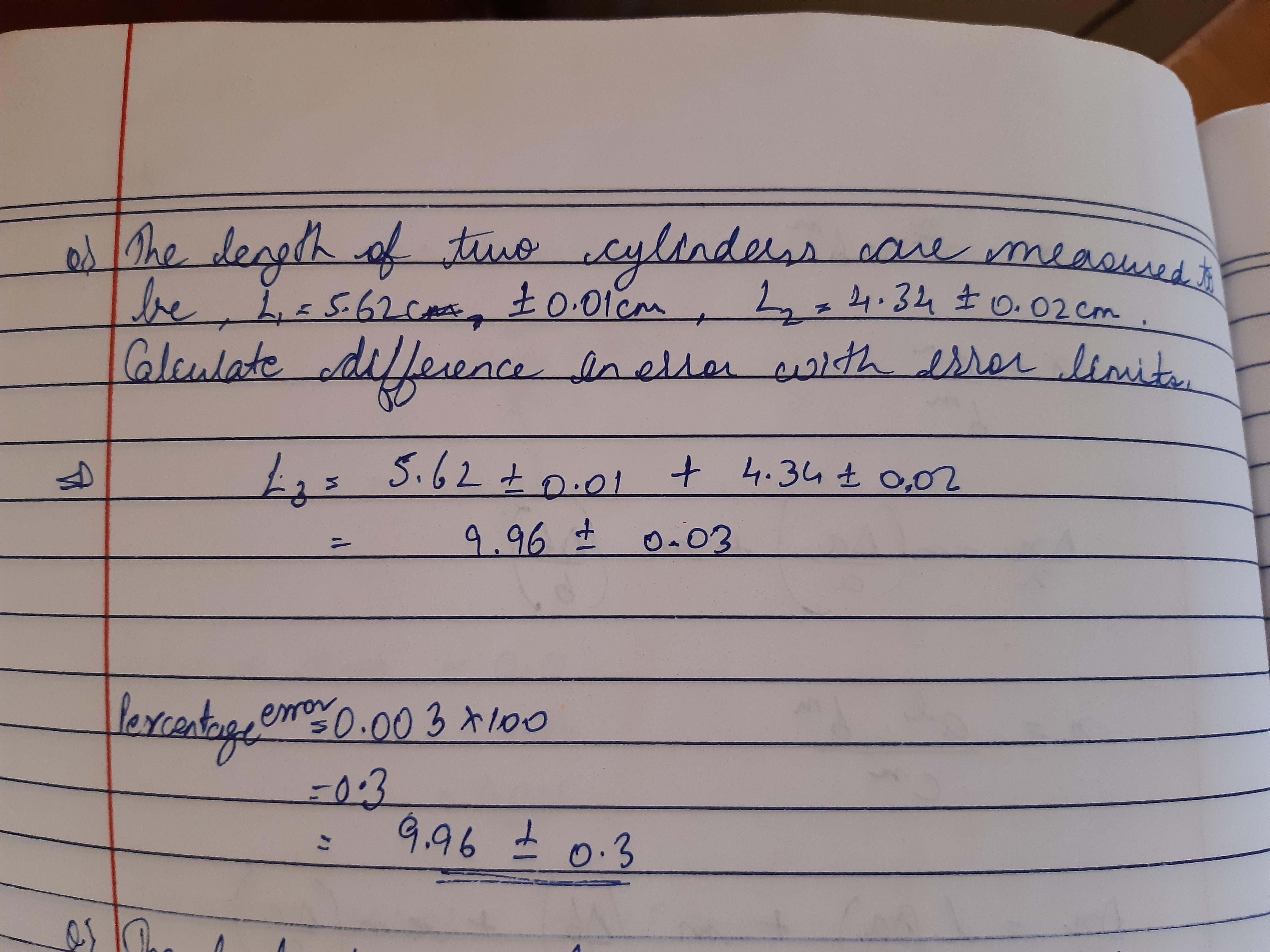
Length of two cylinders are measured to be L1 = 5.62 +/- 0.01cm and L2 = 4.34 +/- 0.02cm.
zavuch27 [327]

Answer:

Explanation:

Just look at the figure

7 0
2 years ago
A uniform cylindrical steel wire (density: 7.8 x 10³ kg/m3), 58.0 cm long and 1.34 mm in diameter, is fixed at both ends. To wha
lbvjy [14]

Answer:

T= 354.65 N

Explanation:

Given that

ρ= 7800 kg/m³

L= 58 cm

d=1.34 mm

f= 311 Hz

T= Tension

Speed of wave ,V

V = f λ      

V = f L

V= 311 x 0.58 m/s

V=180.38 m/s

Area of cross sectional

A= πr² mm²

A= 3.14 x 0.67² mm²

A=1.41 mm²

Mass = Density x Volume

m=7800\times 1.41\times 10^{-6}\ kg/m

m=0.0109 kg/m

Tension ,T

T=m V^2

T= 0.0109 x 180.38² N

T= 354.65 N


3 0
2 years ago
A 2200 kg truck has put its front bumper against the rear bumper of a 2400 kg SUV to give it a push. With the engine at full pow
leonid [27]

Answer:

a) The maximum possible acceleration the truck can give the SUV is 7.5 meters per second squared

b) The force of the SUV's bumper on the truck's bumper is 18000 newtons

Explanation:

a) By Newton's second law we can find the relation between force and acceleration of the SUV:

F=ma

With F the maximum force the truck applies to the SUV, m the mass of the SUV and a the acceleration of the SUV; solving for a:

a=\frac{F}{m}=\frac{18000}{2400}\approx7.5\,\frac{m}{s^{2}}

b) Because at this acceleration the truck's bumper makes a force of 18000 N on the SUV’s bumper by Third Newton’s law the force of the SUV’s bumper on the truck’s bumper is 18000 N too because they are action-reaction force pairs.


7 0
2 years ago
Other questions:
  • Platinum (pt) has the fcc crystal structure, an atomic radius of 0.1387 nm, and an atomic weight of 195.08 g/mol. what is its th
    15·2 answers
  • A robot probe drops a camera off the rim of a 239 m high cliff on mars, where the free-fall acceleration is −3.7 m/s2 .
    13·1 answer
  • How much heat must be absorbed by 375 grams of water to raise its temperature by 25°c
    8·2 answers
  • A student holds one end of a thread, which is wrapped around a cylindrical spool, as shown above. The student then drops the spo
    8·1 answer
  • One end of a piano wire is wrapped around a cylindrical tuning peg and the other end is fixed in place. The tuning peg is turned
    11·1 answer
  • A slender rod is 80.0 cm long and has mass 0.370 kg . A small 0.0200-kg sphere is welded to one end of the rod, and a small 0.05
    5·1 answer
  • A dog of mass 10 kg sits on a skateboard of mass 2 kg that is initially traveling south at 2 m/s. The dog jumps off with a veloc
    9·1 answer
  • Consider three starships that pass by an observer on Earth. Starship A is traveling at speed v=c/3v=c/3 relative to Earth and ha
    13·1 answer
  • An object is located 25.0 cm from a convex mirror. The image distance is -50.0 cm. What is the magnification?
    8·1 answer
  • A frog jumps up at time t = 0.
    15·2 answers
Add answer
Login
Not registered? Fast signup
Signup
Login Signup
Ask question!