answer.
Ask question
Login Signup
Ask question
All categories
  • English
  • Mathematics
  • Social Studies
  • Business
  • History
  • Health
  • Geography
  • Biology
  • Physics
  • Chemistry
  • Computers and Technology
  • Arts
  • World Languages
  • Spanish
  • French
  • German
  • Advanced Placement (AP)
  • SAT
  • Medicine
  • Law
  • Engineering
DerKrebs [107]
2 years ago
15

Glucose (C6H12O6) can be fermented to yield ethanol (CH3CH2OH) and carbon dioxide (CO2). C6H12O6⟶2CH3CH2OH+2CO2 The molar mass o

f glucose is 180.15 g/mol, the molar mass of ethanol is 46.08 g/mol, and the molar mass of carbon dioxide is 44.01 g/mol. What is the theoretical yield of ethanol from the fermentation of 61.5 g of glucose? theoretical yield: g If the reaction produced 23.4 g of ethanol, what is the percent yield? percent yield:
Chemistry
1 answer:
jekas [21]2 years ago
7 0

Answer:

The % yield is 74.45 %

Explanation:

<u>Step 1:</u> The balanced equation

C6H12O6⟶2CH3CH2OH+2CO2

<u>Step 2</u>: Data given

Molar mass glucose = 180.15 g/mol

Molar mass of ethanol = 46.08 g/mol

Molar mass of carbon dioxide = 44.01 g/mol

Mass of glucose = 61.5 grams

Mass of ethanol = 23.4 grams

<u>Step 3:</u> Calculate moles of glucose

Moles glucose = Mass glucose  / Molar mass of glucose

Moles glucose = 61.5 grams / 180.15 g/mol

Moles glucose = 0.341 moles

<u>Step 4:</u> Calculate moles of ethanol

1 mole of glucose consumed, produces 2 moles of ethanol and 2 moles of CO2

0.341 moles of glucose, will produce 2*0.341 = 0.682 moles of ethanol

<u>Step 5:</u> Calculate mass of ethanol

Mass ethanol = moles ethanol * Molar mass ethanol

Mass ethanol = 0.682 moles * 46.08 g/mol

Mass ethanol = 31.43 grams = theoretical mass

<u>Step 6:</u> Calculate % yield

% yield = actual mass / theoretical mass

% yield = (23.4 grams / 31.43 grams) * 100%

% yield = 74.45 %

The % yield is 74.45 %

You might be interested in
An airplane cabin is pressurized to 5.80x10^2.What is the pressure inside the cabin in atmospheres?
joja [24]

Answer:

Explanation:

An airplane cabin is pressurized to 570 mmhg. what is the pressure inside the cabin in atmospheres? a commercial jet takes off from earth's surface and enters the stratosphere

6 0
2 years ago
How many grams of KBr are required to make 550. mL of a 0.115 M KBr solution?
In-s [12.5K]

Molarity is expressed as the number of moles of solute per volume of the solution. For example, we are given a solution of 2M NaOH this describes a solution that has 2 moles of NaOH per 1 L volume of the solution. We calculate as follows:

0.115 M = n mol KBr / .55 L solution

n = 0.06325 mol KBr

mass = 0.06325 mol KBr (119 g / mol) = 7.53 g KBr

4 0
2 years ago
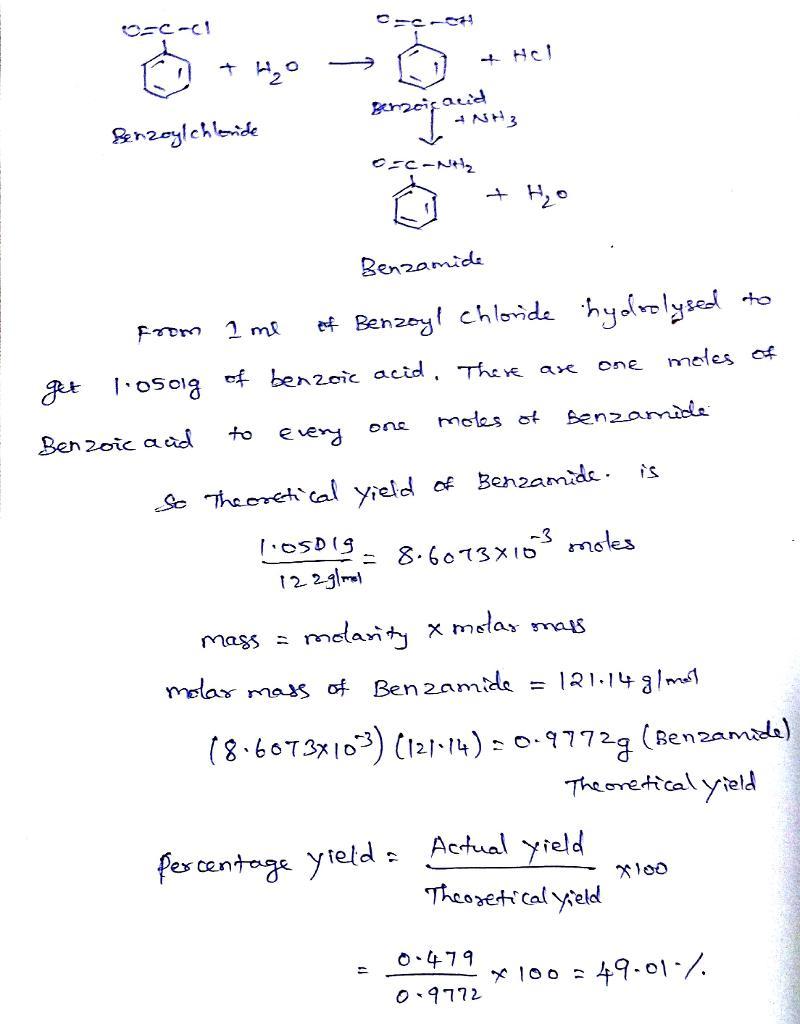
Consider the ammonolysis of benzoyl chloride by adding concentrated ammonium hydroxide to form the final product, benzamide. Rea
gizmo_the_mogwai [7]

Answer:

Explanation: see attachment below

4 0
2 years ago
You wish to make a buffer with pH 7.0. You combine 0.060 grams of acetic acid and 14.59 grams of sodium acetate and add water to
aleksandr82 [10.1K]

Answer:

The pH of the buffer is 7.0 and this pH is not useful to pH 7.0

Explanation:

The pH of a buffer is obtained by using H-H equation:

pH = pKa + log [A⁻] / [HA]

<em>Where pH is the pH of the buffer</em>

<em>The pKa of acetic acid is 4.74.</em>

<em>[A⁻] could be taken as moles of sodium acetate (14.59g * (1mol / 82g) = 0.1779 moles</em>

<em>[HA] are the moles of acetic acid (0.060g * (1mol / 60g) = 0.001moles</em>

<em />

Replacing:

pH = 4.74 + log [0.1779mol] / [0.001mol]

<em>pH = 6.99 ≈ 7.0</em>

<em />

The pH of the buffer is 7.0

But the buffer is not useful to pH = 7.0 because a buffer works between pKa±1 (For acetic acid: 3.74 - 5.74). As pH 7.0 is out of this interval,

this pH is not useful to pH 7.0

<em />

7 0
2 years ago
A gas has a mass of 3.82 g and occupies a volume of 0.854 L. The temperature in the laboratory is 302 K, and the air pressure is
4vir4ik [10]

m = given mass of gas = 3.82 g

M = molar mass of gas = ?

T = temperature of laboratory = 302 K

P = air pressure = 1.04 atm = 1.04 x 101325 pa

V = volume of gas = 0.854 L = 0.854 x 10⁻³ m³

using the ideal gas equation

PV = (m/M) RT

inserting the above values

(1.04 x 101325) (0.854 x 10⁻³) = (3.82/M) (8.314) (302)

M = 106.6 g

hence the molar mass of the gas comes out to be 106.6 g

3 0
2 years ago
Other questions:
  • What is the main difference between the alpine tundra and the arctic tundra? a. The alpine tundra includes trees. b. The alpine
    10·2 answers
  • How many kilograms are in 4 moles of Na2CO3?
    13·1 answer
  • F the solution described in the introduction is cooled to 0 ∘c, what mass of kno3 should crystallize?
    7·2 answers
  • Colorful fireworks often involve the decomposition of barium nitrate and potassium chlorate and the reaction of the metals magne
    9·1 answer
  • The mineral rhodochrosite [manganese(II) carbonate, MnCO3] is a commercially important source of manganese. Write a half-reactio
    7·1 answer
  • For a reaction with ΔH° = −9 kJ/mol, decide if the following statement is true. If it is false, choose the statement that makes
    11·1 answer
  • "11. Barium nitrate reacts with aqueous sodium sulfate to produce solid barium sulfate and aqueous sodium nitrate. Abigail place
    6·2 answers
  • Identify the true statements regarding alpha-1,6 linkages in glycogen.
    11·1 answer
  • Arrange these reactions according to increasing ΔS.
    12·1 answer
  • Bromine has two isotopes, Br79 and Br81. The isotopes occur in a 50:50 (1:1) ratio. Given that the mass spectrum of bromine cont
    12·1 answer
Add answer
Login
Not registered? Fast signup
Signup
Login Signup
Ask question!