answer.
Ask question
Login Signup
Ask question
All categories
  • English
  • Mathematics
  • Social Studies
  • Business
  • History
  • Health
  • Geography
  • Biology
  • Physics
  • Chemistry
  • Computers and Technology
  • Arts
  • World Languages
  • Spanish
  • French
  • German
  • Advanced Placement (AP)
  • SAT
  • Medicine
  • Law
  • Engineering
Zina [86]
2 years ago
13

Which statement is incorrect regarding the reaction of benzene with an electrophile? View Available Hint(s) A) The carbocation i

ntermediate loses a proton from the carbon bonded to the electrophile. B) Carbocation formation is the rate-determining step. C) Benzene functions as a nucleophile. D) The carbocation intermediate reacts with a nucleophile to form the addition product.

Chemistry
1 answer:
Leno4ka [110]2 years ago
3 0

Answer:

The carbocation intermediate reacts with a nucleophile to form the addition product.

Explanation:

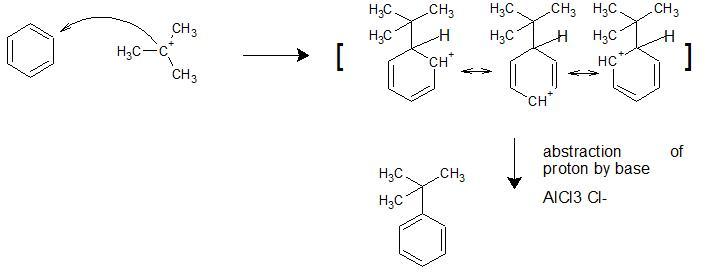
The reaction of benzene with an electrophile is an electrophillic substitution reaction. Here the electrophile replaces hydrogen. There is no formation of carbocation as intermediate in the reaction. Infact there is transition state where the electorphile attacks on benzene ring and at the same time the hydrogen gets removed from the benzene. So a transition carbocation is formed.

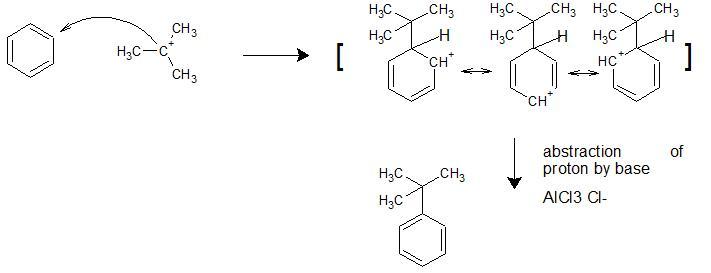
The general mechanism is shown in the figure.

i) Attack of the electrophile on the benzene (which is the nucleophile)

ii) The carbocation intermediate loses a proton from the carbon bonded to the electrophile.

iii) the carbocation formation is the rate determining step.

iv) There is no formation of addition product.

Thus the wrong statement is

The carbocation intermediate reacts with a nucleophile to form the addition product.

You might be interested in
The following chemical reaction takes place in aqueous solution: AgF (aq)+ NH4Cl (aq) →AgCl(s)+ NH4F(aq) Write the net ionic equ
Nadusha1986 [10]

Answer:

  • <em>The net ionic equation is: </em><u>Ag⁺ (aq) + Cl ⁻ (aq) → AgCl (s)</u>

Explanation:

<u>1) Start by writing the total ionic equation:</u>

The total ionic equation shows each aqueous substance in its ionized form, while the solid or liquid substances are shown with their chemical formula.

These are the ionic species:

  • AgF (aq) → Ag⁺ (aq) + F⁻ (aq)

  • NH₄Cl (aq) → NH₄⁺ (aq) + Cl ⁻ (aq)

  • NH₄F(aq) → NH₄⁺ (aq) + F⁻ (aq)

Then, replace each chemical formula in the chemical equation by those ionic forms:

  • Ag⁺ (aq) + F⁻ (aq) +  NH₄⁺ (aq) + Cl ⁻ (aq) → AgCl (s) + NH₄⁺ (aq) + F⁻ (aq)

That is the total ionic equation.

<u>2) Spectator ions:</u>

The ions that appear in both the reactant side and the product side are considered spectator ions (they do not change), and so they are canceled.

In our total ionic equation they are F⁻ (aq) and  NH₄⁺ (aq).

After canceling them, you get the net ionic equation:

<u>3) Net ionic equation:</u>

  • Ag⁺ (aq) + Cl ⁻ (aq) → AgCl (s)     ← answer

4 0
2 years ago
Which coefficient correctly balance the equation CaO + H2O -&gt; Ca(OH)2
deff fn [24]

For the equation that we are given:

CaO+H_{2}O → Ca(OH)_{2}

We see that on the reactants side we have:

Ca: 1 mol

O: 2 mol

H: 2 mol

And then we see that on the products side we have:

Ca: 1 mol

O: 2 mol

H: 2 mol

Therefore since we have equal moles of each of the elements on both sides of the equation, this equation is balanced how it is.

So the correct coefficients for this equation are: B) 1, 1, 1.

4 0
2 years ago
You heat 51 grams of magnesium over a Bunsen burner for several minutes until it reacts with oxygen in the air. Then you weigh t
garik1379 [7]

Answer:

    The mass was there all along, it was just in the air. The weight of the oxygen from the air is not weighed in the beginning, only at the end as part of the product, making it seem like there is a total mass change.

8 0
2 years ago
In a conductivity apparatus, like the one above, you should never touch the ___ while the power is on. A Light Bulb B Leads C Wi
laila [671]

Answer:

Leads

Explanation:

5 0
2 years ago
Read 2 more answers
What is the molarity of 225 mL of a KNO3 solution containing 34.8 g KNO3? (molar mass = 101.1 g/mol)
Charra [1.4K]

Answer:

The answer to your question is the letter B) 1.53 M

Explanation:

Data

Molarity = ?

volume = 225 ml

mass of KNO₃ = 34.8 g

molar mass = 101.1 g/mol

Process

1.- Convert the ml to liters

                  1000 ml ------------------ 1 l

                   225 ml ------------------- x

                   x = (225 x 1) / 1000

                   x = 0.225 l

2.- Convert the mass of KNO₃ to moles

                  101.1 g ---------------------- 1 mol

                   34.8 g --------------------- x

                        x = (34.8 x 1) / 101.1

                        x = 0.344 moles

3.- Calculate the Molarity

Molarity = moles/volume

-Substitution

Molarity = 0.344/ 0.225

-Result

Molarity = 1.53 M
6 0
2 years ago
Read 2 more answers
Other questions:
  • Calculate the number of grams of solute in 500.0 mL of 0.189 M KOH.
    10·2 answers
  • A fog forms over a lake. What two changes of state must occur to produce the fog? Do the water molecules absorb or release energ
    9·1 answer
  • 7. How many moles of argon are there in 20.0 L, at 25 degrees Celsius and 96.8 kPa?
    11·2 answers
  • A cylinder contains 4.0 g of nitrogen gas. A piston compresses the gas to half its initial volume. Afterward, by what factor has
    7·1 answer
  • a gas that exerts a pressure of 215 torr in a container with a volume of 51.0 mL will exert a pressure of ? torr when transferre
    5·1 answer
  • Phosphorous acid, H3PO3(aq), is a diprotic oxyacid that is an important compound in industry and agriculture. K pKa1 K pKa2 1.30
    11·1 answer
  • Modern commercial airliners are largely made of aluminum, a light and strong metal. But the fact that aluminum is cheap enough t
    15·1 answer
  • Identify the oxidizing and reducing agents in the following: 2H+(aq) + H2O2(aq) + 2Fe2+(aq) → 2Fe3+(aq) + 2H2O(l)
    7·1 answer
  • 11. A sample contains 25% water and weighs 201 grams. Determine the grams of water in the
    9·1 answer
  • The infections that people get while they are in hospitals are commonly resistant to multiple drugs. What is a reason for the in
    7·2 answers
Add answer
Login
Not registered? Fast signup
Signup
Login Signup
Ask question!