answer.
Ask question
Login Signup
Ask question
All categories
  • English
  • Mathematics
  • Social Studies
  • Business
  • History
  • Health
  • Geography
  • Biology
  • Physics
  • Chemistry
  • Computers and Technology
  • Arts
  • World Languages
  • Spanish
  • French
  • German
  • Advanced Placement (AP)
  • SAT
  • Medicine
  • Law
  • Engineering
natta225 [31]
2 years ago
8

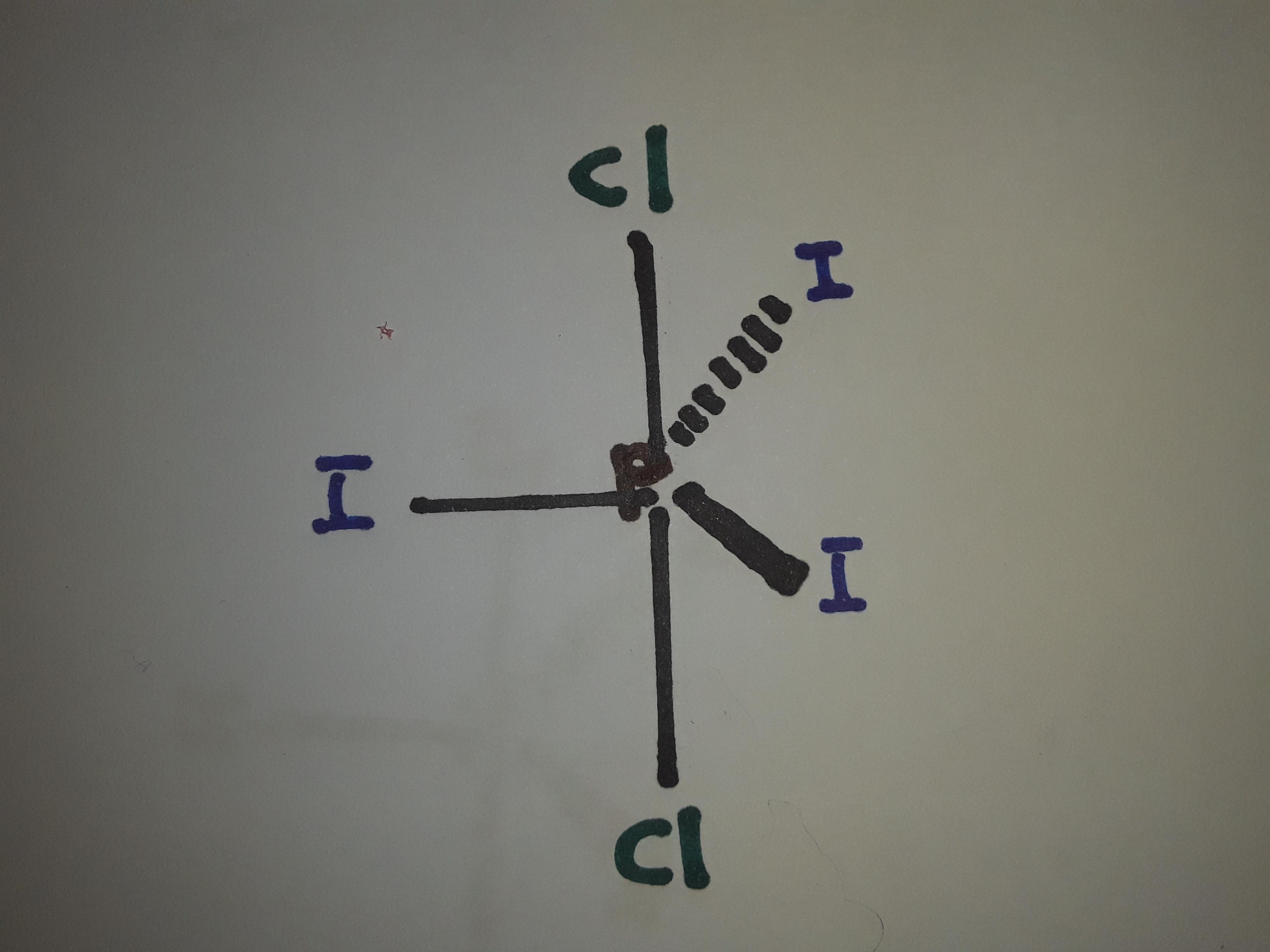
PI3Cl2 is a nonpolar molecule. Based on this information, determine the I−P−I bond angle, the Cl−P−Cl bond angle, and the I−P−Cl

bond angle. Enter the number of degrees of the I−P−I, Cl−P−Cl, and I−P−Cl bond angles, separated by commas (e.g., 30,45,90)

Chemistry
1 answer:
stellarik [79]2 years ago
5 0

Answer:

120, 180,90

Explanation:

According to VSEPR theory with a central atom with 5 gropus, we will expect a trigonal bipyramidal structure. This structure look like a trgonal plane containing the three iodine atoms, and above and below this plane we have the two bromine atoms 180º apart. Why can we say this? The key is that the problem is telling us the PIₐCl₂ is a nonpolar molecule and this shape is the only one that will result in a nonpolar structure. The Chlorine atoms will be in the axial positions 180 degrees apart and the bond angles will be :

I-P- I       120º

Cl-P-Cl   180º

I-P-Cl      90 º

See attachment.

The two Cl atoms are in the axial positions, and the three I atoms are in what we call equatorial position in the trigonal plane.

Any other arrangement will result in a polar molecule. Place a Cl atom in the trigonal plane and I in the axial position, and you can see that the molecule will be polar because the positions will no longer be equivalent and the dipoles will not cancel each other.

You might be interested in
A converging lens with a focal length of 70.0cm forms an image of a 3.20-cm-tall real object that is to the left of the lens. Th
Setler [38]

Answer: (i)The object is at a distance of 120cm from the lens while the image is at a distance of 160cm from the lens. (ii)The image is Real

Note: This is the complete question; A converging lens with a focal length of 70.0cm forms an image of a 3.20-cm-tall real object that is to the left of the lens. The image is 4.50cm tall and inverted. Where are the object and image located in relation to the lens? Is the image real or virtual?

Explanation:

The required formulas are;

1. lens formula given by,  <em>1/s' + 1/s = 1/f</em>

2. magnification = <em>h'/h = s'/s</em>

where h' is image height, h is object height, s' is image distance, s is object distance, f is focal length of lens.

h' = 4.50cm, h = 3.20cm, f = 70cm ( f of a converging lens is positive)

solving for s' and s in eqn (2)

4.50/3.20=s'/s

1.4=s'/s

s'=1.4s

to find the values of s' and s, we use equation (1) and substitute s' = 1.4s

1/1.4s + 1/s = 1/70

2.4/1.4s =1/70

s = 2.4*70/1.4 = 120cm

s' = 1.4*120 = 160cm

Therefore, the object is on the left, 120cm from the lens while the image is 160cm on the right of the lens

<em>Since the object is at a distance between f and 2f from the lens, the image formed is</em> real, inverted and magnified
3 0
2 years ago
How many grams o an ointment base must be added to 45 g o clobetasol (T EMOVAT E) ointment, 0.05% w/w, to change its strength to
saw5 [17]

Answer:

Drug calculation

If we have 45g of clobetasol  = 0.05%w/w

Then what mass in g of clobetasol is in 0.03%w/w = 45 x 0.03/0.05 =27g

It means that 27g of clobetasol must be added to change the drug strength to 0.03% w/w

3 0
2 years ago
For a school event 1/6 of the athletic field is reversed for the fifth -grade classes the reserved part of the field is divided
SVETLANKA909090 [29]

Answer:

\frac{1}{24}

Explanation:

Given:

For a school event, 1/6 of the athletic field is reserved for the fifth -grade classes and the reserved part of the field is divided equally among the 4 fifth grade classes in the school.

To find: fraction of the whole athletic field reserved for each fifth class

Solution:

Fraction of the whole athletic field reserved for four fifth classes = \frac{1}{6}

So, fraction of the whole athletic field reserved for each fifth class = \frac{1}{4}(\frac{1}{6})=\frac{1}{24}

3 0
2 years ago
Lithium chloride forms three hydrates. They are LiCl.H2O, LiCl.2H2O and LiCl.3H2O.
Stels [109]

Answer:

The answer is LiCl.2H2O

Explanation:

Li=7

Cl=35.5

O=16

LiCl.H2O

7+35.5+16+2

60.5

%comp=60.5/78.5×100

22.9

LiCl.2H20

7+35.5+2(2+16)

42.5+36

78.5

%comp=36/78.5×100

45.9

LiCl.3H20

7+35.5+3(2+16)

42.5+54

96.5

54/96.5×100

56.0

7 0
2 years ago
Calculate the pH of a buffer solution prepared by dissolving 0.20 mole of cyanic acid (HCNO) and 0.80 mole of sodium cyanate (Na
Afina-wow [57]

The pH of a buffer solution : 4.3

<h3>Further explanation</h3>

Given

0.2 mole HCNO

0.8 mole NaCNO

1 L solution

Required

pH buffer

Solution

Acid buffer solutions consist of weak acids HCNO and their salts NaCNO.

\tt \displaystyle [H^+]=Ka\times\frac{mole\:weak\:acid}{mole\:salt\times valence}

valence according to the amount of salt anion  

Input the value :

\tt \displaystyle [H^+]=2.10^{-4}\times\frac{0.2}{0.8\times 1}\\\\(H^+]=5\times 10^{-5}\\\\pH=5-log~5\\\\pH=4.3

7 0
2 years ago
Other questions:
  • Suppose you have two cubes of exactly the same volume. You weigh them and find a mass of 8.91g for one and 8.88g for the other c
    13·2 answers
  • How many quarters fit in a 1.75 liter bottle?
    8·2 answers
  • When atoms lose or gain electrons in chemical reactions they form?
    14·1 answer
  • Adam wants to work in the field of forensic science and follow the rules for handling evidence. Which organization can he join t
    12·2 answers
  • 6. Find the number of centimeters in 1.00 x 10² yards. (1 yd = 3 ft, 1 ft = 12 in, 2.54 cm = 1
    5·1 answer
  • Most NADH molecules generated during cellular respiration are produced during __________. View Available Hint(s) Most NADH molec
    10·1 answer
  • A sample of gas with an initial volume of 28.4 Liters at a pressure of 725 mmHg and a temperature of 305 K is compressed to a vo
    9·1 answer
  • The pressure and temperature inside a bike tire is 10 atm and 10k respectively. What will the pressure become in the tire when t
    7·1 answer
  • What is the molarity if 2.00 liters containing 49.0 grams of sodium carbonate [Na2CO3)?
    5·1 answer
  • What percentage of the 20.0 g sample does sugar (sucrose) represent?
    7·1 answer
Add answer
Login
Not registered? Fast signup
Signup
Login Signup
Ask question!
