answer.
Ask question
Login Signup
Ask question
All categories
  • English
  • Mathematics
  • Social Studies
  • Business
  • History
  • Health
  • Geography
  • Biology
  • Physics
  • Chemistry
  • Computers and Technology
  • Arts
  • World Languages
  • Spanish
  • French
  • German
  • Advanced Placement (AP)
  • SAT
  • Medicine
  • Law
  • Engineering
grandymaker [24]
2 years ago
5

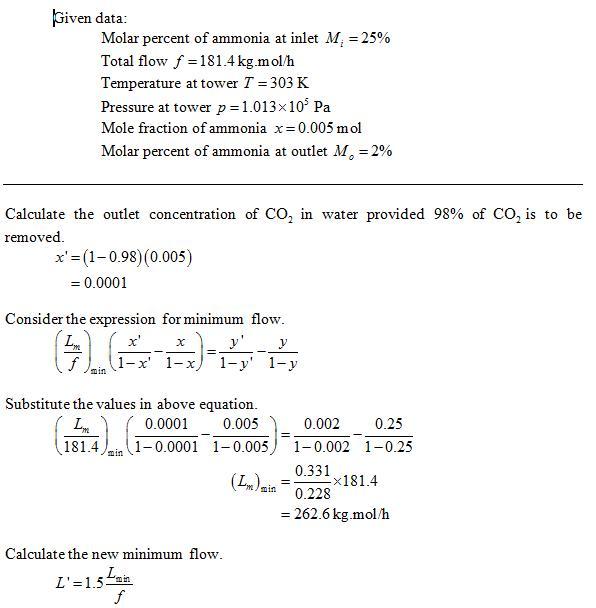
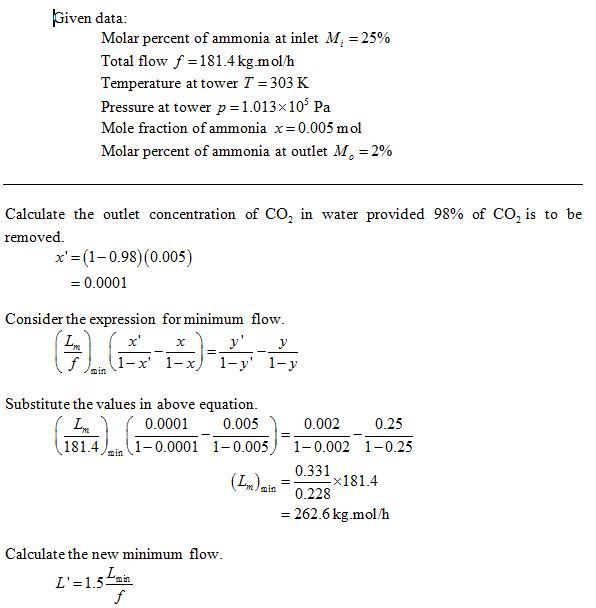
22.5-4. Minimum Liquid Flow in a Packed Tower. The gas stream from a chemical reactor contains 25 mol % ammonia and the rest are

inert gases. The total flow is 181.4 kg mol/h to an absorption tower at 303 K and 1.013 × 10⁵ Pa pressure, where water containing 0.005 mol frac ammonia is the scrubbing liquid. The outlet gas concentration is to be 2.0 mol % ammonia. What is the minimum flow L min ⁡ ′ Using 1.5 times the minimum, plot the equilibrium and operating lines. Ans. L min ⁡ ′ = 262.6kg mol/h

Engineering
1 answer:
Firdavs [7]2 years ago
5 0

Answer:

check attachments for answers

Explanation:

You might be interested in
At his review last year, Lucas was promised a 20 percent raise if he met his production goals. Raises were included in today’s p
Murrr4er [49]

Answer: Instrumentality;low

Explanation: Instrumentality is the impact a person have or will be able to render to a given activity or his or her job. The Instrumentality of a person has been found to be proportional to the what outcome of the person's efforts. Especially if the person's explanations are meant.

When a person's expectations are not meant it will cause the person's Instrumentality to be low.

4 0
2 years ago
True or False: Drag and tailwind are examples of a contact force.<br> tyy guyss
zloy xaker [14]

Answer:

False

Explanation:

8 0
2 years ago
The force exerted on a bridge pier in a river is to be tested in a 1:10 scale model using water as the working fluid. In the pro
Len [333]

Answer:

Force on the prototype is 5000 N

Solution:

As per the question:

Depth of water, x = 2.0 m

Flow velocity, v' = 1.5 m/s

Width of the river, w = 20 m

Force on the bridge pier model, F' = 5 N

Pressure, Ratio = Ratio of scale length

Scale = 1:10

Now,

\frac{P'}{P} = \frac{x}{w} = \frac{2.0}{20}

where

P' = pressure on model

P = pressure on prototype

\frac{\frac{F'}{A'}}{\frac{F}{A}} = \frac{1}{10}

where

F' = Force on model

F = Force on prototype

A' = Area of model

A = Area of prototype

Now:

\frac{F'}{F}.\frac{A}{A'} = \frac{1}{10}

\frac{5}{F}.\frac{1}{\frac{1}{10}}.\frac{1}{\frac{1}{10}} = \frac{1}{10}

F = 5000 N

3 0
2 years ago
A milling operation was used to remove a portion of a solid bar of square cross section. Forces of magnitude P = 18 kN are appli
monitta

The smallest allowable depth is d=16.04 \mathrm{mm} for the milled portion of bar.

<u>Explanation:</u>

Given,

Magnitude of force,\mathbf{p}=18 \mathrm{kN}

a=30 \mathrm{mm}

=0.03 \mathrm{m}

Allowable stress,\sigma_{a l l}=135 \mathrm{MPa}

cross sectional area of bar,

A=a \times d

A=a d

e - eccentricity

e=\frac{a}{2}-\frac{d}{2}

The internal forces in the cross section are equivalent to a centric force P and a bending couple M.

M=P e

=P\left(\frac{a}{2}-\frac{d}{2}\right)

=\frac{P(a-d)}{2}

Allowable stress

\sigma=\frac{P}{A}+\frac{M c}{I}

c=\frac{d}{2}

Moment of Inertia,

I=\frac{b d^{3}}{12}

=\frac{a d^{3}}{12}

\therefore \sigma=\frac{P}{a d}+\frac{\frac{P(a-d)}{2} \times \frac{d}{2}}{\frac{a d^{3}}{12}}

\sigma=\frac{P}{a d}+\frac{3 P(a-d)}{a d^{2}}\\

\sqrt{x} \sigma\left(a d^{2}\right)=P d+3 P(a-d)

\sigma\left(a d^{2}\right)=P d+3 P a-3 P d

\sigma\left(a d^{2}\right)=(P-3 P) d+3 P a

\left(\sigma a d^{2}\right)=-2 P d+3 P a

\sigma d^{2}=-\frac{2 P}{a} d+3 P

By substituting values we get,

\left(135 \times 10^{6}\right) d^{2}+\frac{2 \times 18 \times 10^{3}}{0.03} d-3\left(18 \times 10^{3}\right)=0

\left(135 \times 10^{6}\right) d^{2}+\left(12 \times 10^{5}\right) d-54 \times 10^{3}=0

On solving above equation we get,d=0.01604 \mathrm{m}\\

d=16.04 \mathrm{mm}

3 0
2 years ago
A pressure gage connected to a tank reads 50 psi at a location where the barometric reading is 29.1 inches Hg. Determine the abs
Effectus [21]

Answer:

Absolute pressure , P(abs)= 433.31 KPa

Explanation:

Given that

Gauge pressure P(gauge)=  50 psi

We know that barometer reads atmospheric pressure

Atmospheric pressure P(atm) = 29.1 inches of Hg

We know that

1 psi = 6.89 KPa

So 50 psi = 6.89 x 50 KPa

P(gauge)=  50 psi =344.72 KPa

We know that

1 inch = 0.0254 m

29.1 inches = 0.739 m

Atmospheric pressure P(atm) = 0.739 m of Hg

We know that density of Hg =13.6\times 10^3\ kg/m^3

P = ρ g h

P(atm) = 13.6 x 1000 x 9.81 x 0.739 Pa

P(atm) = 13.6  x 9.81 x 0.739 KPa

P(atm) =98.54 KPa

Now

Absolute pressure = Gauge pressure + Atmospheric pressure

P(abs)=P(gauge) + P(atm)

P(abs)= 344.72 KPa + 98.54 KPa

P(abs)= 433.31 KPa
3 0
2 years ago
Other questions:
  • Write a program with total change amount as an integer input, and output the change using the fewest coins, one coin type per li
    15·1 answer
  • Derive an equation for the work of a mechanically reversible, isothermal compression of 1 mol of a gas from an initial pressure
    11·1 answer
  • Two AISI 304 stainless steel plates 10 mm thick are subjected to a contact pressure of 1 bar under vacuum conditions for which t
    9·1 answer
  • A plate of an alloy steel has a plane-strain fracture toughness of 50 MPa√m. If it is known that the largest surface crack is 0.
    12·1 answer
  • Suppose we store a relation R (x,y) in a grid file. Both attributes have a range of values from 0 to 1000. The partitions of thi
    12·1 answer
  • A thin, flat plate that is 0.2 m × 0.2 m on a side is oriented parallel to an atmospheric airstream having a velocity of 40 m/s.
    5·2 answers
  • Benzene vapor at 480°C is cooled and converted to a liquid at 25°C in a continuous condenser. The condensate is drained into 1.7
    15·1 answer
  • Q10. Select the correct option for the following questions – (10 points, 2 each) a. After an edge dislocation has passed through
    15·1 answer
  • A pair of spur gears with 20 degree pressure angle, full-depth, involute teeth transmits 65 hp. The pinion is mounted on a shaft
    5·1 answer
  • Solid spherical particles having a diameter of 0.090 mm and a density of 2002 kg/m3 are settling in a solution of water at 26.7C
    8·1 answer
Add answer
Login
Not registered? Fast signup
Signup
Login Signup
Ask question!