answer.
Ask question
Login Signup
Ask question
All categories
  • English
  • Mathematics
  • Social Studies
  • Business
  • History
  • Health
  • Geography
  • Biology
  • Physics
  • Chemistry
  • Computers and Technology
  • Arts
  • World Languages
  • Spanish
  • French
  • German
  • Advanced Placement (AP)
  • SAT
  • Medicine
  • Law
  • Engineering
Murljashka [212]
2 years ago
9

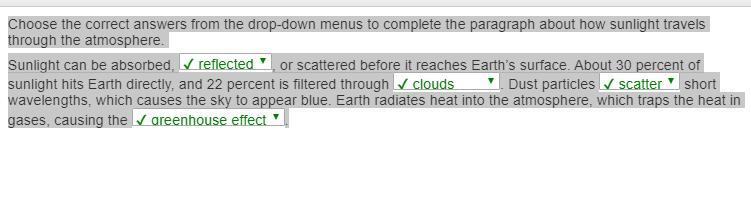
Choose the correct answers from the drop-down menus to complete the paragraph about how sunlight travels through the atmosphere.

Chemistry
2 answers:
Georgia [21]2 years ago
8 0

Answer:just did the assignment on ingenuity and got it correct  

Explanation:

Alex_Xolod [135]2 years ago
6 0

Answer: reflected, clouds, greenhouse effect.

Explanation:

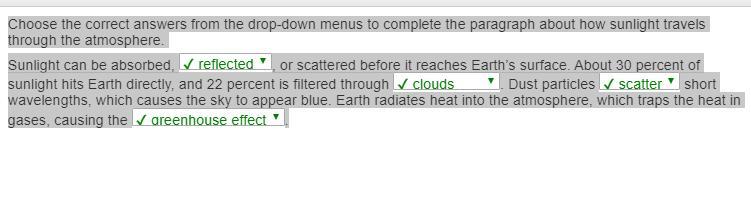
  Sunlight can be absorbed, reflected , or scattered before it reaches Earth’s surface. About 30 percent of sunlight hits Earth directly, and 22 percent is filtered through clouds . Dust particles scatter short wavelengths, which causes the sky to appear blue. Earth radiates heat into the atmosphere, which traps the heat in gases, causing the greenhouse effect.

You might be interested in
A 50.0 mL Erlenmeyer flask filled with 1-hexanol has a mass of
Iteru [2.4K]
Yes it is correct for that answer
4 0
2 years ago
Read 2 more answers
What type of bond would form between two atoms of selenium?
siniylev [52]

Answer:

the correct answer is B

hope it helps !!!

8 0
2 years ago
Q1) A vapor-compression refrigeration system operates on the cycle of Fig. 9.1. The refrigerant is 1,1,1,2-Tetrafluoroethane. Gi
hoa [83]

Answer:

i)   0.5071 (kg/s)

ii)  -1407.1 kj/kg

iii)  204.05 Kw

iv)  5.881

v)    9.238

Explanation:

Given Data:

evaporation temperature ( T ) = 4°c = 277.15 K

Condensation Temperature ( T ) = 34°c = 307.15 K

<em>n</em> ( compressor efficiency ) = 0.76

refrigeration rate = 1200 kJ.s^-1

i) determine the circulation rate of the refrigerant

m = \frac{Q}{H2 - H1}  = \frac{Q}{H2 - H4\\}  ------- 1

Q = 1200 Kj.s^-1

H2 = entropy at step 2 = 2508.9 (kJ / kg ) ( gotten from Table F )

H4 = entropy at step 4 = 142.4 ( kJ/ kg )

back to equation 1

m ( circulation rate of refrigerant ) = 0.5071 (kg/s)

ii) heat transfer rate in the condenser

Q = m ( H4 - H3 )

    = 0.5071 ( 142.4 - 2911.27 )

    = -1407.1 kj/kg

where H3 = H2 + ΔH23 = 2911.27 (kj/kg) ( as calculated )

iii) power requirement

w = m * ΔH23

   = 0.5071 (kg/s) * 402.37 (kj/kg) =  204.05 Kw

where: ΔH23 = \frac{H'3 - H2 }{0.76} = \frac{2814.7-2508.9}{0.76} = 402.37 (kj/kg)

iv) coefficient of performance of a cycle

W = Qc / w

  = 1200 Kj.s^-1/ 204.05 kw

  = 5.881

v) coefficient of performance of a Carnot refrigeration cycle

w_{carnot} = \frac{T2}{T4 - T2}

            =  277.15 / ( 307.15 - 277.15 )

            = 9.238

4 0
2 years ago
What is the conjugate acid of each of the following? What is the conjugate base of each?
Lilit [14]

Answer:

a. H₂O (conjugate acid) ; b. OH⁻ (conjugate base), H₃O⁺ (conjugate acid) ; c. H₂CO₃ (conjugate acid), CO₃⁻² (conjugate base) ; d. NH₄⁺ (conjugate strong acid) e. H₂SO₄ (conjugate acid), SO₄⁻² (conjugate base) ; f. No conjugate acid either base;  g. H₂S (conjugate acid), S⁻² (conjugate base);

h. H₄N₂ (conjugate base)

Explanation:

a.  OH⁻  +  H⁺  ⇄ H₂O

The hydroxide acts like a Bronsted Lory base, so it can catch a proton. Water will be the conjugate acid.

b. H₂O, is an amphoterus compound. It can act as an acid or a base. If it is a base, the conjugate acid is the H₃O⁺. If it is an acid, the conjugate base is the OH⁻.

c. HCO₃⁻  +  H⁺  ⇄  H₂CO₃

HCO₃⁻  +  H₂O  ⇄ CO₃⁻²  +  H₃O⁺

The bicarbonate is also amphoteric. When it catches the proton, the carbonic acid is the conjugate acid, cause it works as a base.

When the HCO₃⁻ (acid) release the proton, the conjugate base is the carbonate.

d. Ammonia is a weak base, so the conjugate strong acid is the ammonium.

NH₃ + H₂O  ⇄  NH₄⁺  +  OH⁻

e. Another amphoteric compound. The acid sulfate acts an acid and a base.

(like bicarbonate). When it is a base, the conjugate acid is the sulfuric acid, when it is an acid, the conjugate base is the sulfate.

HSO₄⁻  +  H₂O  ⇄  SO₄⁻²  +  H₃O⁺

HSO₄⁻  +  H⁺  ⇄  H₂SO₄

f. H₂O₂ does not recieve H⁺ or OH⁻, and it does not release H⁺. It is a neutral compound and it doesn't act as a base or acid.

g. HS⁻ is amphoterous.

HS⁻  +  H⁺  ⇄  H₂S

HS⁻  +  H₂O  ⇄  S⁻²  +  H₃O⁺

Same case as bicarbonate or acid sulfate.

h. H₅N₂⁺  +  H₂O  ⇄  H₄N₂  + H₃O⁺

Hidrazinium acts an acid, so, the conjugate base will be the hidrazine.

                                                                                                                                                                                                                                                                                                                                                                                                                                                                                                                                                                                                                                                                                                                                                                                                                                                                                                                                                                                                                                                                                                                                                                                                                                                                                                                                                                                                                                                                                                                                                                                                                                                                                                                                                                                                                                           

3 0
2 years ago
A sample of pure iron has a mass of 5.00 g. Calculate its volume.
olga55 [171]
<span>It's volume is 0.48 cm3Specific </span>
3 0
2 years ago
Other questions:
  • A beam of light passes though a liquid in a test tube without scattering. Which type of mixture is most likely in the test tube?
    13·2 answers
  • How many moles of hydrogen gas are produced when 0.066 mole of sodium is completely reacted?
    14·2 answers
  • In the diagram below, particles of the substance are moving from the liquid phase to the gas phase at the same rate as they move
    11·2 answers
  • A fog forms over a lake. What two changes of state must occur to produce the fog? Do the water molecules absorb or release energ
    9·1 answer
  • A 10 ft diameter by 15 ft height vertical tank is receiving water (p 62.1 lb/ cu ft) at the rate of 300 gpm and is discharging t
    7·1 answer
  • H2A and BOH are acid and base and they react according to the following balanced equation: H2A(aq) + 2 BOH(aq) → B2A(aq) + 2 H2O
    6·1 answer
  • During a laboratory experiment, 36.12 grams of Al2O3 was formed when O2 reacted with aluminum metal at 280.0 K and 1.4 atm. What
    11·1 answer
  • We are all familiar with the general principles of operation of an internal combustion engine: the combustion of fuel drives out
    15·1 answer
  • Calculate the number of C atoms in 9.837 x 1024 molecules of CO2. <br><br>Please help
    15·1 answer
  • Activity 1: My Incompleteness, Complete Me. Fill in the Punnett squares with the correct genotypes based on the key pictures tha
    14·1 answer
Add answer
Login
Not registered? Fast signup
Signup
Login Signup
Ask question!