answer.
Ask question
Login Signup
Ask question
All categories
  • English
  • Mathematics
  • Social Studies
  • Business
  • History
  • Health
  • Geography
  • Biology
  • Physics
  • Chemistry
  • Computers and Technology
  • Arts
  • World Languages
  • Spanish
  • French
  • German
  • Advanced Placement (AP)
  • SAT
  • Medicine
  • Law
  • Engineering
Leviafan [203]
2 years ago
5

35 Which element reacts with oxygen to form ionic bonds?(1) calcium (3) chlorine

Chemistry
2 answers:
QveST [7]2 years ago
8 0

Covalent bonds exist between two nonmetal elements while ionic bonds exist between a metal and a nonmetal element. In this case, oxygen is a nonmetal and in order to create an ionic bond, the other substance should be a metal. The answer therefore to this problem is calcium. 
kow [346]2 years ago
3 0

\boxed{\left( 1 \right){\text{ calcium}}} reacts with oxygen to form ionic bonds.

Further Explanation:

Covalent bonds are the types of bonds that involve the sharing of electrons between the bonded atoms. This bond is usually formed between two or more non-metals.

Ionic bonds are the chemical bonds that involve the transference of electrons from one atom to another. These bonds are generally formed between metals and non-metals. In these types of bonds, ions are formed by the atoms. Cations are formed by the loss of electrons and anions result from the gain of electrons.

Oxygen is a non-metal. In order to form an ionic bond with oxygen, the other element has to be a metal.

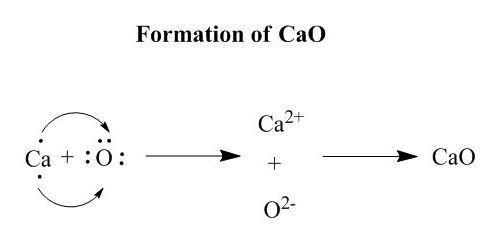
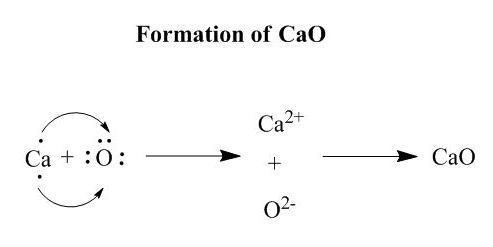
Hydrogen, chlorine, and nitrogen are non-metals so these can form covalent bonds with oxygen. But calcium is a metal and it forms ionic bonds with oxygen. Calcium loses two electrons to form {\text{C}}{{\text{a}}^{2 + }} and these electrons are gained by oxygen, resulting in the formation of {{\text{O}}^{2 - }}. The attraction between {\text{C}}{{\text{a}}^{2 + }} and {{\text{O}}^{2 - }} is an ionic bond and the resulting compound is CaO (For structure, refer to the attached image).

Learn more:

  1. Identification of ionic bonding: brainly.com/question/1603987
  2. What type of bond exists between phosphorus and chlorine? brainly.com/question/81715

Answer details:

Grade: High School

Chapter: Ionic and covalent compounds

Subject: Chemistry

Keywords: ionic bond, covalent bond, nitrogen, hydrogen, chlorine, calcium, oxygen, CaO, metal, non-metal.
You might be interested in
Keiko needs 100mL of a 5% acid solution for a science experiment. She has available a 1% solution and a 6% solution. How many mi
4vir4ik [10]

Answer:

Keiko should mix 20 mL 1% solution and 80 mL 6% solution for to make 100 mL 5% solution

Explanation:

There are 2 unknown values X= mL 6% solution and Y=1% solution. So, we need 2 equations:

1. Equation acid concentration. X mL 6% + Y mL 1% = 100 mL 5%

2. Equation solvent concentration X mL 94% + Y mL 99% = 100 mL 95%

When clearing X and Y :

(X mL 6%    +   Y mL 1%      =    100 mL 5%) (-15,7)

X mL 94%  +   Y mL 99%   =   100 mL 95%

_______________________________

 -                      Y  0.83       =   16.5

                        Y                =   19.9 mL 1% solution

Replace Y in anyone equation and X = 80 mL 6% solution

I hope to see been helpful

7 0
2 years ago
Read 2 more answers
What is the overall charge of the compound frbr
sammy [17]

Answer:

Zero  

Explanation:

FrBr is an ionic compound .

Fr is in Group 1. Br is in Group 17.

The charges on the ions are +1 and -1, respectively.

The compound consists of Fr⁺Br⁻ ions.

However, there are equal numbers of + and - charges, so

The overall charge of the compound is zero.

5 0
2 years ago
What volume (ml) of a 0.2450 m koh(aq) solution is required to completely neutralize 55.25 ml of a 0.5440 m h3po4(aq) solution?
Nonamiya [84]
<span>Answer: It depends on what came after "0.5440 M H...". If it was a monoprotic acid, like HCl, the calculation would go like this: (55.25 mL) x (0.5440 M acid) x (1 mol KOH / 1 mol acid) / (0.2450 M KOH) = 122.7 mL KOH If it was a diprotic acid, like H2SO4, like this: (55.25 mL) x (0.5440 M acid) x (2 mol KOH / 1 mol acid) / (0.2450 M KOH) = 245.4 mL KOH If it was a triprotic acid, like H3PO4, like this: (55.25 mL) x (0.5440 M acid) x (3 mol KOH / 1 mol acid) / (0.2450 M KOH) = 368.0 mL KOH</span>
5 0
2 years ago
Hydrogen reacts with chlorine to form hydrogen chloride (HCl (g), Delta.Hf = –92.3 kJ/mol) according to the reaction below. Uppe
erik [133]

Answer:

The enthalpy of the reaction is –184.6 kJ, and the reaction is exothermic.

Explanation:

7 0
2 years ago
Read 2 more answers
The table lists the chemical formulas or symbols of a few common substances. Which two substances are compounds? A) aluminum and
katrin [286]
D is the correct answer

every other option contains an element
7 0
2 years ago
Read 2 more answers
Other questions:
  • A 50.6 grams sample of magnesium hydroxide (Mg(OH)2) is reacted with 45.0 grams of hydrochloric acid (HCl). What is the theoreti
    15·2 answers
  • 100 points!!!!!!!!!!!!!!!!!! how does a volcanic eruption benefit the surrounding area? A. Lava and ash bury animal habitats. B.
    7·2 answers
  • Examine the sets of bonds given in the choices. which one arranges the bonds in order of increasing (shortest to longest) bond l
    11·1 answer
  • Instrumental methods need only a microscopic sample to return an accurate result. Why is this so?
    7·1 answer
  • Six moles of an ideal gas are in a cylinder fitted at one end with a movable piston. the initial temperature of the gas is 27.0c
    7·1 answer
  • Richardo throws a football straight into the air. It goes up to a height of 10 meters and then falls back down into his hands. W
    5·2 answers
  • Oxyacetylene torches produce such high temperature that they are often used to weld and cut metal. When 1.53 g of acetylene (C2H
    7·1 answer
  • The reading on a speedometer represents the average velocity of the car. True False
    15·1 answer
  • Why is it important to have regular supervision of the weight and measurements in the market
    10·1 answer
  • During a process called photoact, ________ give up an electron as a part of the light-dependent reactions.
    6·1 answer
Add answer
Login
Not registered? Fast signup
Signup
Login Signup
Ask question!
