
answer.
Ask question
Login Signup
Ask question
All categories
  • English
  • Mathematics
  • Social Studies
  • Business
  • History
  • Health
  • Geography
  • Biology
  • Physics
  • Chemistry
  • Computers and Technology
  • Arts
  • World Languages
  • Spanish
  • French
  • German
  • Advanced Placement (AP)
  • SAT
  • Medicine
  • Law
  • Engineering
otez555 [7]
2 years ago
9

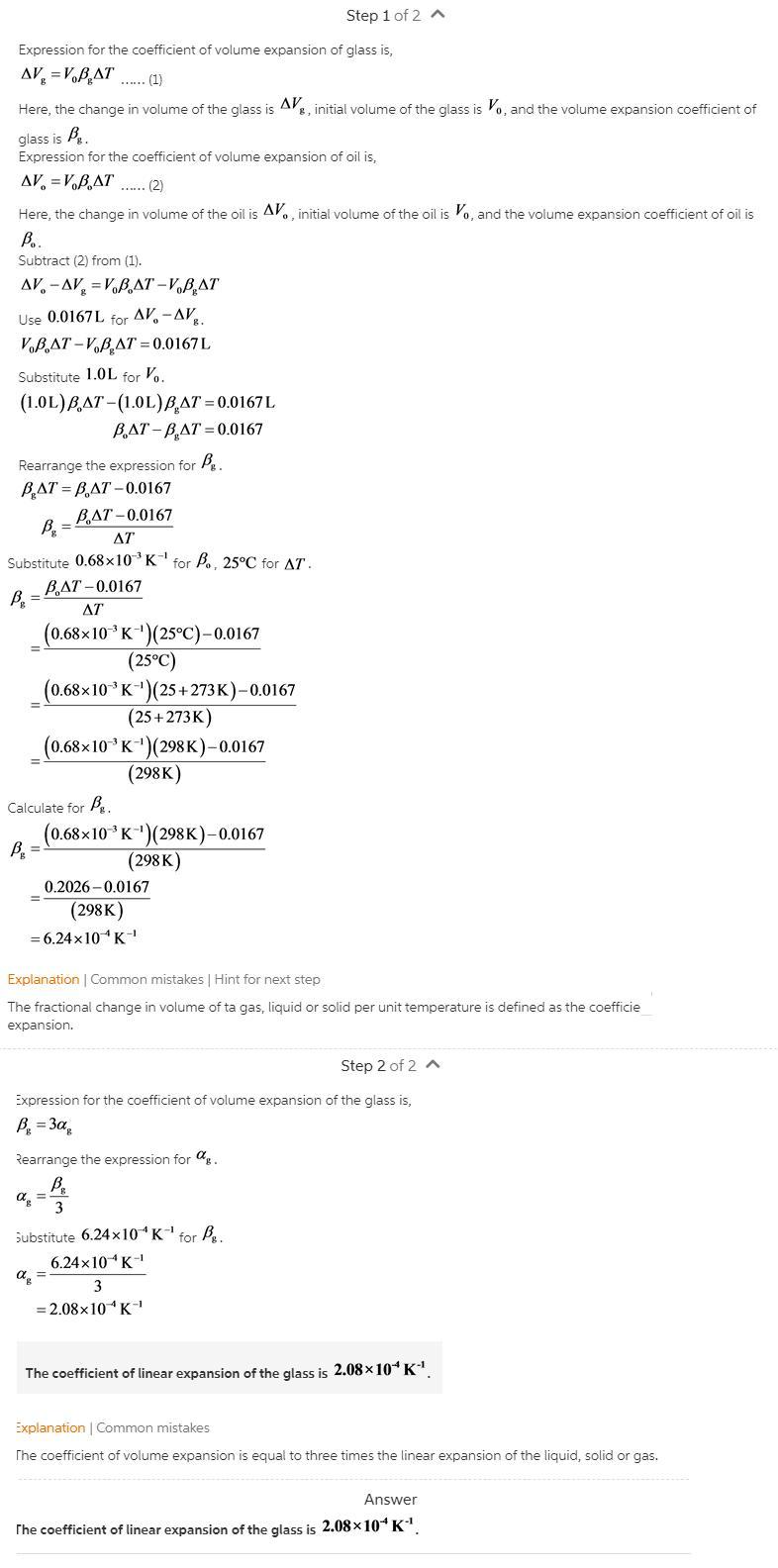
The coefficient of volume expansion of a certain olive oil is 0.68 × 10⁻³ K-1. A 1.0-L glass beaker is filled to the brim with o

live oil at room temperature. The beaker is placed on a range and the temperature of the oil and beaker increases by 25 C°. As a result, 0.0167 L of olive oil spills over the top of the beaker. Which of the following values is closest to the coefficient of linear expansion of the glass from which the beaker is made?
a. 4 × 10⁻⁶ K^-1
b. 2 × 10⁻⁵ K^-1
c. 3 × 10⁻⁵ K^-1
d. 1 × 10⁻⁵ K^-1
e. 1 × 10⁻⁶ K^-1

Physics
1 answer:
natita [175]2 years ago
4 0

Answer

The answer and procedures of the exercise are attached in the following archives.

Step-by-step explanation:

You will find the procedures, formulas or necessary explanations in the archive attached below. If you have any question ask and I will aclare your doubts kindly.  

You might be interested in
A cart, which has a mass of 2.30 kg is sitting at the top of an inclined plane, which is 4.50 meters long and meets the horizont
expeople1 [14]

Answer:

a) The gravitational potential energy before the cart rolls down the incline is 24.6 J.

b) The magnitude of the force that causes the cart to roll down is 5.47 N.

c) The acceleration of the cart is 2.38 m/s²

d) It takes the cart 1.94 s to reach the bottom of the incline.

e) The velocity of the cart at the bottom of the inclined plane is 4.62 m/s.

f) The kinetic energy of the cart as it reaches the bottom of the incline is 24.6 J.

g) The work done by the gravitational force is 24.6 J.

Explanation:

Hi there!

a) The gravitational potential energy is calculated using the following equation:

EP = m · g · h

Where:

EP = gravitational potential energy.

m = mass of the object.

g = acceleration due to gravity.

h = height at which the object is located.

The height of the inclined plane can be calculated using trigonomoetry:

sin 14.0° = height / lenght

sin 14.0° = height / 4.50 m

4.50 m · sin 14.0° = height

height = 1.09 m

Then, the gravitational potential energy will be:

EP = m · g · h

EP = 2.30 kg · 9.81 m/s² · 1.09 m = 24.6 J

The gravitational potential energy before the cart rolls down the incline is 24.6 J.

b) Please, see the attached figure for a graphical description of the problem and the forces acting on the cart. The force that causes the cart to accelerate down the incline is the horizontal component of the weight (Fwx in the figure). The magnitude of this force can be obtained using trigonometry:

sin 14° = Fwx / Fw

The weight of the cart (Fw) is calculated as follows:

Fw = m · g

Fw = 2.30 kg · 9.81 m/s²

Fw = 22.6 N

Then, the x-component of the weight will be:

FW · sin 14° = Fwx

22.6 N · sin 14° = Fwx

Fwx = 5.47 N

The magnitude of the force that causes the cart to roll down is 5.47 N.

c)Using the equation of Fwx we can calculate the acceleration of the cart:

Fwx = m · a

Where "m" is the mass of the cart and "a" is the acceleration.

Fwx / m = a

5.47 N / 2.30 kg = a

a = 2.38 m/s²

The acceleration of the cart is 2.38 m/s²

d) To calculate the time it takes the cart to reach the bottom of the incline, let´s use the equation of position of the cart:

x = x0 + v0 · t + 1/2 · a · t²

Where:

x = position of the cart at time t.

x0 = initial position.

v0 = initial velocity.

a = acceleration.

t = time.

Considering the initial position as the point at which the cart starts rolling (x0 = 0) and knowing that the cart starts from rest (v0 = 0), let´s find the time it takes the cart to travel the 4.50 m of the inclined plane:

x = 1/2 · a · t²

4.50 m = 1/2 · 2.38 m/s² · t²

2 · 4.50 m / 2.38 m/s² = t²

t = 1.94 s

It takes the cart 1.94 s to reach the bottom of the incline.

e) The velocity of the cart at the bottom of the inclined plane can be obtained using the following equation:

v = v0 + a · t

v = 0 m/s + 2.38 m/s² · 1.94 s

v = 4.62 m/s

The velocity of the cart at the bottom of the inclined plane is 4.62 m/s.

f) The kinetic energy can be calculated using the following equation:

KE = 1/2 · m · v²

Where:

KE =  kinetic energy.

m = mass of the cart.

v = velocity of the cart.

KE = 1/2 · 2.30 kg · (4.62 m/s)²

KE = 24.6 J

The kinetic energy of the cart as it reaches the bottom of the incline is 24.6 J.

The gain of kinetic energy is equal to the loss of gravitational potential energy.

g) The work done by the gravitational force can be calculated using the work-energy theorem: the work done by the gravitational force is equal to the negative change in the gravitational potential energy:

W = -ΔPE

W = -(final potential energy - initial potential energy)

W = -(0 - 24.6 J)

W = 24.6 J

This can also be calculated using the definition of work:

W = Fw · d

Where "d" is the distance traveled in the direction of the force, that is the height of the inclined plane:

W = 22.6 N · 1.09 m = 24.6 J.

The work done by the gravitational force is 24.6 J.

4 0
2 years ago
You are driving on the highway, and you come to a steep downhill section. As you roll down the hill, you take your foot off the
Natasha2012 [34]

Answer:

air

Explanation:

The car is being slowed down by air.

5 0
2 years ago
Read 2 more answers
Calculate the longest wavelength visible to the human eye. express the wavelength in nanometers to three significant figures.
slega [8]

NOTE: The given question is incomplete.

<u>The complete question is given below.</u>

The human eye contains a molecule called 11-cis-retinal that changes conformation when struck with light of sufficient energy. The change in conformation triggers a series of events that results in an electrical signal being sent to the brain. The minimum energy required to change the conformation of 11-cis-retinal within the eye is about 164 kJ/mole. Calculate the longest wavelength visible to the human eye.

Solution:

Energy (E) = 164 kJ/mole

             E = 164 kJ/mole = 164 kJ /6.023 x 10²³

                = 2.72 x 10⁻²² kJ = 2.72 x 10⁻¹⁹J

Planck's constant = 6.6 x 10⁻³⁴ J s,

Speed of light = 3.00 x 10⁸ m/s

Let the required wavelength be λ.

Formula Used: E = hc / λ

or,                  λ = hc / E

or,                  λ = (6.6 x 10⁻³⁴ J s)× (3.00 x 10⁸ m/s) / (2.72 x 10⁻¹⁹J)

or,                  λ = 7.28 x 10⁻⁷ m

or,                  λ = (7.28 x 10⁻⁷ m) ×( 1.0 x 10⁹ nm / 1.0 m)

or,                  λ = (7.28 x 10² nm)

or,                  λ = 728 nm

Hence, the required wavelength will be 728 nm.

6 0
2 years ago
the grid in a triode is kept negatively charged to prevent… a. the variations in voltage from getting too large. b. electrons be
Nezavi [6.7K]
D:the electrons from being attracted to the grid instead of the anode
5 0
2 years ago
Read 2 more answers
If you wanted to measure the width of the gym, how would the accuracy of a meter stick compare with that of a 50m tape
Alisiya [41]
Meter stick would not be as accurate,
Every time you placed it down and picked it back up you run the chance of losing 2-4 cm each time.
7 0
2 years ago
Other questions:
  • Which statement correctly compares and contrasts the information represented by the chemical formula and model of a compound?
    5·2 answers
  • Eratosthenes determined the circumference of Earth by conducting an experiment. Put his steps in order as they correlate to the
    9·1 answer
  • A 36,287 kg truck has a momentum of 907,175 kg • m/s. What is the trucks velocity.
    5·1 answer
  • A compact, dense object with a mass of 2.90 kg is attached to a spring and is able to oscillate horizontally with negligible fri
    13·1 answer
  • In springboard diving, the diver strides out to the end of the board, takes a jump onto its end, and uses the resultant spring-l
    15·2 answers
  • Water is stored in a municipal water tank at a mean height of 25 m. If a faucet of diameter 1.2 cm is opened in a house at groun
    7·1 answer
  • A slide whistle is an open-closed tube with an adjustable plunger that changes the length. You are playing the slide whistle and
    9·1 answer
  • 8. The resistance of a bagel toaster is 14 Ω. To prepare a bagel, the toaster is operated for one minute from a 120-V outlet. Ho
    9·2 answers
  • An astronaut holds a rock 100m above the surface of Planet XX. The rock is then thrown upward with a speed of 15m/s, as shown in
    11·1 answer
  • Four kilograms of carbon monoxide (CO) is contained in a rigid tank with a volume of 1 m^3. The tank is fitted with a paddle whe
    11·1 answer
Add answer
Login
Not registered? Fast signup
Signup
Login Signup
Ask question!