answer.
Ask question
Login Signup
Ask question
All categories
  • English
  • Mathematics
  • Social Studies
  • Business
  • History
  • Health
  • Geography
  • Biology
  • Physics
  • Chemistry
  • Computers and Technology
  • Arts
  • World Languages
  • Spanish
  • French
  • German
  • Advanced Placement (AP)
  • SAT
  • Medicine
  • Law
  • Engineering
IgorLugansk [536]
2 years ago
3

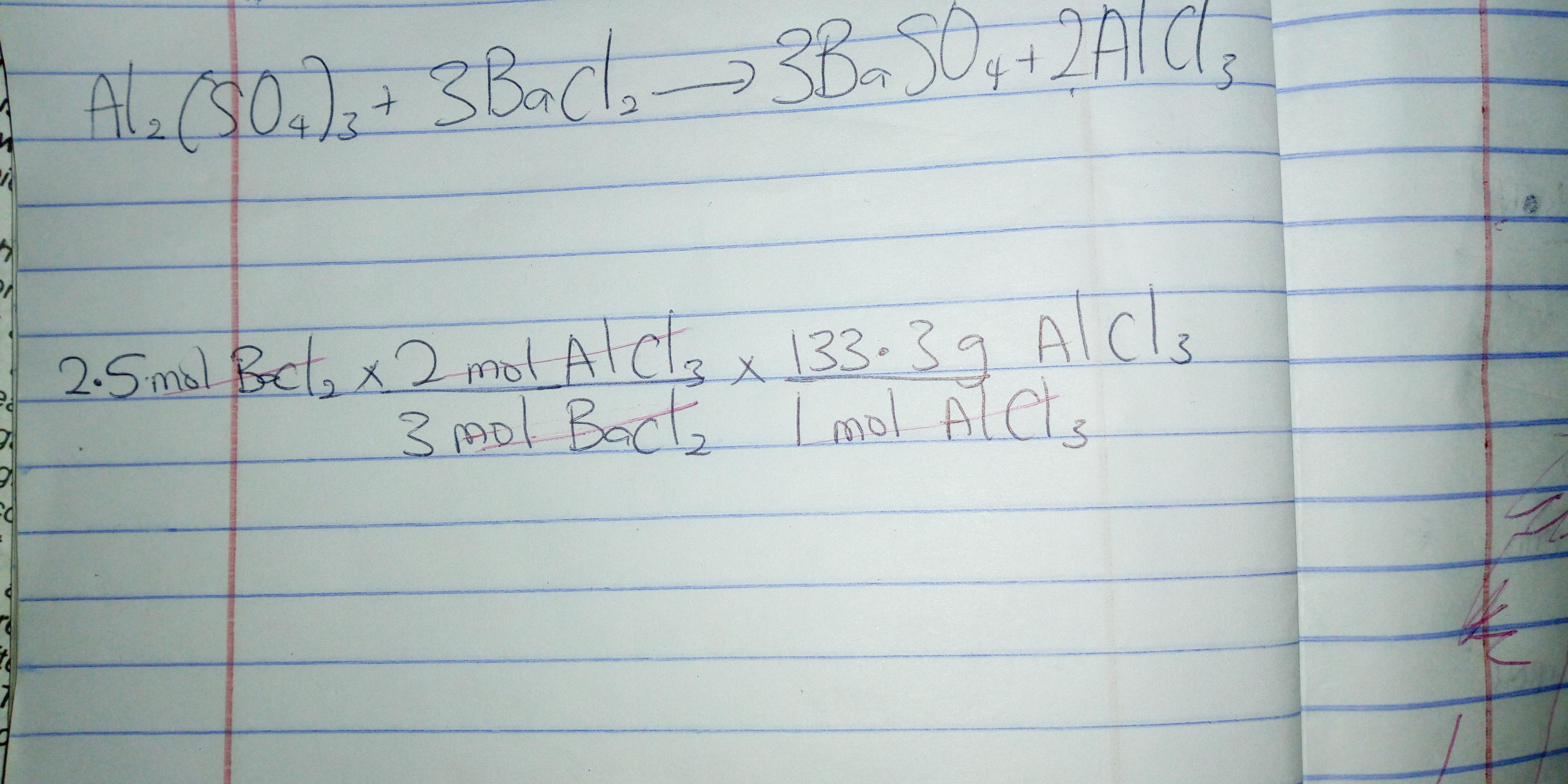
What is the maximum mass in grams of aluminum chloride that could be obtained from 2.50 mol of barium chloride and excess alumin

um sulfate? This is the balanced equation for the reaction: Al2(SO4)3 + 3BaCl2--> 3BaSO4 + 2AlCl3. BaCl2 molar mass is 208.3 g/mol and AlCl3molar mass is 133.3 g/mol.
a. 521 g
b. 334 g
c. 222 g
d. 55.8

Chemistry
2 answers:
Vikki [24]2 years ago
5 0

Answer:

The maximum amount of aluminium chloride that could be obtained is 222 grams (option C)

Explanation:

Step 1: Data given

Number of moles barium chloride = 2.50 mol

Molar mass of BaCl2 = 208.3 g/mol

Molar mass of AlCl3 = 133.3 g/mol

Step 2: The balanced equation:

Al2(SO4)3 + 3BaCl2 → 3BaSO4 + 2AlCl3

Step 3: Calculate moles of AlCl3

For 1 mol aluminium sulfate we need 3 moles Barium chloride to produce 3 moles of barium sulfate and 2 moles of Aluminium chloride

For 2.50 mol of BaCl2 we have (2/3) * 2.50 = 1.667 moles of aluminium chloride

Step 4: Calculate mass of aluminium chloride

Mass AlCl3 = moles AlCl3 * molar mass AlCl3

Mass AlCl3 = 1.667 moles * 133.3 g/mol

Mass AlCl3 = 222 grams

The maximum amount of aluminium chloride that could be obtained is 222 grams (option C)

Inga [223]2 years ago
3 0

Answer:c. 222 g

Explanation:

You might be interested in
BH+ClO4- is a salt formed from the base B (Kb = 1.00e-4) and perchloric acid. It dissociates into BH+, a weak acid, and ClO4-, w
Len [333]

Answer:

The pH of 0.1 M BH⁺ClO₄⁻ solution is <u>5.44</u>

Explanation:

Given: The base dissociation constant: K_{b} = 1 × 10⁻⁴, Concentration of salt: BH⁺ClO₄⁻ = 0.1 M

Also, water dissociation constant: K_{w} = 1 × 10⁻¹⁴

<em><u>The acid dissociation constant </u></em>(K_{a})<em><u> for the weak acid (BH⁺) can be calculated by the equation:</u></em>

K_{a}. K_{b} = K_{w}    

\Rightarrow K_{a} = \frac{K_{w}}{K_{b}}

\Rightarrow K_{a} = \frac{1\times 10^{-14}}{1\times 10^{-4}} = 1\times 10^{-10}

<em><u>Now, the acid dissociation reaction for the weak acid (BH⁺) and the initial concentration and concentration at equilibrium is given as:</u></em>

Reaction involved: BH⁺  +  H₂O  ⇌  B  +  H₃O+

Initial:                     0.1 M                    x         x            

Change:                   -x                      +x       +x

Equilibrium:           0.1 - x                    x         x

<u>The acid dissociation constant: </u>K_{a} = \frac{\left [B \right ] \left [H_{3}O^{+}\right ]}{\left [BH^{+} \right ]} = \frac{(x)(x)}{(0.1 - x)} = \frac{x^{2}}{0.1 - x}

\Rightarrow K_{a} = \frac{x^{2}}{0.1 - x}

\Rightarrow 1\times 10^{-10} = \frac{x^{2}}{0.1 - x}

As, x

\Rightarrow 0.1 - x = 0.1

\therefore 1\times 10^{-10} = \frac{x^{2}}{0.1 }

\Rightarrow x^{2} = (1\times 10^{-10})\times 0.1 = 1\times 10^{-11}

\Rightarrow x = \sqrt{1\times 10^{-11}} = 3.16 \times 10^{-6}

<u>Therefore, the concentration of hydrogen ion: x = 3.6 × 10⁻⁶ M</u>

Now, pH = - ㏒ [H⁺] = - ㏒ (3.6 × 10⁻⁶ M) = 5.44

<u>Therefore, the pH of 0.1 M BH⁺ClO₄⁻ solution is 5.44</u>

5 0
2 years ago
Sodium acetate spontaneously crystallizes out of a supersaturated solution upon standing or upon the addition of a seed crystal.
AlekseyPX

Answer:

Option (c) is correct.

Explanation:

According to 2nd law of thermodynamics, every spontaneous process is associated with increase in entropy (\Delta S>0).

As sodium acetate crystallizes out spontaneously therefore it is associated with \Delta S>0.

During crystallization, bond formation takes place which results evolution of heat. In other words, crystallization phenomenon is exothermic (\Delta H).

So, the given crystallization process renders the following thermodynamic quantities- \Delta S>0 J/K and \Delta H J

Option (c) is correct.

6 0
2 years ago
An irregularly shaped solid which has a mass of 10.283g was placed in a graduated cylinder containing an inert liquid. The initi
Gwar [14]
Liquid  + Solid = 8.89 mL
V ( Solid ) = 8.89 mL - 6.26 mL = 2.63 mL
The density of the solid = m / V = 10.283 g / 2.63 mL =
= 3.9 g/mL = 3.9 g / cm³
3 0
2 years ago
For each of the following compounds, state whether it is ionic or covalent, and if it is ionic, write the symbols for the ions i
kupik [55]

Answer :

Covalent compound : It is defined as the compound which is formed by the sharing of electrons between the atoms forming a compound.

The covalent compound are usually formed when two non-metals react.

Ionic compound : It is defined as the compound which is formed when electron gets transferred from one atom to another atom.

All the polyatomic ions always form an ionic compound.

Polyatomic ions : It is a charged species that composed of two or more atoms and these charged species are bonded by the covalent bond.

For the given options:

Option A:  KClO_4

This compound is formed by the combination of potassium, K^+ which is a metal and ClO_4^- ion which is a polyatomic ion. Thus, it will form an ionic compound.

Option B:  Mg(C_2H_3O_2)_2

This compound is formed by the combination of magnesium, Mg^{2+} which is a metal and C_2H_3O_2^{-} ion which is a polyatomic ion. Thus, it will form an ionic compound.

Option C:  H_2S

Hydrogen and sulfur, both are non-metals and they will form a covalent compound.

Option D:  Ag_2S

This compound is formed by the combination of silver, Ag^{+} which is a metal and sulfur, S^{2-} which is a non-metal. Thus, it will form an ionic compound.

Option E:  N_2Cl_4

Nitrogen and chlorine, both are non-metals and they will form a covalent compound.

Option F:  Co(NO_3)_2

This compound is formed by the combination of cobalt, Co^{2+} which is a metal and NO_3^{-} ion which is a polyatomic ion. Thus, it will form an ionic compound.

6 0
2 years ago
Explain the effects of nh3 and hcl on the cuso4 solution in terms of le chatelier's principle
Fittoniya [83]

The Principle of Le Chatelier states that if a system in equilibrium is subjected to a disturbance, the system will react in such a way that it will diminish the effect of that disturbance. Thus, when the concentration of one of the substances in an equilibrium system is changed, the equilibrium varies in such a way that it can compensate for this change.

For example, if the concentration of one of the reactants is increased, the equilibrium shifts to the right or to the side of the products. Also, if you add more reagents, the reaction will move even more to the right until the balance is re-established again, increasing the quantity of products.

In this way, adding HCl to a solution of CuSO4 will produce the following reaction:

CuSO4 (aq) + 2HCl (aq) ⇔ CuCl2 (aq) + H2SO4 (aq)

Initially the solution of CuSO4 in water will be blue, but when adding HCl the solution will change color to green, since the aqueous solutions of CuCl2 are green. By adding more HCl this color will intensify as the balance shifts to the right, producing more CuCl2 and H2SO4.

On the other hand, adding NH3 to a solution of CuSO4 will produce the following reaction

CuSO4 (aq) + 4NH3 (aq) ⇔ [Cu(NH3)4] SO4 (s)

Thus, by adding NH3 to the CuSO4 solution we will observe the formation of a precipitate corresponding to [Cu(NH3) 4] SO4. <u>When adding more NH3, the formation of more precipitate will be observed as the equilibrium moves to the right, producing a greater quantity of [Cu (NH3) 4] SO4.</u>
6 0
2 years ago
Other questions:
  • Na+ and Cl- are ions formed from _____.
    11·1 answer
  • What is the approximate tangential speed of an object orbiting Earth with a radius of 1.8 × 10⁸ m and a period of 2.2 × 10⁴ s?
    8·2 answers
  • The average distance between nitrogen and oxygen atoms is 115 pm in a compound called nitric oxide. what is this distance in cen
    12·1 answer
  • The highest energy occupied molecular orbital in the f-f bond of the f2 molecule is _____
    10·1 answer
  • According to the lab guide, which changes below will you look for in order to test the hypothesis? check all that apply. changes
    15·2 answers
  • The acid-dissociation constant, ka, for gallic acid is 4.57 ⋅ 10-3. what is the base-dissociation constant, kb, for the gallate
    8·2 answers
  • Complete the chemical formula for each ionic compound. Consult the periodic table to help you answer the question. beryllium nit
    9·2 answers
  • One of the emission lines of the hydrogen atom has a wavelength of 93.07 nm. Determine the initial value of n associated with th
    8·2 answers
  • Air in a 0.3 m3 cylinder is initially at a pressure of 10 bar and a temperature of 330K. The cylinder is to be emptied by openin
    11·1 answer
  • Study Example 8.1 on page 321. Then, calculate the molarity of a solution made by adding 5.51 g of CaCl2 to enough water to crea
    6·1 answer
Add answer
Login
Not registered? Fast signup
Signup
Login Signup
Ask question!
