answer.
Ask question
Login Signup
Ask question
All categories
  • English
  • Mathematics
  • Social Studies
  • Business
  • History
  • Health
  • Geography
  • Biology
  • Physics
  • Chemistry
  • Computers and Technology
  • Arts
  • World Languages
  • Spanish
  • French
  • German
  • Advanced Placement (AP)
  • SAT
  • Medicine
  • Law
  • Engineering
Georgia [21]
2 years ago
10

1.2 moles of (NH4)3PO3

Chemistry
1 answer:
Aleks04 [339]2 years ago
3 0
1.2 moles of (nph4)3po3 is.......159.6 grams
You might be interested in
For each case below, identify the most likely value for x: a. BHx b. CHx c. NHx d. CH2Clx
Snezhnost [94]

Answer:

BHx, x=3

CHx, x=4

NHx, x=3

CH2Clx, x=2

Explanation:

We have to know that the value of x must depend on the valency of the central atom. If we look at each of the species;

Boron has a common valency of 3

Carbon has a common valency of 4

Nitrogen has a common valency of 3

The valency of each elements will determine the most likely value of x as outlined in the answer above.

8 0
2 years ago
How many mm are equal to 4.75 x 10⁻² m?
kherson [118]

Answer:

47.5 mm

Explanation:

5 0
2 years ago
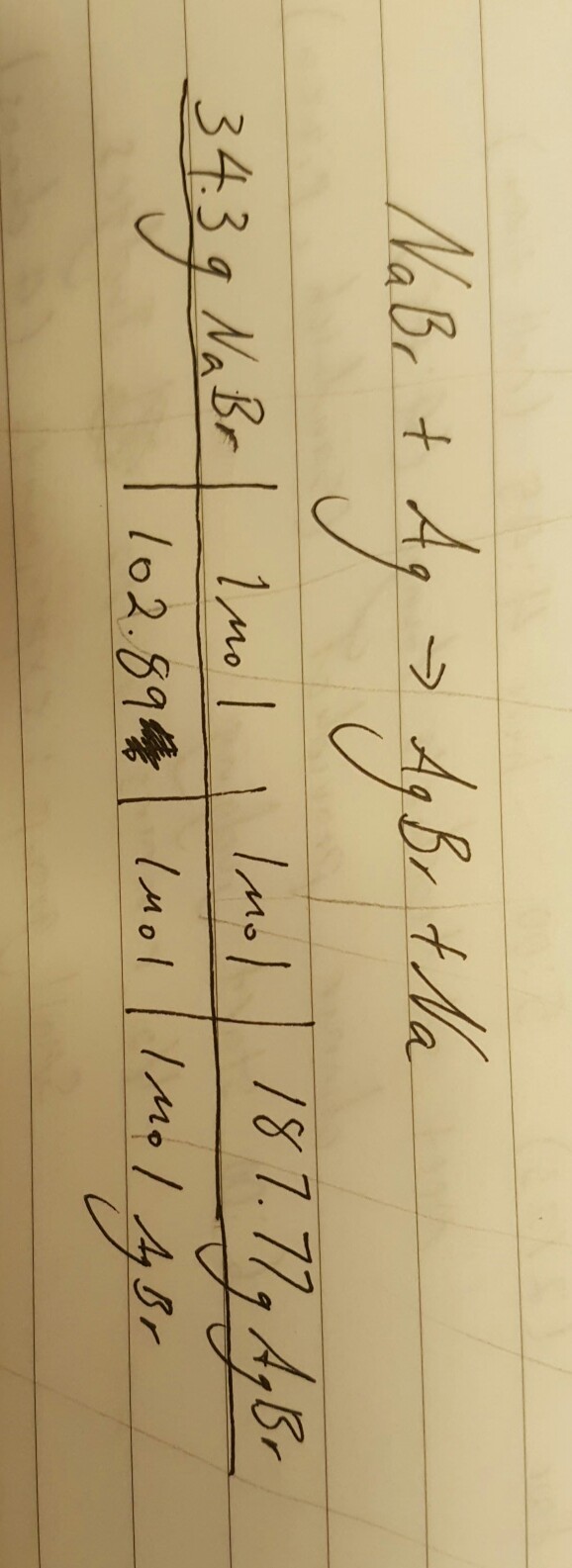
What mass of AgBr can be produced starting with 34.3G of NaBr? (Stoichiometry method)
olga nikolaevna [1]
The equation is already balanced so the mole ratio is just 1/1 and from the question you could conclude that the equation is a single displacement

5 0
2 years ago
Recalling that a beaker of water is two dimensional, what is the three dimensional shape of the micelle
saul85 [17]
A micelle refers to an aggregate of a surfactant molecule, which a dispersed in a liquied colloid. In an aqueous liquid, a micelle is arranged in such a way that its hydrophillic head region will be in contact with the surrounding solvents while the hydrophobic tail region will be embedded in its center. 
The three dimensional shape of a micelle is A SPHERE. 
7 0
2 years ago
When 13.6 g of calcium chloride, CaCl2, was dissolved in 100.0 mL of water in a coffee cup calorimeter, the temperature rose fro
DanielleElmas [232]

Answer:

THE ENTHALPY OF SOLUTION IS 3153.43 J/MOL OR 3.15 KJ/MOL.

Explanation:

1. write out the variables given:

Mass of Calcium chloride = 13.6 g

Change in temperature = 31.75°C - 25.00°C = 6.75 °C

Density of the solution = 1.000 g/mL

Volume = 100.0 mL = 100.0 mL

Specific heat of water = 4.184 J/g °C

Mass of the water = unknown

2. calculate the mass of waterinvolved:

We must first calculate the mass of water in the bomb calorimeter

Mass = density  * volume

Mass = 1.000 * 100

Mass = 0.01 g

3. calculate the quantity of heat evolved:

Next is to calculate the quantity of heat evolved from the reaction

Heat = mass * specific heat of water * change in temperature

Heat = mass of water * specific heat *change in temperature

Heat = 13.6 g * 4.184 * 6.75

Heat = 13.6 g * 4.184 J/g °C * 6.75 °C

Heat = 384.09 J

Hence, 384.09J is the quantity of heat involved in the reaction of 13.6 g of calcium chloride in the calorimeter.

4. calculate the molar mass of CaCl2:

Next is to calculate the molar mas of CaCl2

Molar mass = ( 40 + 35.5 *2) = 111 g/mol

The number of moles of 13.6 g of CaCl2 is then:

Number of moles of CaCl2 = mass / molar mass

Number of moles = 13.6 g / 111 g/mol

Number of moles = 0.1225 mol

So 384.09 J of heat was involved in the reaction of 1.6 g of CaCl2 in a calorimter which translates to 0.1225 mol of CaCl2..

5. Calculate the enthalpy of solution in kJ/mol:

If 1 mole of CaCl2 is involved, the heat evolved is therefore:

Heat per mole = 384.09 J / 0.1225 mol

Heat = 3 135.43 J/mol

The enthalpy of solution is therefore 3153.43 J/mol or 3.15 kJ/mol.

5 0
2 years ago
Other questions:
  • Carbon dioxide dissolves in water to form carbonic acid. this acid lowers the ph of the water and makes the water corrosive. wha
    12·1 answer
  • Which mass of urea CO(NH2)2 contains same mass of nitrogen as 101.1 g of potassium nitrate?
    5·1 answer
  • You have two containers of equal volume. one is full of helium gas. the other holds an equal mass of nitrogen gas both gases hav
    7·1 answer
  • The structure of carbonic acid, an important component of ocean chemistry, is depicted below. What type of model best describes
    10·2 answers
  • A mixture of three gases has a total pressure at 298 K of 1560 mm Hg. the mixture is analyzed and is found to contain 1.50 mol N
    10·1 answer
  • "11. Barium nitrate reacts with aqueous sodium sulfate to produce solid barium sulfate and aqueous sodium nitrate. Abigail place
    6·2 answers
  • Write a chemical formula for each molecular model. (Blue ball represents nitrogen atom, red ball represents oxygen atom, white b
    8·1 answer
  • One million argon atoms is how many mol of argon atoms? (2 significant figures)
    5·1 answer
  • We would like to make a golden standard kilogram in the shape of circular cylinder. The density of gold is 19.32 g/cm3. a) Find
    9·1 answer
  • Why is it necessary to assign organic chemistry exclusively to the study of carbon compounds?​
    10·1 answer
Add answer
Login
Not registered? Fast signup
Signup
Login Signup
Ask question!