answer.
Ask question
Login Signup
Ask question
All categories
  • English
  • Mathematics
  • Social Studies
  • Business
  • History
  • Health
  • Geography
  • Biology
  • Physics
  • Chemistry
  • Computers and Technology
  • Arts
  • World Languages
  • Spanish
  • French
  • German
  • Advanced Placement (AP)
  • SAT
  • Medicine
  • Law
  • Engineering
Leni [432]
2 years ago
13

When an aqueous solution of magnesium nitrate is mixed with an aqueous solution of potassium carbonate, ____________.?

Chemistry
1 answer:
spin [16.1K]2 years ago
3 0
  <span>Ca(NO3)2 + Na2CO3 = CaCO3 + 2NaNO3 
Yes a precipitate of Calcium Carbonate is formed since it is insoluble in water. 
Mol Wt of Calcium Nitrate is 164. And that of Calcium Carbonate is 100. 
One mole of Calcium Nitrate produces one mole of Calcium Carbonate. 
i.e. 164 gms will produce 100gms of precipitate 
So, 1.74gms of Calcium Carbonate will be obtained from 2.85gms Calcium Nitrate present in the original solution.</span>
You might be interested in
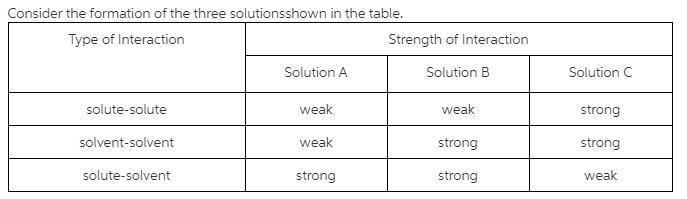
Rank the formation of the solutions A, B, and C from the most exothermic to the most endothermic. Rank the enthalpy of solution
Elodia [21]

This is an incomplete question, the table is attached below.

Answer : The correct ranking of the solution from most exothermic to most endothermic will be: A, B and C.

Explanation :

As we know that the intermolecular force of attraction play an important role in the interaction of solute-solute, solute-solvent and solvent solvent solution.

In the solution A, the solute-solute and solvent-solvent interactions are weak. So, their solute-solvent interaction will be strong. That means, the solution will be more exothermic.

In the solution C, the solute-solute and solvent-solvent interactions are strong. So, their solute-solvent interaction will be weak. That means, the solution will be more endothermic.

Thus, the correct ranking of the solution from most exothermic to most endothermic will be: A, B and C.

4 0
2 years ago
At a temperature of __________ °c, 0.444 mol of co gas occupies 11.8 l at 889 torr.
Novay_Z [31]
<span>ideal gas law is: PV = nRT P = pressure (torr) = 889 torr V = volume (Liters) = 11.8 L n = moles of gas = 0.444 mol R = gas constant = 62.4 (L * torr / mol * k) solve for T (in kelvin) T = PV/nR T = (889*11.8)/(.444*62.4) T = 378.6 K convert to C (subtract 273) T = 105.6 deg C</span>
3 0
2 years ago
Read 2 more answers
A 1.00 g sample of a hydrogen peroxide (H2O2) solution is placed in an Erlenmeyer flask and diluted with 20 mL of 1 M aqueous su
Minchanka [31]
Following reaction is involved in present system:

2KMnO4  +  5H2O2 +  3H2SO4 →  2MnSO4    +     K2SO4  + 5O2  +   8H2O

From the above balance reaction, it can be seen that 2 moles of KMnO4 is consumed for every 5 moles of H2O2.

 Now, percent by mass of hydrogen peroxide in the original solution can be estimated as follows:
percent by mass = \frac{\text{mass of H2O2(g)}}{\text(volume of H2SO4(ml))}X 100
∴percent by mass = \frac{\text{1}}{\text(25)}X 100
                             = 4 % 
5 0
2 years ago
The molecular weight of a gas is ________ g/mol if 6.7 g of the gas occupies 6.3 l at stp.
PIT_PIT [208]
At STP, also known as standard temperature and pressure, 1 mole of a gas occupies 22.4 L. Since we are given with the volume of 6.3L, we calculate the amount of gas in mol. 
                               n = (6.3L)/ (22.4L/mol) = 0.28125 mol
We are given with the mass of 6.7 g. Therefore, the molar mass or molecular weight of the gas is equal to,
                                          6.7g/0.28125 mol = 23.82 g/mol 
6 0
2 years ago
Determine net ionic equations, if any, occuring when aqueous solutions of the following reactants are mixed. Select "True" or "F
nirvana33 [79]

<u>Answer:</u>

<u>For 1:</u> The correct answer is False.

<u>For 2:</u> The correct answer is True.

<u>For 3:</u> The correct answer is True.

<u>For 4:</u> The correct answer is False.

<u>For 5:</u> The correct answer is True.

<u>Explanation:</u>

Net ionic equation of any reaction does not include any spectator ions.  If no net ionic equation is formed, it is said that no reaction has occurred.

Spectator ions are defined as the ions which does not get involved in a chemical equation. They are found on both the sides of the chemical reaction when it is present in ionic form. Solids, liquids and gases do not exist as ions.

  • <u>For 1:</u> Lead(II) nitrate and sodium chloride

The chemical equation for the reaction of lead (II) nitrate and sodium chloride is given as:

Pb(NO_3)_2(aq.)+2NaCl(aq.)\rightarrow PbCl_2(s)+2NaNO_3(aq.)

Ionic form of the above equation follows:

Pb^{2+}(aq.)+2NO_3^-(aq.)+2Na^+(aq.)+2Cl^-(aq.)\rightarrow PbCl_2(s)+2Na^+(aq.)+2NO_3^-(aq.)

As, sodium and nitrate ions are present on both the sides of the reaction. Thus, it will not be present in the net ionic equation and are spectator ions.

The net ionic equation for the above reaction follows:

Pb^{2+}(aq.)+Cl^-(aq.)\rightarrow PbCl_2(s)

Hence, the correct answer is False.

  • <u>For 2:</u> Sodium bromide and hydrochloric acid

The chemical equation for the reaction of sodium bromide and hydrochloric acid is given as:

NaBr(aq.)+HCl(aq.)\rightarrow NaCl(aq.)+HBr(aq.)

Ionic form of the above equation follows:

Na^{+}(aq.)+Br^-(aq.)+H^+(aq.)+Cl^-(aq.)\rightarrow Na^+(aq.)+Cl^-(aq.)+H^+(aq.)+Br^-(aq.)

There are no spectator ions in the equation. So, the above reaction is the net ionic equation.

Hence, the correct answer is True.

  • <u>For 3:</u> Nickel (II) chloride and lead(II) nitrate

The chemical equation for the reaction of lead (II) nitrate and nickel (II) chloride is given as:

Pb(NO_3)_2(aq.)+NiCl_2(aq.)\rightarrow PbCl_2(s)+Ni(NO_3)_2(aq.)

Ionic form of the above equation follows:

Pb^{2+}(aq.)+2NO_3^-(aq.)+Ni^{2+}(aq.)+2Cl^-(aq.)\rightarrow PbCl_2(s)+Ni^{2+}(aq.)+2NO_3^-(aq.)

As, nickel and nitrate ions are present on both the sides of the reaction. Thus, it will not be present in the net ionic equation and are spectator ions.

The net ionic equation for the above reaction follows:

Pb^{2+}(aq.)+Cl^-(aq.)\rightarrow PbCl_2(s)

Hence, the correct answer is True.

  • <u>For 4:</u> Magnesium chloride and sodium hydroxide

The chemical equation for the reaction of magnesium chloride and sodium hydroxide is given as:

MgCl_2(aq.)+2NaOH(aq.)\rightarrow Mg(OH)_2(s)+2NaCl(aq.)

Ionic form of the above equation follows:

Mg^{2+}(aq.)+2Cl^-(aq.)+2Na^+(aq.)+2OH^-(aq.)\rightarrow Mg(OH)_2(s)+2Na^+(aq.)+2Cl^-(aq.)

As, sodium and chloride ions are present on both the sides of the reaction. Thus, it will not be present in the net ionic equation and are spectator ions.

The net ionic equation for the above reaction follows:

Mg^{2+}(aq.)+OH^-(aq.)\rightarrow Mg(OH)_2(s)

Hence, the correct answer is False.

  • <u>For 5:</u> Ammonium sulfate and barium nitrate

The chemical equation for the reaction of ammonium sulfate and barium nitrate is given as:

(NH_4)_2SO_4(aq.)+Ba(NO_3)_2(aq.)\rightarrow BaSO_4(s)+2NH_4NO_3(aq.)

Ionic form of the above equation follows:

2NH_4^{+}(aq.)+SO_4^{2-}(aq.)+Ba^{2+}(aq.)+2NO_3^-(aq.)\rightarrow BaSO_4(s)+2NH_4^+(aq.)+2NO_3^-(aq.)

As, ammonium and nitrate ions are present on both the sides of the reaction. Thus, it will not be present in the net ionic equation and are spectator ions.

The net ionic equation for the above reaction follows:

Ba^{2+}(aq.)+SO_4^{2-}(aq.)\rightarrow BaSO_4(s)

Hence, the correct answer is True.

3 0
2 years ago
Other questions:
  • Rank the size of a change in temperature of one degree Fahrenheit, one degree Celsius, and one kelvin. In other words, if a ther
    6·1 answer
  • Consider the balanced equation below. 4NH3 + 3O2 --&gt; 2N2 + 6H2O What is the mole ratio of NH3 to N2?
    14·2 answers
  • Na3X, Enter the group number of X?
    15·2 answers
  • Which element has atoms with the strongest attraction for electrons in a chemical bond?1)aluminium, 2)carbon, 3)chlorine, 4)lith
    5·1 answer
  • What concentration of clo3– results when 925 ml of 0.393 m agclo3 is mixed with 685 ml of 0.283 m mn(clo3)2?
    7·2 answers
  • A pan containing 30 grams of water was allowed to cool from a temperature of 90.0 °C. If the amount of heat released is 1,500 jo
    6·2 answers
  • The enthalpy of combustion of lactose, C12H22O11, is -5652 kJ/mol. A 2.50 g sample of lactose was burned in a calorimeter that c
    13·1 answer
  • The noble gases are inert. This means they a. exist as gases at room temperature. b. undergo many chemical reactions. c. lose an
    14·1 answer
  • What is the main purpose of using NaOH in the saponification reaction . NaOH works as the catalyst b. NaOH solution is the solve
    14·1 answer
  • Pluto's average distance from the Sun is about 3,666,000,000 miles. What is this in inches?​
    15·1 answer
Add answer
Login
Not registered? Fast signup
Signup
Login Signup
Ask question!