answer.
Ask question
Login Signup
Ask question
All categories
  • English
  • Mathematics
  • Social Studies
  • Business
  • History
  • Health
  • Geography
  • Biology
  • Physics
  • Chemistry
  • Computers and Technology
  • Arts
  • World Languages
  • Spanish
  • French
  • German
  • Advanced Placement (AP)
  • SAT
  • Medicine
  • Law
  • Engineering
stepladder [879]
2 years ago
12

A) Write the word equation for the reaction of barium nitride (Ba3N2) with potassium.

Chemistry
1 answer:
artcher [175]2 years ago
3 0

Answer:

Explanation:

In order to balance it, we need to have the same number of atoms of each element on both sides of the equation. There are two atoms of nitrogen on the left, so we need to put 2 in front of K₃N. Now, we have six atoms of potassium on the right, so we need to put 6 in front of K on the left. Finally, there are three atoms of barium on the left, so we put 3 before Ba on the tight. Which means:

Ba₃N₂ + 6K = 2K₃N + 3Ba

Now, we can do the work. First, we determine the molar mass of each reactant ( from the periodic table). Molar mass of the barium is 137, potassium 39 and nitrogen 14.

Ba₃N₂₂ has molar mass of 3Ba and 2N, which means 3 • 137 + 2 • 14 = 439. That means that one mole of Ba₃N₂ weights 439 grams.

We are given grams of reactants, but in order to find the limiting and the excess reactant, we need to transfer it into moles.

We are given 66.5 grams of Ba₃N₂ and we know that 439 grams equals 1 mole. We want to know how many moles there are in 66.5 grams, so the answer is 66.5 / 439 = 0.15 moles.

Let's do the same for potassium. We are given 29 grams of K and we know that 1 mole has 39 grams. We want to know how many moles of K are there in 29 grams, so the answer is 29 / 39 = 0.74 moles.

We now know that 0.15 moles of Ba₃N₂ reacted with 0.74 moles of K. From the balanced equation we see that 1 mole of Ba₃N₂ reacts with 6 moles of K, so the ratio has to be 1:6.

Now let's find limiting and excess reactant. That means that in our reaction, there are more (or less) of one reactant then needed.

We know that we had 0.15 moles of Ba₃N₂ reacting. Let's pretend we don't know the moles of K and let's see with which amount of K should 0.15 moles of barium nitride react, if the ratio is 1:6.

0.15 moles of Ba₃N₂ : x moles of K = 1:6

x = 0.9 moles of K

So, for the completed reaction we need to have 0.9 moles of K, but we previously calculated that we had 0.74. That means that there is less K then needed, so potassium is our limiting reactant, which obviously means that Ba₃N₂ is our excess reactant.

Now, we need to find how many moles of Ba₃N₂ there needed to be for a completed reaction

x moles of Ba₃N₂ : 0.74 moles of K = 1:6

x = 0.124 moles of Ba₃N₂

So we needed to have 0.124 moles, but we had 0.15 of Ba₃N₂, which is 0.15 - 0.124 = 0.026 moles in excess.

If we want to find how many grams that is, we only multiply it with molar mass of Ba₃N₂:

0.026 • 439 = 11.4 grams

That means that only 66.5 - 11.4 = 55.1 grams of Ba₃N₂ reacted.

You might be interested in
4. How does the kinetic theory of gases explain the weather changes happening in the troposphere? You can also research on the I
uranmaximum [27]
According to the kmt pressure is directly proportional to the number of collision between particles
4 0
2 years ago
Read 2 more answers
A student titrates 10.00 milliliters of hydrochloric acid of unknown molarity with 1.000 m naoh. it takes 21.17 milliliters of b
Dima020 [189]
Mole ratio for the reaction is 1:1
no of moles in NaOH that reacted= 1*21.17/1000=0.02117mols
 molarity of HCl=0.02117*10/1000
                         =2.117M
4 0
2 years ago
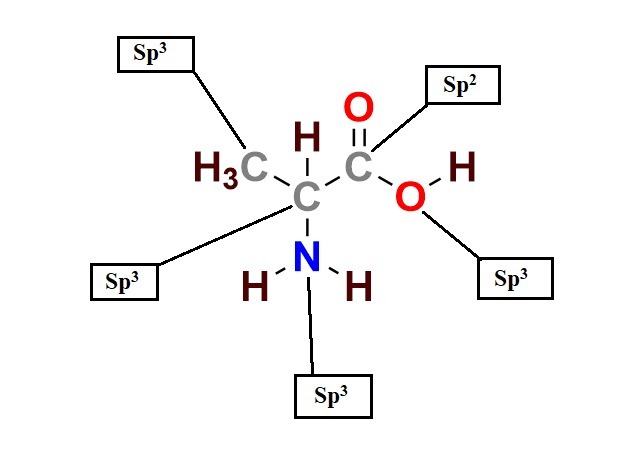
Consider the structure of the amino acid alanine. indicate the hybridization about each interior atom.
OLEGan [10]
The structure of Alanine is shown below,
Except the carbon atom of carbonyl group which is Sp² Hybridized, all remaining atoms are Sp³ Hybridized. The hybridization of each element is depicted in a box below,

5 0
2 years ago
Read 2 more answers
If the actual yield of the reaction was 75% instead of 100%, how many molecules of no would be present after the reaction was ov
artcher [175]
To be able to answer this equations, we must set given information. Suppose the reaction to yield NO is:

N₂ + O₂ → 2 NO

Next, suppose you have 1 g of each of the reactants. Determine first which is the limiting reactant.

1 g N₂ (1 mol N₂/ 28 g)(2 mol NO/1 mol N₂)= 0.07154 mol NO present

Number of molecules = 0.07154 mol NO(6.022×10²³ molecules/mol)
<em>Number of molecules = 4.3×10²² molecules NO present</em>
8 0
2 years ago
Read 2 more answers
IF YOU GIVE A LINK OR DON"T ACTUALLY ANSWER THIS QUESTION RIGHT JUST FOR POINTS I WILL REPORT YOUR ANSWER AND YOU
AVprozaik [17]

Answer:

No, the puddle was formed because of the sun, because if there was snow and it rained then it would have turned slippery or icy

8 0
2 years ago
Read 2 more answers
Other questions:
  • Which has a lower freezing point ice or ice cream?
    6·2 answers
  • If 8.00 g NH4NO3 is dissolved in 1000 g of water, the water decreases in temperature from 21.00 degrees Celsius to 20.39 degrees
    7·1 answer
  • A certain element X has four isotopes. 4.350% of X has a mass of 49.94605 amu. 83.79% of X has a mass of 51.94051 amu. 9.500% of
    8·1 answer
  • The first step in the Ostwald process for producing nitric acid is 4NH3(g) + 5O2(g) --&gt; 4NO(g) + 6H2O(g). If the reaction of
    9·2 answers
  • Write chemical equations and corresponding equilibrium expressions for each of the two ionization steps of carbonic acid. Part A
    11·1 answer
  • Ethyl butyrate, CH3CH2CH2CO2CH2CH3, is an artificial fruit flavor commonly used in the food industry for such flavors as orange
    14·1 answer
  • A 5 gram piece of aluminum foil at 100 degrees C is dropped into a 25 gram container of water at 20 degrees C. What is the final
    15·2 answers
  • Give two examples (i.e. list 2 elements that are examples) of: a. an atom with a half-filled subshell b. an atom with a complete
    13·1 answer
  • Assuming ideal solution behavior, what is the freezing point of a solution of 9.04 g of I2 in 75.5 g of benzene?
    5·1 answer
  • Determine whether each description applies to electrophilic aromatic substitution or nucleophilic aromatic substitution.
    12·1 answer
Add answer
Login
Not registered? Fast signup
Signup
Login Signup
Ask question!